Influencer marketing attracts a particular kind of bad thinking: pick a creator with a large number next to their name, hand them a brief written for a television ad, and then wonder why the campaign produced impressions and nothing else. The failure is almost never the creator. It is that nobody asked why anything spreads, what the audience relationship actually consists of, or what result the spend was supposed to produce.
This path is ordered to fix that. Mechanics of transmission first, then platform-native craft, then what audience actually means, then the program and measurement layer. The tactical books at the end are far more useful once the first half has done its work, and their platform specifics date fast while the underlying principles do not.
Why things spread
Start with Contagious by Jonah Berger, the most useful research-backed account of transmission — social currency, triggers, emotion, public visibility, practical value, and story. Berger is a marketing academic and the studies behind the framework are real, which makes it a better foundation than the anecdote-driven alternatives.
Then Jab, jab, jab, right hook by Gary Vaynerchuk, which is dated in its platform screenshots and still correct in its central argument: give repeatedly in the native language of each platform before you ask for anything. The examples are from a previous era of social media; the ratio and the native-format discipline are the takeaway.
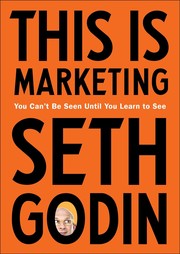
This is marketing by Seth Godin belongs here as the strategic frame — smallest viable audience, permission, positioning, and the case that marketing is about serving a specific group rather than reaching everyone. It is the book that stops you optimizing reach for its own sake.
What an audience actually is
KNOWN by Mark Schaefer treats personal brand building as a systematic process — finding a sustainable niche, choosing a home base, producing consistently, and building an actual audience. Read it to understand the creator's side of the transaction, which is the half most brand-side marketers never learn.
Superfans by Pat Flynn goes further into the depth dimension: how casual audiences become committed ones, and why a small number of deeply engaged people outperform a large number of indifferent ones. Together these two explain why follower count is a poor proxy for influence.
Running the programs
Influencer Marketing for Brands by Aron Levin is the operational book — how creator partnerships are structured, priced, briefed, and scaled on Instagram and YouTube, from someone who built platforms in the space. Age of Influence by Neal Schaffer covers similar territory with more emphasis on strategy, identifying the right creators, and integrating influencer work into a broader marketing program. Read Levin for mechanics and Schaffer for the strategic wrapper; if you only need one, choose by which gap you have.
Killing Marketing by Joe Pulizzi and Robert Rose reframes the whole activity, arguing that content operations can become revenue-generating assets rather than cost centers. It is the most ambitious argument on the list and the most useful for anyone deciding whether to build an owned audience instead of renting someone else's.
Measure it
Marketing metrics by Farris and colleagues is the reference that makes the rest accountable: how to construct and interpret the measures that actually connect activity to outcomes. It is dry and it is the difference between a program you can defend and one you cannot.
Freakonomics closes the path for a specific reason — it teaches the habit of asking whether a correlation is causal. In a field awash in attribution claims and inflated engagement numbers, that habit is worth more than another tactic. Note that some of its individual studies have been contested since publication; the reasoning style is what transfers.
Two honest cautions: influencer disclosure is legally required in most markets and the rules are enforced, and engagement fraud is common enough that verification should be a standing part of any program. Adjacent small-business paths sit at opening a coffee shop.
Follow the full path and you will build programs that survive a results review.
Follow the full ordered path here: Best Books on Influencer Marketing, in Reading Order.