Books about hospitals come in three forms that are easy to mistake for one another. Embedded reporting follows an institution and its people over time. Clinician memoir describes the same institution from inside a role, with all the selectivity that implies. Policy history and health-economics writing explain the financial machinery that produces the behaviour the first two describe. They answer different questions, and a reader who takes a memoir as evidence about the system, or a policy book as an account of what a ward is like, will be misled.
The order that works is reporting first, memoir second, policy last. Once you have watched a real hospital operate, terms like facility fee, chargemaster and consolidation stop being abstractions and become names for things you have already seen happen. Nothing here is medical advice, and none of it substitutes for a clinician.
Reporting from inside institutions
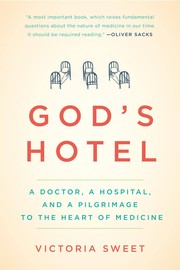
God's hotel is Victoria Sweet's account of Laguna Honda in San Francisco, one of the last American almshouses — part memoir, part institutional history, and an argument for what she calls slow medicine. Hospital is Julie Salamon's year embedded at Maimonides in Brooklyn, and the closest thing here to straight ethnography: administrators, surgeons, translators, and the friction of a hospital serving dozens of language communities. The Hospital is Brian Alexander reporting from a small community hospital in Bryan, Ohio, and the best single book on why rural and community hospitals fail financially while still being the only care available for miles.
Five days at Memorial is Sheri Fink's investigation of Memorial Medical Center in New Orleans during Hurricane Katrina, and of the deaths and the criminal investigation that followed. It is reported at extraordinary depth and it is genuinely difficult material: the central question is whether patients were deliberately given lethal doses when evacuation failed, and Fink lays out the evidence and the disagreement rather than resolving it. Read it as a study of how institutions make decisions when their assumptions collapse.
From inside a role
Atul Gawande's Complications is the surgical-training essay collection that made his name — fallibility, uncertainty, and how surgeons actually learn. Better is the follow-up, on performance and measurement. Both are essays, not systematic evidence, and Gawande is a persuasive writer arguing positions.
The House of God is a 1978 novel, satirical and deliberately brutal, about a medical internship. It is a primary document of a specific era of training culture and it introduced vocabulary that persists in American medicine. It is also widely criticised now for its treatment of women and for its dehumanising language about elderly patients, and defenders and critics both have a case. Read it as evidence about 1978, not as a guide to how medicine is practised or should be.
Theresa Brown writes from nursing, which is the perspective the physician memoirs systematically miss. The shift is a single day on an oncology floor; Critical care is her account of moving into nursing from another career. Extreme Measures is Jessica Nutik Zitter on intensive care and end-of-life decision-making — a critical care and palliative physician arguing that default escalation often harms the people it is meant to save. It pairs closely with geriatric medicine and elder care.
The money and the machinery
Three books here also appear on the health-economics path, and are worth reading differently in this context: not as general system critiques but as explanations of the hospital specifically. An American sickness by Elisabeth Rosenthal is strongest on how hospital billing itself works — the itemised bill, the facility fee, the reason an identical procedure costs differently across the street. The Price We Pay by Marty Makary is a surgeon's account of predatory billing and lawsuits against patients, reported hospital by hospital. The social transformation of American medicine by Paul Starr is the historical foundation: how the American hospital went from a charitable refuge for the poor to the centre of a profession's authority and then of an industry. It is a 1982 academic history and it stops there, so read it for the origins rather than the present.
The digital doctor by Robert M. Wachter is the newest structural problem: what happened to hospital work when the electronic health record arrived, including the ways safety improved and the ways attention did not.
Read the full path in sequence — the policy books land far harder after the reporting.
Follow the full ordered path here: How Hospitals Really Work: The Best Books to Read, in Order.