Insulation is the most commonly botched home improvement in North America, and the failure mode is consistent: someone stuffs fiberglass into a cavity, skips the air sealing, adds a vapor barrier on the wrong side for their climate, and creates a condensing surface inside the wall. Two winters later there is mold behind the drywall. The insulation was not the problem — the physics around it was.
That is why this path is ordered the way it is. Air sealing before insulation, because air movement carries far more heat and far more water vapor than conduction does. Moisture behavior before assembly details. Climate-specific guidance before you decide where a vapor retarder goes, because the correct answer in Minneapolis is the wrong answer in Houston.
Start with air sealing
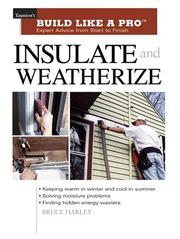
Insulate and Weatherize by Bruce Harley is the right first book: practical, project-ordered, and clear that sealing the leaks comes before adding R-value. It walks attic bypasses, rim joists, ducts, windows, and the diagnostic logic of finding where a house actually loses air, with enough building science to explain why each step matters. A homeowner can act on this book immediately.
Then learn how water moves
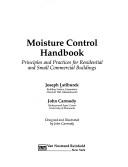
Moisture control handbook by Joseph Lstiburek is the conceptual core of the whole path. Lstiburek explains vapor drive, dew point, drying potential, and why an assembly must be able to dry in at least one direction — the single idea that prevents the mold failure described above. It is more technical than Harley and worth the effort; nearly everything else you read about walls will make more sense afterward.
Follow it with Builder's Guide to Mixed Climates, also Lstiburek, which takes those principles into specific assemblies for a specific climate zone. The mixed-climate case is the hardest one — the wall has to handle inward vapor drive in summer and outward in winter — so it teaches the reasoning more forcefully than a heating-dominated example would. If you live in a different zone, the reasoning transfers even where the details do not; check which climate volume matches your location before buying materials.
Applying it to an existing house
Retrofits are their own discipline, because you are working inside assemblies someone else built. Renovating Old Houses by George Nash covers that context broadly — structure, envelope, systems, and the sequencing of a renovation — and is particularly good on old buildings that were never designed to be airtight and can be damaged by treating them as if they were.
Residential Energy Cost Savings and Comfort for Existing Buildings by Krigger is the weatherization-professional reference: audits, blower-door testing, prioritizing measures by cost-effectiveness, combustion safety, and the crew-level procedures used in the weatherization trade. It is the most systematic treatment here of how to decide what to do first with a limited budget.
Close with The greened house effect by Jeff Wilson, a narrative account of one deep-energy retrofit that shows the decisions, costs, and compromises in sequence. It is the least technical book on the path and useful precisely because it shows how theory meets an actual budget and an actual old house.
Two cautions
Air-sealing a house tightens it, and a tight house with atmospherically vented combustion appliances can backdraft carbon monoxide. Combustion safety testing and mechanical ventilation are not optional afterthoughts; both Krigger and Harley address this, and it warrants a professional check. Likewise, insulation and vapor requirements are set by local building code, which overrides any book. See related structural work at framing a house.
Read in this order and you will insulate a house that dries out instead of one that rots. Follow the full path to keep the sequence.
Follow the full ordered path here: Best Books on Home Insulation and Weatherizing, in Order.