Ethology is the study of animal behavior in its natural context, and it grew from patient field observation into a rigorous science grounded in evolution. Its literature is unusually rich because the pioneers were also wonderful writers, and reading in order lets you move from the pleasure of observation to the theory that explains it and finally to the hard questions about animal minds.
The trap is treating cognition and emotion books as light reading disconnected from the science. Read the foundations first and the later claims about what animals think carry real weight rather than sentiment.
Begin with the great observers
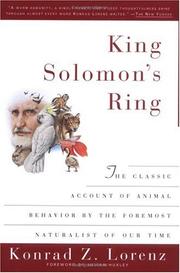
King Solomon's ring by Konrad Lorenz is a founding classic of ethology, a naturalist's delight that also introduces core ideas like imprinting. In the shadow of man by Jane Goodall follows with her landmark chimpanzee fieldwork, showing what long, careful observation reveals. Together they establish the observational heart of the field.
Build the evolutionary framework
Behavior makes sense in the light of evolution. An introduction to behavioural ecology by John Krebs and Nicholas Davies is the standard text on how natural selection shapes behavior, and Animal behavior by John Alcock is the comprehensive teaching survey. The Selfish Gene by Richard Dawkins supplies the gene's-eye logic that reframed how we think about altruism and cooperation. For a spectacular case study in social behavior, The ants by Bert Holldobler and Edward Wilson is unmatched.
Ask what animals know and feel
With the science in place, the cognition books land properly. Are We Smart Enough to Know How Smart Animals Are? by Frans de Waal challenges our tests of animal intelligence, and The Soul of an Octopus by Sy Montgomery explores minds utterly unlike ours. Mama's Last Hug by Frans de Waal makes the case for animal emotions, building on The expression of emotions in man and animals by Charles Darwin, the founding text on the subject. Close with Behave by Robert Sapolsky, which ties behavior back to biology across every timescale.
Read in this order and observation, theory, and mind fit together. Follow the full path to keep the arc whole.
Follow the full reading path →
Ready to learn something deeply?
Build a reading path — free