Deal with the naming problem first, because it costs more beginners more money than anything else in this subject. English paper piecing means basting fabric by hand over stiff paper templates and whip-stitching the shapes together — hexagons, diamonds, the interlocking rosettes of a La Passacaglia. Foundation paper piecing, often shortened to machine paper piecing, means sewing fabric to a printed paper foundation by machine and tearing the paper away. Same words, different craft, different tools, different results. A book titled for one will not teach the other.
The second thing worth knowing is that this is a small, slow, portable craft with an unusually good literature. The books that exist tend to be beautiful and long-lived, because the technique has not changed in two centuries and a well-photographed hexagon is still a well-photographed hexagon. What follows is short, and one entry is here specifically so you can avoid it.
The one to skip, and why it is on the list
Easy Machine Paper Piecing is a genuinely good book by a well-regarded teacher, and it is not about English paper piecing. Carol Doak's subject is foundation piecing by machine — precise points, sharp angles, sewn fast. If that is what you want, buy it with confidence. If you came here to sew hexagons on a train, this is the wrong book and the similar title is why. We have left it in the path rather than quietly deleting it, because the confusion is the single most common mistake in the subject.
The core of the craft
Millefiori Quilts is the landmark. Willyne Hammerstein's designs are what pulled English paper piecing back into fashion, and La Passacaglia in particular became the project a generation of quilters used to learn the technique. It is a pattern book more than a manual — the instructions assume you can baste and whip-stitch — so pair it with a basic technique tutorial for your first rosette. It appears twice in our catalogue because of duplicate editions; you only need one copy.
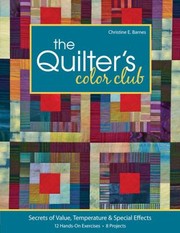
The quilter's color club is the book that separates a competent English paper piecing project from a striking one. Fussy cutting is central to this craft: you choose which part of a printed fabric lands in each tiny shape, so colour, value and scale decisions do more work here than in almost any other quilting form. Christine Barnes writes on value and contrast in a way that transfers directly to that decision.
Widening out
Quilting by Dorothy Osler gives the historical and technical context — regional traditions, the place of paper templates in British quilting, and how hand-pieced tops relate to the wider craft. Read it when you want to know where your hexagons came from.
Hand quilting with Alex Anderson covers what happens after the top is finished, which is the step beginners forget to plan for. A paper-pieced top is one layer of three, and hand quilting is the finish that suits it — the same portable, quiet, slow work, and a skill worth learning deliberately rather than improvising at the end of a two-year project.
That is the honest list: one book to avoid, one landmark, and three that surround it. English paper piecing is not a subject with a fifteen-book curriculum, and it does not need one — the technique itself takes an afternoon to learn and a decade to get elegant at. Most of what you will learn comes from your third rosette, not your third book.
Follow the full ordered path here: English Paper Piecing: The Best Books, and the One to Skip.
Ready to learn something deeply?
Build a reading path — free