The first practical problem in this subject is that the books are named almost identically. Fontana's Corrosion engineering, Zaki Ahmad's Principles of corrosion engineering and corrosion control, Revie's Corrosion and corrosion control, and Roberge's Handbook of Corrosion Engineering and Corrosion basics are five different books at three different levels. Always search by author here, or you will buy the wrong one.
The second is background. All of these assume undergraduate general chemistry and enough materials science to read a phase diagram and know what a grain boundary is. From the electrochemical side they assume, or will teach quickly and then rely on, the Nernst equation, mixed-potential theory, Pourbaix diagrams and Tafel kinetics. If none of that is familiar, the introductory titles below are written to close the gap; the graduate texts are not.
The course texts
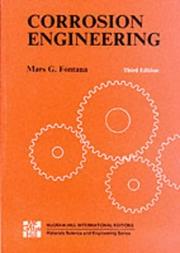
Mars G. Fontana's Corrosion engineering is the classic undergraduate text and the source of the eight-forms-of-corrosion framework that most of the field still teaches. Its last edition is old, so it is thin on modern instrumentation and on newer alloy systems, but as a way of learning to recognise what you are looking at it has not been bettered. Denny A. Jones's Principles and prevention of corrosion is the usual North American alternative and is markedly stronger on the electrochemistry — if you want to understand why corrosion happens rather than catalogue how it looks, start here instead.
Zaki Ahmad's Principles of corrosion engineering and corrosion control is the most self-contained of the three, with worked problems and a slower ramp, which makes it a reasonable choice for self-study. R. Winston Revie's Corrosion and corrosion control is the continuation of Herbert Uhlig's textbook and is the one most often set alongside Fontana in a syllabus. David E.J. Talbot's Corrosion science and technology leans metallurgical: more on alloy behaviour and materials selection, less on plant practice.
For a genuinely introductory start, Pierre R. Roberge's Corrosion basics is the AMPP training-course book, written for technicians and certification candidates rather than for engineering undergraduates. It is the least demanding book on the shelf and the right one if you are coming from the field rather than from a degree.
The electrochemistry, properly
Two books take the theory seriously. E. E. Stansbury's Fundamentals of electrochemical corrosion, written with R. A. Buchanan, is a graduate-level treatment of thermodynamics and kinetics — this is where polarisation behaviour is derived rather than asserted. Electrochemical Techniques in Corrosion Science and Engineering, from Rudolph G. Buchheit and co-authors, is the laboratory companion: polarisation measurement, electrochemical impedance spectroscopy, and how to avoid the standard ways of getting a corrosion rate wrong. Together they are the bridge from reading about corrosion to measuring it.
Ulick R. Evans's An introduction to metallic corrosion belongs here for historical reasons. Evans built much of the conceptual apparatus the field still uses, and the diagram named after him appears in every modern text; as a teaching book it has been superseded, and it should be read as a foundational document rather than as a current course.
Reference and application
The last group is not read cover to cover. Roberge's Handbook of Corrosion Engineering and Revie's Uhlig's Corrosion Handbook are both desk references — the first organised around engineering practice and monitoring, the second a very large edited collection covering specific metals, environments and industries. Buy one, not both, unless a job requires it.
Then three specialist volumes for specific failure modes and assets. Russell H. Jones's Stress-Corrosion Cracking is the ASM treatment of the mechanism that causes most of the catastrophic failures in this field, and it assumes fracture mechanics. Peabody's control of pipeline corrosion is the standard practitioner text on cathodic protection and coatings for buried and submerged pipe. John P. Broomfield's Corrosion of steel in concrete is the civil-engineering counterpart, covering reinforcement corrosion, chloride and carbonation damage, and the repair options — the version of this subject that determines the lifespan of most bridges and car parks.
Follow the full reading path in order and the handbooks will make sense when you reach them.
Follow the full ordered path here: Best Books on Corrosion Engineering and Corrosion Control, in Order.