Borderline personality disorder carries more stigma and more misinformation than almost any other diagnosis, including within healthcare itself. It is also, contrary to its reputation, responsive to treatment — dialectical behaviour therapy and related approaches have decades of outcome data behind them. Reading well on this subject means getting the clinical picture straight before you go anywhere near the popular material.
These books are a supplement to care, never a substitute for it. BPD involves real risk, including self-harm and suicidality, and the skills books on this list are designed to be used alongside a trained clinician. If you are in crisis, contact a crisis line or emergency service rather than a reading list.
Get the picture straight
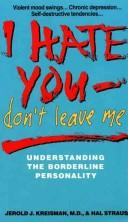
Start with I Hate You - Don't Leave Me by Jerold Kreisman and Hal Straus, the long-standing general introduction. It explains the core features — emotional instability, fear of abandonment, identity disturbance, impulsivity — in plain language, with case material. It is widely recommended precisely because it makes the disorder legible to people encountering it for the first time.
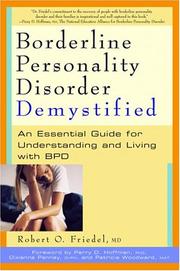
Follow with Borderline Personality Disorder Demystified by Robert Friedel, a psychiatrist's overview that leans harder on neurobiology, medication questions and what treatment actually involves. Between the two you get both the experiential and the medical framing.
The clinical model and its skills
Cognitive-Behavioral Treatment of Borderline Personality Disorder is Marsha Linehan's foundational text — the book that introduced DBT and the dialectic of acceptance and change at its centre. It is written for clinicians and reads like it; a motivated general reader can follow the theory chapters, but nobody should expect a self-help book here. Its value is that everything downstream refers back to it.
The dialectical behavior therapy skills workbook by Matthew McKay, Jeffrey Wood and Jeffrey Brantley is the practical companion: distress tolerance, mindfulness, emotion regulation and interpersonal effectiveness as exercises you can work through. It is best used in parallel with therapy, where a clinician can help with the skills that are hardest to apply alone.
Then Borderline personality disorder by Francis Mark Mondimore and Patrick Kelly, a level-headed guide that covers diagnosis, co-occurring conditions and the treatment landscape without either alarmism or false reassurance.
For families and partners
Stop walking on eggshells by Paul Mason and Randi Kreger is the best-known book for people close to someone with BPD, focused on boundaries, communication and not losing yourself in the relationship. It has been criticised for a framing that can read as adversarial toward the diagnosed person — worth knowing before you open it, and worth balancing against the first-person accounts below.
Loving someone with borderline personality disorder by Shari Manning is the gentler and more clinically grounded family book, written from a DBT perspective and more attentive to what the person with BPD is experiencing. If you only read one family book, this is the one that ages best.
First-person and long-view
Close with Get Me Out of Here by Rachel Reiland, a memoir of diagnosis and recovery through therapy that puts a person back at the centre of everything the clinical books describe. Then Beyond borderline, edited by John Gunderson and Perry Hoffman, which pairs recovery narratives with clinical commentary and makes the case that the long-term outlook is far better than the diagnosis's reputation suggests.
Read in this order and the disorder stops being a label and becomes a set of problems with known treatments. Follow the full path for the stage-by-stage plan.
Follow the full ordered path here: Best Books on Borderline Personality Disorder, in Order.