Understanding Emile Durkheim: books to read, in order
Durkheim did not simply write sociology; he argued sociology into existence as a discipline with its own object, and every one of his major books is partly a demonstration that the object is real. This path follows that argument in the order he made it: a short secondary orientation, then the methodological manifesto and the book on solidarity, then Suicide as the proof-of-concept, then the religion book that is now his most read work, and finally the lectures on morality and the modern reception. All four of the major works are translated from French; the catalogue records here are English translations, but several carry French display forms or garbled years, and the notes say which.
Orientation
BeginnerUnderstand what Durkheim was arguing against — psychological and individualist explanations of social life — and get the vocabulary of social facts, anomie, solidarity and collective conscience before meeting them in his own prose. Both books here are secondary literature and neither assumes any sociology.
▸ Study plan for this stage
Pace: Two weeks for 292 pages, and this is the lightest stage on the path by a wide margin. Anthony Giddens's Durkheim is 125 pages and genuinely readable in an evening or two — a Modern Masters volume, compressed but not difficult. Robert Alun Jones's Emile Durkheim is 167 pages and is structured as a bo
- Social facts: ways of acting external to the individual and endowed with constraining power
- The polemical target — psychological and individualist explanation, which Durkheim spends every book refusing
- Mechanical and organic solidarity as two ways a society can hold together
- Anomie as normlessness produced by rapid change or insufficient regulation, not as personal disorientation
- The collective conscience, and the difficulty of the term in English translation
- Durkheim's institution-building project: he was arguing sociology into existence as a discipline with its own object
- What makes a fact social on Durkheim's definition, and what is excluded by it?
- Why does he think psychology cannot explain social phenomena even in principle?
- Distinguish mechanical from organic solidarity and give a case of each from Giddens.
- Where does Jones say Durkheim's reasoning is weakest, and does Giddens agree?
- What did Durkheim need to establish institutionally, and how does that shape the way the books argue?
- Write a one-page glossary of the six terms above from Giddens and Jones. All four primary books use them constantly and none of them define them for a beginner.
- Read Jones's chapter on The Rules of Sociological Method before you read the Rules, and list the criticisms he flags. You will be checking them against the text next stage.
- Pick a social phenomenon you would ordinarily explain psychologically and write the Durkheimian explanation of it. Note what the second account can and cannot do.
- From Giddens, list the ways in which Durkheim's political position differed from what his later reputation as a conservative suggests.
Next up: With the vocabulary in hand, the next stage is Durkheim stating the method and then demonstrating it at book length.
A short Modern Masters volume by a sociologist who later became one of the discipline's leading theorists, and still the fastest reliable route in. Read it in an evening before starting the primary texts.
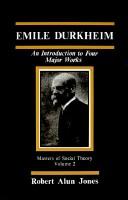
A book-by-book walkthrough of exactly the four works this path is built on, summarising the argument of each and flagging where the reasoning is weakest. Keep it beside you rather than reading it straight through; the catalogue record displays under the bare name Emile Durkheim.
The method, and the first big book
IntermediateMeet the founding claim — that social facts are external to individuals, exert constraint on them, and must be explained by other social facts rather than by psychology — and then see it applied to the transition from mechanical to organic solidarity, and to anomie in the modern division of labour.
▸ Study plan for this stage
Pace: Four weeks for 492 pages, and both books read considerably slower than the count implies because the argument advances by definition and classification rather than by narrative. The Rules Of Sociological Method And Selected Texts On Sociology And Its Method is 230 pages in the Lukes-edited edition,
- Treat social facts as things: what the injunction actually asks of a researcher
- The rules for distinguishing the normal from the pathological, which is the most contested part of the method
- Explanation by cause and by function as two separate operations that must not be confused
- The transition from mechanical to organic solidarity as societies specialise
- Repressive versus restitutive law as Durkheim's proposed index of solidarity — his attempt to make an inner state externally measurable
- The forced division of labour and the anomic division of labour as the two pathological forms
- Why he thinks specialisation produces moral density rather than merely economic efficiency
- What does treating a social fact as a thing rule out methodologically?
- How does Durkheim propose to tell a normal social form from a pathological one, and why has that criterion been attacked?
- Explain the law-as-index argument. What has to be true about legal systems for it to work?
- Where does The Division of Labor's argument depend on an evolutionary sequence, and how much of it survives if you drop the sequence?
- What is anomie in this book, as distinct from what it becomes in Suicide?
- Apply the four rules of the Rules to a research question of your own choosing, and write down where you cannot follow them. That gap is the standard objection to Durkheim's method.
- Test the repressive-restitutive law claim against a legal system you know something about. Does the index behave as Durkheim predicts?
- Track the word anomie through The Division of Labor and write its definition each time it appears. It is not stable.
- Return to Jones's list of weaknesses from stage one and mark which ones you found on the page and which you did not.
Next up: The method is stated and demonstrated; Suicide is where Durkheim stakes it on the case that ought to be hardest for him.
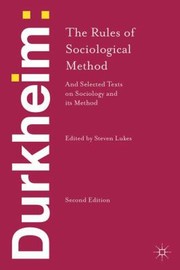
The manifesto: treat social facts as things. Short, combative, and the statement of principle every later book is executing. The catalogue record is the Lukes-edited edition, whose full title adds And Selected Texts on Sociology and Its Method.
The doctoral thesis and the first major work: as societies specialise, the shared conscience that once held them together is replaced by interdependence, and the transition can go wrong. Read after the Rules because it is the method's first large-scale demonstration; note it is also published in Britain as The Division of Labour in Society, which is the same book.
Suicide as the proof of concept
IntermediateRead the book Durkheim intended as the decisive demonstration that the most private-seeming act has social causes, and then get a scholarly account of how the whole system fits together and where the statistics have been challenged.
▸ Study plan for this stage
Pace: Five weeks. Our record for Suicide carries no page count — it is the Spaulding and Simpson English translation, displayed under the bare title — so treat it as a full-length monograph and give it three weeks rather than budgeting to a number. The book is a sustained statistical argument: rates by re
- Egoistic, altruistic, anomic and fatalistic suicide, and the two axes of integration and regulation that generate them
- The move from individual act to social rate as the object of explanation — the single most important step in the book
- The Protestant-Catholic differential, and what Durkheim infers from it
- The ecological fallacy problem: inferring individual-level causes from group-level rates
- The reliability of nineteenth-century official statistics on cause of death, which is the standing empirical objection
- Lukes on where the system coheres and where Durkheim's later work quietly abandons earlier positions
- Why does Durkheim insist the object of explanation is the rate rather than the act, and what does that let him ignore?
- Set out the two axes and place all four types on them. Which type gets the least attention, and why might that be?
- State the ecological fallacy objection and then Durkheim's best defence against it.
- How dependent is the argument on the accuracy of the recorded statistics, and what does Lukes say about that?
- Does Suicide prove the method of the Rules, or does it presuppose it? Argue both sides.
- Reconstruct one of Durkheim's comparisons from his own tables and check that the conclusion he draws is the one the numbers support.
- Read Lukes's chapter on Suicide after finishing the book and list every criticism he makes. Mark which ones you had spotted.
- Write the fatalistic type up properly from the footnote Durkheim gives it, and argue for or against the claim that it deserved a chapter.
- Take a present-day social statistic and write the analysis Durkheim would perform on it, including which comparisons he would insist on.
Next up: Having watched the method vindicated on its hardest case, you are ready for the late work, where the object shifts from social structure to the sacred.
The classic study of egoistic, altruistic, anomic and fatalistic suicide, and the origin of the modern practice of arguing from social statistics. The catalogue record is the Spaulding and Simpson English translation, displayed under the bare title Suicide and carrying a garbled publication year; the French original is 1897.
Secondary, and the definitive intellectual biography — the standard reference on what Durkheim argued, when, against whom, and where the arguments fail. Placed here rather than at the start because it is a reference work you will use better once you have read three of the primary books.
Religion and the origin of the sacred
IntermediateWork through the late masterpiece and its companion essay: the claim that religion's object is society itself, that the sacred and profane distinction is the elementary form of all classification, and that collective effervescence is where new moral realities are generated.
▸ Study plan for this stage
Pace: Four to five weeks for 609 pages. The Elementary Forms Of Religious Life is 416 of them and is the book people abandon on this path — not because the prose is hard but because the middle sections work through Australian Aboriginal ethnographic detail at length, and readers who came for the theory lo
- Religion's object is society itself: the central and most contested claim in Durkheim
- The sacred-profane division as the elementary form of all classification
- Totemism as a system of thought rather than a stage of superstition
- Collective effervescence: the assembled group as the site where new moral realities are generated
- The sociological theory of the categories — that space, time and causality are socially derived
- Value judgements and judgements of reality, and what Durkheim thinks sociology does to philosophy's traditional questions
- The reflexive problem: if religion is society worshipping itself, what is the status of that claim?
- How does Durkheim get from Australian totemism to a general theory of religion, and how good is the inference?
- What does collective effervescence explain that a functional account of religion cannot?
- State the argument that the categories of understanding are social in origin. Is it an empirical or a philosophical claim?
- What is the strongest anthropological objection to the ethnographic base, and does it damage the theory or only the evidence?
- In Sociology and philosophy, what is the difference between a value judgement and a judgement of reality, and why does Durkheim need it?
- Read Primitive classification first and then the corresponding argument in Elementary Forms, and write what the decade between them added.
- Take a modern secular gathering and apply the effervescence analysis to it in a page. Then write what the application smuggles in.
- Set the sacred-profane distinction against the social-fact definition from stage two and decide whether the later book is applying the method or replacing it.
- Find the passages where Durkheim addresses the reflexive problem directly and judge whether his answer works.
Next up: The theory of the sacred is also a theory of moral authority, which is what the final stage's lectures were written to put into practice.
The most influential book Durkheim wrote and the one still argued about, built on ethnography of Australian Aboriginal totemism that anthropologists have since heavily criticised — read the theory and treat the empirical base sceptically. Also published as The Elementary Forms of the Religious Life; the two titles are the same work.

The short essay with Marcel Mauss arguing that logical categories are modelled on social ones. It is the argument of Elementary Forms in miniature and written a decade earlier, so it works well read immediately alongside it.

Essays including Value Judgments and Judgments of Reality, where Durkheim states most directly what he thinks sociology does to philosophy's traditional questions. The bridge from the religion book to the moral writings in the final stage.
Morality, education and the afterlife of the work
IntermediateRead the lecture courses that carry the practical programme — moral education for a secular republic, and occupational groups as the institution that could remedy anomie — then see what modern sociologists have kept, discarded and revived.
▸ Study plan for this stage
Pace: Four weeks. Our record for Moral Education carries no page count; it is a full lecture course delivered to future schoolteachers of the Third Republic, so budget it as a substantial book and give it a fortnight rather than assuming a length. Professional Ethics and Civic Morals is 243 pages of lectu
- The three elements of morality — discipline, attachment to the group, autonomy — and the claim that the third completes rather than opposes the first two
- Secular moral education as a political programme for the Third Republic, not a neutral pedagogy
- Occupational corporations as the intermediate bodies between individual and state, and Durkheim's institutional answer to anomie
- The state as an organ of reflection rather than merely of coercion
- Why Durkheim's individualism is a moral doctrine produced by society rather than an alternative to it
- The postwar reception: functionalism, its collapse, and the cultural-sociology revival
- What later sociologists kept, discarded and revived — the honest ledger the Companion supplies
- How can autonomy be an element of morality alongside discipline, on Durkheim's account?
- What problem are occupational corporations meant to solve, and why does he think the state alone cannot solve it?
- Is the moral education programme separable from the Third Republic's anticlericalism?
- Which parts of Durkheim did functionalism take, and did the collapse of functionalism damage the original?
- Why has Elementary Forms outlived Suicide in the discipline's estimation, on the Companion's account?
- Having read the whole path, which of Durkheim's claims do you think survives, and which was a demand of discipline-building rather than of evidence?
- Set the anomie diagnosis in The Division of Labor beside the corporation proposal here, and write whether the remedy actually addresses the disease as diagnosed.
- Take Moral Education's account of discipline and write how a critic who thinks Durkheim authoritarian would read the same passages. Then write Durkheim's reply.
- Using the Cambridge companion, list three current research programmes that trace back to Durkheim and one that defines itself against him.
- Write a 500-word answer to the question the path opened with: what did sociology gain when Durkheim argued it into existence, and what did that argument cost it?
- Go back to your stage-one glossary and rewrite every definition in your own words now. The distance between the two versions is what you have learned.
Next up: This is the last stage: the system is complete and its afterlife is in view, so you can now read anyone who invokes Durkheim and tell which Durkheim they mean.

The lectures on how to teach discipline, attachment to the group and autonomy without religion, delivered to future schoolteachers of the Third Republic. The clearest statement of what Durkheim thought sociology was for.

The lectures proposing occupational corporations as the intermediate bodies between individual and state — his actual institutional answer to the anomie diagnosed in The Division of Labor. Read it as the constructive counterpart to that book.
Secondary, and the right book to end on: specialist essays on the reception, the cultural-sociology revival of Elementary Forms, and the standing objections. It assumes you have read the primary works, which by this stage you have.
Discussion
Keep reading
Paths that share books, cover the same subject, or open a related topic.