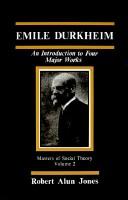
Start with Anthony Giddens's Durkheim, 125 pages in the Modern Masters series and still the fastest reliable way in. Read it in an evening, then keep Robert Alun Jones's Emile Durkheim — 167 pages, a book-by-book walkthrough of exactly the four major works — open beside the primary texts rather than reading it straight through. Between them you get social facts, anomie, solidarity and collective conscience before you meet those words in Durkheim's own prose.
What he argued is one claim pressed for a lifetime: that social facts are external to individuals, exert constraint on them, and must be explained by other social facts rather than by psychology or individual choice. Every book is that claim applied somewhere new.
The method, and the first big book
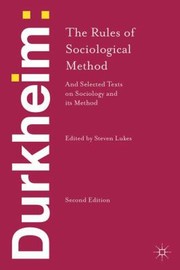
The Rules Of Sociological Method And Selected Texts On Sociology And Its Method is the manifesto — treat social facts as things — at 230 pages in the Lukes-edited version our record holds, which is why the title runs so long. The Division of Labor in Society, 262 pages, was the doctoral thesis: as societies specialise, a shared conscience gives way to interdependence, and the transition can go wrong. British editions print it as The Division of Labour in Society; it is the same book, so do not buy both.
Then the proof of concept. Suicide set out to show that the most private-seeming act has social causes, and it invented the modern habit of arguing from social statistics. One thing to know before you order: our catalogue record is the Spaulding and Simpson English translation, displayed under the bare title, carrying no page count and a garbled publication year of 1860. The French original is 1897. The record is thin, not wrong.
Steven Lukes's Emile Durkheim, his life and work sits here at 676 pages, and its length is misleading. It is the standard reference on what Durkheim argued, when, against whom and where the argument fails — you consult it, you do not read it end to end, which is why the path places it after three primary books rather than at the start.
The religion book, and the one people abandon
The Elementary Forms Of Religious Life is the most influential thing he wrote and the book readers most often stop finishing. At 416 pages it is not the longest item here, but its argument — that religion's real object is society itself — is carried on ethnography of Australian Aboriginal totemism that anthropologists have criticised heavily since. Read the theory closely and treat the empirical base sceptically. It also appears as The Elementary Forms of the Religious Life; same work.
Two short companions make it survivable. Primitive classification, written with Marcel Mauss, is 96 pages arguing that logical categories are modelled on social ones — the same argument in miniature, and written a decade earlier. Sociology and philosophy, 97 pages, is where he states most directly what sociology does to philosophy's traditional questions.
Page count is a poor guide to Durkheim
Those two 96- and 97-page essays are the densest reading on the path, per page, by some distance. The 676-page Lukes is the easiest, because it is written as reference prose and you take it in pieces. Two Durkheim lecture courses close the sequence: Moral Education, on teaching discipline and autonomy without religion in a secular republic, and Professional Ethics and Civic Morals, 243 pages proposing occupational corporations as the institution that could remedy the anomie diagnosed in the Division of Labor. Neither is famous; both are where his practical programme actually lives.
Finish with The Cambridge companion to Durkheim, 426 pages of specialist essays on the reception, the cultural-sociology revival and the standing objections. It assumes you have read the primary works, which by then you have.
Our staged Durkheim reading path puts the same books in order with a study plan for each stage.