The history of Finland: books to read, in order
Finland spent six hundred years as part of Sweden, a century as a Grand Duchy of the Russian Empire, and then had to hold its independence against the Soviet Union twice in five years. This path follows that sequence and takes seriously the two things Finns argue about most: the civil war of 1918, which killed a larger share of the population in four months than the world wars did, and the postwar accommodation with Moscow that outsiders named Finlandisation and Finns experienced as survival. Two novels are load-bearing here, because in Finland the war literature is the national argument.
Finland in one volume
BeginnerGet the whole arc from the Swedish period to EU membership, and the two things that make Finland structurally unusual in Europe: a Finno-Ugric language unrelated to its neighbours', and a border with Russia that has determined nearly every choice the country has made.
▸ Study plan for this stage
Pace: Two to three weeks for 650 pages, and the two surveys overlap deliberately. Meinander's A History of Finland (288 pages) is the shorter and the better starting point: compact, elegant, written by a Finnish historian who explains the country to outsiders without flattering it, and readable in about a
- Six hundred years as part of Sweden, and what that left in law, administration and the Swedish-speaking elite
- The Grand Duchy after 1809: an autonomous entity inside the Russian Empire with its own institutions and a Tsar as sovereign
- A Finno-Ugric language unrelated to those of its neighbours, and what that does to the possibility of assimilation
- The border with Russia as the standing constraint on nearly every Finnish decision
- Russification at the turn of the twentieth century and the resistance it provoked
- Independence in 1917 as an opportunity created by the collapse of the empire that held it
- The postwar arc through neutrality to EU membership
- What did Finland retain when it passed from Sweden to Russia, and why was the Tsar willing to leave so much intact?
- How much of Finnish law and administration is Swedish in origin, and is any of it still visible?
- What did Russification actually try to change, and what did it achieve?
- In what respects does an unrelated language change the politics of national identity, and where does Kirby show it mattering?
- Where do Meinander and Kirby weight the same events differently, and what accounts for it?
- Build a single timeline from Meinander from the medieval period to EU membership, then annotate it with the extra material Kirby supplies on the Swedish and Russian centuries.
- Write a paragraph on what Finland was in 1850, in political and legal terms, without using the words nation or country.
- Take the Russification measures Kirby lists and note for each which group in Finnish society it targeted and which it left alone.
- Mark on your timeline every point at which a decision was determined by the Russian border. Keep the marks; they will accumulate through the whole path.
Next up: The surveys will tell you that a Finnish national movement emerged during the Grand Duchy, and the next stage asks how, given that the elite spoke Swedish and the sovereign was the Tsar.

A compact, elegant survey by a Finnish historian who is unusually good at explaining the country to outsiders without flattering it. The best single starting point in English.
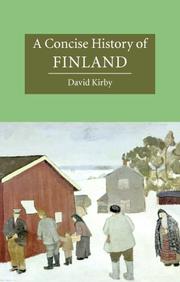
The Cambridge concise history, stronger than Meinander on the Swedish and Russian periods and on social history. Read it second as the fuller version of the same story.
Sweden, Russia, and the invention of a nation
BeginnerUnderstand where a Finnish national identity came from, given that the elite spoke Swedish and the sovereign after 1809 was the Tsar. The answer is largely literary: the Kalevala was assembled from oral poetry in the 1830s and 1840s and gave the movement a usable antiquity, and Kivi's novel gave it a modern prose language. Both are read here as historical acts, not just as literature.
▸ Study plan for this stage
Pace: Four to five weeks for 1,313 pages, and the arithmetic is dominated by one book. Christiansen's The Northern Crusades (287 pages) is the deep background nothing else on this path supplies, covering how Sweden and the crusading orders brought the eastern Baltic into Latin Christendom and therefore ho
- The Northern Crusades as the mechanism by which Finland entered both Latin Christendom and the Swedish realm
- A Swedish-speaking elite governing a Finnish-speaking population, and the language question that follows from it
- The Kalevala as a compiled epic: authentic oral material assembled into a form that did not previously exist
- Usable antiquity as a nationalist resource, and what a movement gains from having an epic
- Karelia as the source region of the oral poetry and its later political charge
- Kivi's novel as proof of concept for Finnish as a literary language, and the hostility that greeted it
- National identity as something built by specific people doing specific work rather than as something uncovered
- What did the crusading period settle about Finland's religious and political orientation, and how permanent did it prove?
- What did Lonnrot actually do to the material he collected, and does the answer change the Kalevala's standing?
- Why does a national movement need an epic, and what would Finnish nationalism have lacked without one?
- Why was Seven Brothers attacked on publication, and by whom?
- How did a Swedish-speaking elite come to promote a Finnish-language national identity, and what did it get out of doing so?
- Read one substantial sequence of the Kalevala and write down which elements read as archaic and which read as nineteenth-century arrangement. Then find out what Lonnrot said he was doing and compare.
- Trace one place name or region from Christiansen through to its appearance in the Kalevala or in later nationalist rhetoric.
- Write half a page on what Seven Brothers demonstrates about the Finnish language, using specific features of the prose rather than the fact of its existence.
- List the deliberate acts of nation-building this stage documents, with the person responsible for each, and check whether any of them were coordinated.
Next up: A nation had been assembled culturally by 1900; the next stage is what happened when it acquired a state in 1917 and immediately turned on itself.
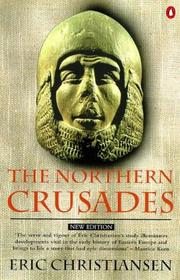
How Sweden and the crusading orders brought the eastern Baltic into Latin Christendom, which is how Finland ended up Swedish in the first place. The deep background nothing else here supplies.
The epic Lonnrot compiled from Karelian oral singers, published in 1835 and expanded in 1849, and the single most important object in Finnish nationalism. Read a chunk rather than all of it, and read it knowing it is a nineteenth-century construction from genuinely ancient material.
The first significant novel written in Finnish, published in 1870 and savaged at the time. It matters here because writing it was a political act: it proved Finnish could carry a modern literature.
1917, the civil war, and the republic
IntermediateFinland declared independence in December 1917 and was at war with itself by January. The Whites won in four months; the reprisals, the prison camps and the roughly thirty-six thousand dead shaped politics for two generations, and the war was called different things — class war, war of liberation, rebellion — depending on which side your family was on. Read the modern scholarship and then a novel written from the losing side.
▸ Study plan for this stage
Pace: Four weeks for 1,127 pages. Finland declared independence in December 1917 and was at war with itself by January; the Whites won in four months, and the reprisals, the prison camps and roughly thirty-six thousand dead shaped politics for two generations. The war has been called a class war, a war of
- Independence in December 1917 as a consequence of Russian collapse rather than of a successful struggle
- The Red and White sides as social positions before they were military ones: tenant farmers and workers against landowners and the propertied
- The scale of the killing relative to the population, and that most of it came after the fighting rather than during it
- The prison camps and the deaths in them as the largest single component of the toll
- That what the war is called is itself the argument, and that the naming tracked family allegiance for generations
- Tepora and Roselius's treatment of memory as a historical subject in its own right
- Fiction as an intervention in historiography, which is the specific claim made for Linna
- What made the split of 1918 fall where it did, socially and geographically?
- How much of the death toll came from combat, how much from executions and how much from the camps?
- How was the war narrated officially in the following decades, and what changed that narration?
- What does Linna's novel do that the scholarship cannot, and what does it not establish?
- How did the memory of 1918 constrain Finnish politics when the country faced the Soviet Union twenty years later?
- Write down the three names given to the events of 1918 and, for each, the account of causation it implies. Then check which of the three the Tepora and Roselius contributors use and when.
- Break the death toll into its components using the scholarly volume, and note which components were publicly acknowledged in which decades.
- Read Linna's treatment of one episode against the corresponding chapter in Tepora and Roselius and write out what the novel adds and what it compresses.
- Track a single family or community through Under the North Star and record what happens to their position over the span; then ask what that trajectory represents in the aggregate.
- Set your notes on 1918 aside carefully, because the next stage returns to the same population under attack from outside.
Next up: A country that had killed thirty-six thousand of its own two decades earlier had to defend itself against the Soviet Union in 1939, and how a divided society managed that is the first question of the next stage.
Kirby's political history of the independent state, and still the clearest account in English of how the Grand Duchy became a republic and what the civil war did to its politics afterwards.
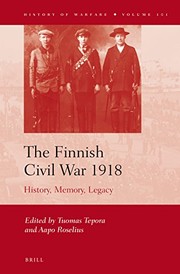
The Tepora and Aapo Roselius collection, the current scholarly reassessment of the war, the terror on both sides and the century of contested memory that followed. The book to read if you only read one on 1918.

Linna's novel of a tenant-farmer family from the 1880s through the 1918 civil war, and the book through which most Finns understand that war. Our record is the first volume of the trilogy at 420 pages, not the complete work — the two later volumes carry the story to the 1950s and are bought separately.
The Winter War and the Continuation War
IntermediateThe Soviet invasion of November 1939 produced one of the great military upsets of the century and then a punishing peace; Finland went back to war alongside Germany in 1941 to recover what it had lost, which is the choice its historians are still uncomfortable about. Lunde's title states the problem — co-belligerence was a decision, not only a necessity — and this stage is where you should form your own view of it.
▸ Study plan for this stage
Pace: Five weeks for 1,350 pages, the heaviest stage on the path. Trotter's A Frozen Hell (284 pages) is the standard English narrative of the Winter War, from the Mannerheim Line to the motti tactics that destroyed Soviet divisions on the Raate road; it is popular military history, moves fast, and was al
- The Soviet invasion of November 1939 and why the initial Soviet performance was so poor
- Motti tactics and the exploitation of terrain, mobility and winter against a mechanised opponent
- The punishing peace of 1940 and the territory Finland lost despite having held
- Co-belligerence with Germany from 1941 as a choice, and the arguments made for and against treating it as one
- The distinction between fighting alongside Germany and fighting for German aims, and whether it survives scrutiny
- The 1944 exit and the terms on which Finland left the war
- Mannerheim as the continuous figure from 1918 through both wars to the negotiated exit
- Why did the Red Army fail so badly in the first phase, and how much of it was doctrine rather than weather?
- What did Finland actually gain from the Winter War, given the terms it accepted?
- What is Lunde's evidence that 1941 was a choice, and what is the strongest counter-argument from necessity?
- How did the memory of 1918 affect the cohesion of Finnish society under attack in 1939?
- How did Finland extract itself in 1944, and what did the exit cost?
- What does Clements establish about Mannerheim's judgement that the campaign histories, focused on operations, cannot?
- Read Trotter and Chew on the same battle and list every point where the popular narrative and the military study diverge, marking whether each divergence is fact or interpretation.
- Draw the territorial changes of 1940 and 1944 on one map and write beside it what each transfer meant in population and in industry.
- Set out Lunde's argument as a numbered case, then write the reply from necessity using facts drawn from Trotter and Clements, and decide which case the evidence supports.
- Follow Mannerheim through Clements at four points, 1918, 1939, 1941 and 1944, and write a sentence at each on what he was trying to preserve.
- Write a paragraph on how you would describe Finland's position between 1941 and 1944 to someone insisting it was simply a German ally, and to someone insisting it was simply a victim.
Next up: Finland ended the war having fought the Soviet Union twice and lost territory to it while keeping its independence, and the last stage is about the price it then paid for forty years to keep that arrangement standing.
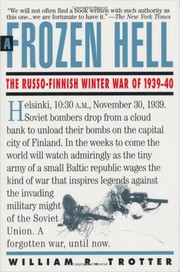
The standard English narrative of the Winter War, from the Mannerheim Line to the motti tactics that destroyed Soviet divisions on the Raate road. It was also published in Britain as The Winter War, so you may find the same book under either title.
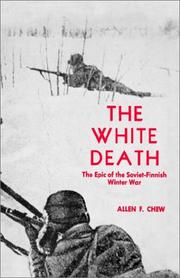
A tighter military study of the same campaign, better than Trotter on Soviet planning and on why the Red Army performed as badly as it did. Filed in the catalogue as The White Death.

A biography of the Tsarist cavalry officer who commanded the Whites in 1918, the army in both Soviet wars, and then served as president to negotiate the exit. One life running through the entire path.
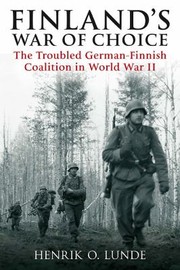
The Continuation War of 1941-44 and the awkward coalition with Nazi Germany, argued as a decision Finland made rather than one forced on it. The most directly challenging book in the stage; the catalogue drops the apostrophe.
Finlandisation and the memory of it
IntermediateFinland kept its democracy, its markets and its independence and paid for them with a foreign policy written with Moscow in mind, self-censorship in its press and publishing, and the 1948 treaty. Outside the country this was named Finlandisation and used as a slur; inside it, it is defended as the only realistic policy available. Note that Linna's novel had to fight its own censors, which is part of why it belongs here rather than in the war stage.
▸ Study plan for this stage
Pace: Two to three weeks, and it is a deliberately short closing stage. Finland kept its democracy, its markets and its independence and paid with a foreign policy written with Moscow in mind, self-censorship in its press and publishing, and the 1948 treaty; outside the country this was named Finlandisati
- The 1948 treaty and what it committed Finland to and, equally importantly, what it did not
- Finlandisation as a term coined abroad and used as a warning, and the Finnish response that it was the only available policy
- Self-censorship in press and publishing as a distributed practice rather than a state censorship apparatus
- The cutting of The Unknown Soldier before release as a concrete instance of that practice
- Democracy and a market economy preserved intact, which is the substance of the Finnish defence of the policy
- The difference between a foreign policy constrained by a neighbour and a satellite relationship
- How the postwar settlement is reassessed once the constraint that produced it is gone
- What did the 1948 treaty actually require, and what did Finland refuse to concede in negotiating it?
- Who did the censoring in practice, and what made publishers cut before anyone asked them to?
- What was cut from The Unknown Soldier, and what does the pattern of cuts reveal about what was unsayable?
- Is Finlandisation a fair description or a polemical one, and what would decide the question?
- What alternatives did Finland actually have after 1944, and what would each have cost?
- List the concessions Finland made under the postwar settlement and the things it kept, in two columns, and then judge the bargain rather than describing it.
- Find out what was removed from The Unknown Soldier before publication, read the corresponding passages in a later uncut edition if you can obtain one, and write a paragraph on what the cuts were protecting.
- Read Singleton's defence of Finnish policy against Lunde's argument about 1941 and note whether the same reasoning about constrained choice is being applied consistently.
- Write a final page on Finland using only the fourteen books on this path, and mark every point where your sources disagreed. Expect the largest marks at 1918 and at 1941, which are the two arguments Finns have with themselves.
Next up: This ends the path: from the crusading conquest and six centuries under Sweden, through an assembled national identity, independence and a civil war, two wars against the Soviet Union, and forty years of a foreign policy the country is still assessing.
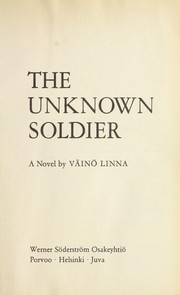
The 1954 novel of an ordinary machine-gun company in the Continuation War, which refused the heroic register the state wanted and was cut by its publisher before release. The most important Finnish book of the century and a document of exactly the pressures this stage is about.

Written by a British scholar during the Cold War and revised after it, this is the one survey here that treats the postwar relationship with the Soviet Union as its central problem. The right closing book because it argues the case Finns had to make for themselves.
Discussion
Keep reading
Paths that share books, cover the same subject, or open a related topic.

