The history of the Baltic states: books to read, in order
Estonia, Latvia and Lithuania are three separate countries with three unrelated trajectories before 1800 and two unrelated languages, and this path nonetheless treats them together — because the English-language literature does, and because from 1918 onward their history genuinely is one story of independence, annexation, occupation, deportation and recovery on a shared timetable. The path moves from the crusading orders and the German landlord class through the interwar republics to the two occupations, then to the collaboration and Holocaust questions that the region argues about most bitterly, and out through the Singing Revolution to the citizenship disputes that followed.
Three countries, one shelf
BeginnerStart by understanding why these three get bound together and where the binding is misleading. What justifies it: a shared fate from 1918, identical dates in 1940, 1941, 1944 and 1991, and a serious body of scholarship written regionally. What it obscures: Lithuania was a vast medieval Catholic empire that reached the Black Sea, while Estonia and Latvia were ruled by German, Swedish, Polish and Russian masters and became Lutheran; Estonian is a Finno-Ugric language closer to Finnish than to Latv
▸ Study plan for this stage
Pace: Three weeks for 720 pages, two regional surveys read in order of increasing depth. Kasekamp's A History of the Baltic States (248 pages) is the shorter and the more current, by an Estonian scholar, running from prehistory to EU accession, and it is the clearest single statement of what the three cou
- What justifies the regional frame: an identical political timetable from 1918 onward and a substantial body of regional scholarship
- What the frame obscures: Lithuania as a medieval Catholic power against Estonia and Latvia as ruled Lutheran provinces
- Estonian as a Finno-Ugric language against Latvian and Lithuanian as Indo-European ones
- The Baltic German nobility as the continuous landholding class in the north across changes of sovereign
- The alternating sovereigns over the northern provinces: German, Swedish, Polish and Russian
- That a regional history is a scholarly convention with real explanatory power and real distortions, both traceable
- Which specific dates and events actually apply identically to all three countries, and which are usually generalised without warrant?
- What difference does it make to Estonian and Latvian history that they were Lutheran and Lithuania Catholic?
- Where does Plakans's greater attention to social structure change the picture Kasekamp gives?
- What would a history of Lithuania written entirely on its own terms emphasise that a regional survey cannot?
- Is the term Baltic states a description or an artefact of the twentieth century?
- Build three parallel timelines, one per country, from these two surveys, and mark the points where all three lines carry the same entry. Those points are the justification for the shelf.
- Write a paragraph on what the three countries share and a paragraph on what they do not, using no dates after 1800 in the second.
- Compare how Kasekamp and Plakans each handle the medieval period and note which country gets the most space in each.
- Keep the three timelines; every remaining stage will add to them.
Next up: The next stage takes the three trajectories apart at the point where they diverge hardest, in the centuries when the north was conquered and the south was conquering.

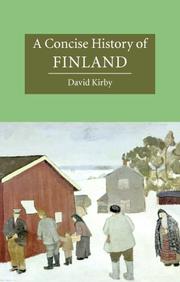
The most current and readable single-volume regional history, by an Estonian scholar, from prehistory to EU accession. The best starting point and the book that most clearly explains what the three countries do and do not share.

The Cambridge concise history, by a Latvian-American historian, longer and stronger than Kasekamp on the early modern period and on social structure. Read it second as the fuller version.
Crusaders, landlords, and a grand duchy
IntermediateThis is where the three histories diverge hardest, so read them separately. In the north, the Teutonic and Livonian orders conquered pagan Estonia and Latvia in the thirteenth century and installed a Baltic German nobility that ran the countryside for six hundred years under whichever crown held the region. In the south, pagan Lithuania was never conquered, expanded instead into one of the largest states in Europe, and merged with Poland. Come out able to explain why Latvian and Estonian nationa
▸ Study plan for this stage
Pace: Five weeks for 1,255 pages, and the four books should be read as two pairs rather than as a sequence. Christiansen's The Northern Crusades (287 pages) and Rowell's Lithuania Ascending (375 pages) form the medieval pair and are the divergence itself: Christiansen on the conquest and Christianisation
- The thirteenth-century conquest of pagan Estonia and Latvia by the military orders, and Christianisation as an instrument of it
- A Baltic German nobility running the countryside for six centuries under whichever crown held the region
- Lithuania as the pagan state that was never conquered, expanded to the Black Sea, and then merged with Poland
- Serfdom and emancipation in the north, and the estate order that survived emancipation
- Latvian and Estonian national movements beginning as revolts against a landlord class
- Lithuanian national revival beginning instead as the recovery of a lost empire and a lost polity
- Two different structures of grievance producing two different kinds of nationalism
- What did the military orders actually establish in the north, institutionally, and how much of it outlasted them?
- How did Lithuania avoid conquest, and what did merging with Poland cost and gain it?
- What did emancipation change for Latvian and Estonian peasants, and what did it leave in place?
- Why does a national movement aimed at a landlord class differ in character from one aimed at recovering a state?
- Where do Plakans and Raun tell the same nineteenth-century story with different emphasis, and what accounts for it?
- Map the eastern Baltic in about 1400 with the order territories and the grand duchy marked, and set it beside a modern map of the three states.
- Take one estate or one district described by Plakans and follow the same institution in Raun, writing down what differed.
- Write out the Latvian, Estonian and Lithuanian national awakenings as three short accounts, each identifying the enemy the movement defined itself against.
- From Rowell, list what Lithuania actually controlled at its height, then ask what the memory of that was later used to justify.
Next up: Three divergent histories converge in 1918, when all three declared independence in the same months, and the next stage is the twenty years in which they were separate states in fact rather than in retrospect.
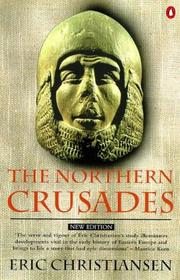
The standard account of the conquest and Christianisation of the eastern Baltic, and the origin of the German presence that shapes everything afterwards in Estonia and Latvia.

The rise of pagan Lithuania into a major European power between 1295 and 1345, and the corrective to any account that treats the Baltic as three small peoples to whom things happened.

Plakans's history of the Latvians as a people rather than a state, strongest on serfdom, the Baltic German estate order and the nineteenth-century national awakening.
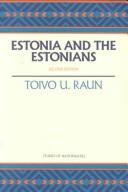
The standard English history of Estonia, and the natural companion to Plakans. Read them together to see how similar the Estonian and Latvian nineteenth centuries were, and how differently each nation tells it.
Twenty years of independence
IntermediateAll three declared independence in 1918, fought wars against Bolsheviks, Germans and each other's neighbours to keep it, ran land reforms that broke the estates, and had all slid into authoritarian rule by the late 1930s. Understand that interwar period on its own terms rather than as a prelude, because the 1991 restorations claimed legal continuity with precisely these states.
▸ Study plan for this stage
Pace: Two weeks for 477 pages, the lightest stage on the path and one to read attentively rather than quickly. Hiden and Salmon's The Baltic Nations and Europe (227 pages) is the shorter book and covers the three republics in the interwar international system and their reappearance in 1991; it is the best
- Independence declared in 1918 and then fought for against Bolsheviks, German forces and neighbouring claims
- The interwar land reforms that broke the Baltic German estate order in a few years
- The slide to authoritarian rule in all three states by the late 1930s, and the different routes each took
- The Vilnius dispute with Poland and the Klaipeda question as specifically Lithuanian problems
- Small-state diplomacy in a system whose guarantors were unwilling to guarantee
- Legal continuity from these republics as the basis of the 1991 restorations, and what that doctrine requires
- Against whom exactly did each of the three fight to secure independence, and what did each conflict settle?
- What did the land reforms do to the Baltic German nobility, and where did that class go?
- How did each state arrive at authoritarian rule, and how similar were the three routes?
- Why was Vilnius disputed, and what did the dispute cost Lithuania diplomatically?
- What does a claim of legal continuity from 1940 require to be true about the interwar states, and does the record support it?
- Add the interwar decades to your three timelines, marking the constitutional change in each country separately rather than treating the authoritarian turn as one event.
- Write out the land reform in one country as a policy, with who lost what and who gained it, then check how quickly it was completed.
- Trace the Vilnius dispute from claim to settlement in Eidintas and Zalys and write a paragraph on how it shaped Lithuania's relations with Poland and with Germany.
- Using Hiden and Salmon, list what the great powers said they would do for these states and what they did, and keep the list for the next stage.
Next up: The abandonment described at the end of this stage becomes concrete in the secret protocol of 1939, and the next stage is what the three states experienced when it was executed.
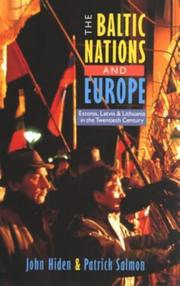
Hiden and Patrick Salmon on the three republics in the interwar international system and their reappearance in 1991. The best single account of how they were made and how they were abandoned.
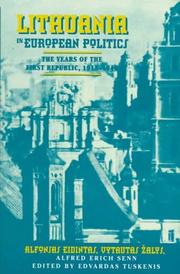
Eidintas and Zalys on the first Lithuanian republic, including the Vilnius dispute with Poland and the Klaipeda question. Included because Lithuania's interwar problems were genuinely unlike its neighbours' and get compressed in the regional surveys.
1940, 1941, 1944: the occupations and the accusations
IntermediateThe hardest stage, and the one where the sources take sides. The secret protocol to the Molotov-Ribbentrop pact assigned the three states to the USSR; annexation in 1940 was followed in June 1941 by mass deportations to Siberia, and days later by the German invasion, which many Balts initially welcomed. What followed is the region's open wound: over ninety per cent of Lithuania's and Latvia's Jewish populations were murdered, and local auxiliary units — the Arajs Kommando in Latvia, Lithuanian p
▸ Study plan for this stage
Pace: Five to six weeks, and this is the hardest stage on the path in every sense. The secret protocol to the Molotov-Ribbentrop pact assigned the three states to the USSR; annexation in 1940 was followed in June 1941 by mass deportations to Siberia, and days later by the German invasion, which many Balts
- The secret protocol and the mechanics of annexation in 1940, including the staged appearance of consent
- The June 1941 deportations to Siberia, and the German invasion arriving days later
- Why the German arrival was welcomed by many, and what that welcome did and did not commit people to
- The murder of over ninety per cent of Lithuania's and Latvia's Jewish populations, and the speed with which it was carried out
- Local auxiliary participation: the Arajs Kommando and the Lithuanian police battalions as documented units with named members
- The 1949 deportations and the Forest Brothers insurgency as the second Soviet layer of the wound
- The double genocide framing, the case for it as lived experience, and the historians' objection that it relativises
- Baltic units raised on both sides, and why an operational history is useful for establishing who was where
- How was the 1940 annexation staged, and what makes the resulting legal claim of continuity possible?
- What is documented about local auxiliary participation, and how was it organised and directed?
- What does Kruk record about the ghetto's internal life that a history of the killing would not preserve?
- What is the strongest version of the double genocide argument, and what is the strongest objection to it?
- How does Eksteins refuse to make anyone purely a victim, and does the refusal hold up over his whole account?
- What did the Forest Brothers achieve, and how long did the insurgency last?
- Build a single chronology for 1939 to 1949 with four rows: Soviet actions, German actions, local participation and Jewish community events. Then look at how much of the fourth row is compressed into a few months of 1941.
- Write out the double genocide argument in its strongest form and the historians' objection in its strongest form, each in one paragraph, without editorialising. Then write a third paragraph on where you stand and what evidence took you there.
- Take a specific locality that appears in both Kruk and Buttar and set the operational record beside the diary, noting what each source contains and cannot contain.
- Follow one Latvian or Estonian unit through Buttar and write down whom it fought for, when and under what compulsion, then ask what that record settles and what it does not.
- From Eksteins, trace his own family's trajectory and mark each point where he declines to give them the status of pure victims.
Next up: The occupations produced both the restoration claim and the citizenship dispute, and the final stage covers the recovery of independence and the argument it left unresolved.
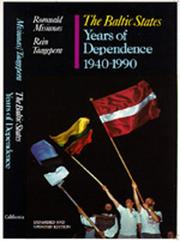
Misiunas and Rein Taagepera's history of 1940 to 1990, still the standard scholarly account of the Soviet period, the deportations and the armed resistance. Catalogued as The Baltic States, years of dependence, 1940-1990.

The military history of the fighting across the Baltics from 1939 to 1945, including the Latvian and Estonian units raised on both sides. Straightforwardly operational, which makes it a useful factual floor under the moral arguments.
The librarian of the Vilna ghetto kept a diary until shortly before his murder in 1944; it survived buried. Vilnius was the Jerusalem of Lithuania and this is what its destruction looked like from inside. The catalogue lists it as Diary of the Vilna ghetto.
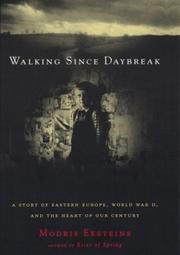
A Latvian-Canadian historian reconstructing his own family's flight westward and using it to write the twentieth-century Baltic as a single catastrophe. The book that refuses to make anyone in it purely a victim, which is why it belongs at the end of this stage.
Singing them back, and what came after
IntermediateClose with the recovery: the Baltic Way human chain of two million people in August 1989, the mass song festivals that gave the movement its name, and the restoration of independence in 1991. Then the unfinished part — Estonia and Latvia restored citizenship on the basis of pre-1940 continuity, which left large Russian-speaking populations, many of them born there, as non-citizens. That dispute is still running, and Lieven saw it forming.
▸ Study plan for this stage
Pace: Three weeks for 653 pages, split unevenly between a short account of the events and a long analysis of them. Vesilind's The Singing Revolution (178 pages) is the shortest book on the path and can be read in two or three sittings: the Estonian story of how song festivals became the vehicle of a natio
- The Baltic Way human chain of roughly two million people in August 1989 as a coordinated tri-national act
- Song festivals as an existing cultural institution repurposed into a political vehicle
- Restoration rather than secession as the legal theory of 1991, following directly from the continuity claim
- Citizenship restored on pre-1940 continuity in Estonia and Latvia, and the non-citizen populations that produced
- Lithuania's different citizenship settlement, and why its demographics allowed it
- Lieven's combination of sympathy and refusal to sentimentalise, and what that lets him see
- That an independence movement's founding legal doctrine can determine a minority-rights problem thirty years later
- Why did the restoration doctrine matter legally, and what would have followed from claiming secession instead?
- How did a song festival become a political instrument, and what made it hard for the authorities to suppress?
- Who became a non-citizen in 1991, and on what precise criterion?
- Why did Lithuania handle citizenship differently, and would the same approach have been available to its neighbours?
- What does Lieven anticipate about the ethnic question, and how much of it has since happened?
- Having finished the path, does the regional frame from stage one still seem justified to you?
- Complete your three timelines through 1991 and EU accession, and mark which entries are genuinely identical across all three countries and which only look it.
- Write out the restoration doctrine as a legal argument in numbered steps, then follow it through to the citizenship criterion and see where the consequence for Russian-speakers becomes unavoidable.
- Read Lieven's passages on the citizenship question and compare them with what you can establish about the present situation, marking which of his expectations held.
- Write a final page on the Baltic states using only the fourteen books on this path, and mark every point where your sources disagreed. The largest mark should sit on the double genocide dispute, which this path presents rather than settles.
Next up: This closes the path: from three unrelated medieval trajectories through conquest, empire, twenty years of independence, annexation, occupation, mass murder and deportation, to a restoration achieved by singing and a citizenship question it has still not resolved.

The Estonian story of how song festivals became the vehicle of a national movement that overturned Soviet rule without violence. The most direct account of the events the period is named for.
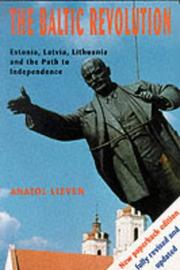
Written by a journalist on the ground as it happened and still the sharpest analysis of the three independence movements and of the ethnic and citizenship questions they were storing up. Lieven is sympathetic and refuses to be sentimental, which makes it the right book to end on.
Discussion
Keep reading
Paths that share books, cover the same subject, or open a related topic.