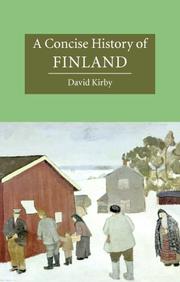
Begin with Henrik Meinander's A history of Finland, a compact 288-page survey by a Finnish historian who explains the country to outsiders without flattering it. Follow it with David Kirby's A Concise History of Finland, which is stronger on the Swedish and Russian periods and on social history — the fuller version of the same story rather than a competing one.
A word on that name before you go further: the same historian appears twice on this path under two catalogue forms, as David Kirby on the Cambridge concise history and as D. G. Kirby on the political history of the twentieth century. They are one person and two different books.
The order matters here because Finland is usually read through the Winter War alone, and the Winter War is the third act. What makes the country structurally unusual — a Finno-Ugric language unrelated to its neighbours', and a border with Russia that has determined nearly every choice it has made — is set long before 1939.
Sweden, Russia, and the invention of a nation
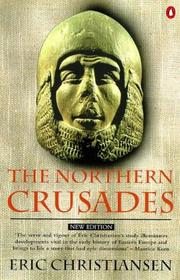
Eric Christiansen's The Northern Crusades supplies the deep background nothing else here provides: how Sweden and the crusading orders brought the eastern Baltic into Latin Christendom, which is how Finland ended up Swedish in the first place.
Then two literary works read as historical acts. The Kalevala is the epic Elias Lonnrot compiled from Karelian oral singers, published in 1835 and expanded in 1849, and the single most important object in Finnish nationalism. Read a substantial chunk rather than all 679 pages of it, and read it knowing it is a nineteenth-century construction from genuinely ancient material. Check the listing carefully: the record we hold is an Indian publisher's edition whose subject metadata mentions translation into Hindi, so confirm you are getting an English translation.
Aleksis Kivi's Seven brothers was the first significant novel written in Finnish, published in 1870 and savaged at the time. It matters here because writing it was a political act — it proved that Finnish could carry a modern literature.
1917, the civil war, and the republic
Finland declared independence in December 1917 and was at war with itself by January. The Whites won in four months; the reprisals, the prison camps and the roughly thirty-six thousand dead shaped politics for two generations, and the war was called different things — class war, war of liberation, rebellion — depending on which side your family was on.
D. G. Kirby's Finland in the twentieth century is still the clearest English account of how the Grand Duchy became a republic and what the civil war did to its politics afterwards. Tuomas Tepora and Aapo Roselius's collection The Finnish Civil War 1918 is the current scholarly reassessment — the terror on both sides and the century of contested memory that followed — and the one to read if you read only one.
Then Väinö Linna's Under the North Star, the novel of a tenant-farmer family running up to 1918, and the book through which most Finns understand that war. Know what you are buying: our record is the first volume of a trilogy at 420 pages, not the complete work. The two later volumes carry the story to the 1950s and are sold separately.
The Winter War and the Continuation War
William R. Trotter's A Frozen Hell is the standard English narrative of the Winter War, from the Mannerheim Line to the motti tactics that destroyed Soviet divisions on the Raate road. It was also published in Britain under a different title, so you may find the same book twice. Allen F. Chew's The White Death is a tighter military study of the same campaign and better on Soviet planning and on why the Red Army performed as badly as it did.
Jonathan Clements's Mannerheim follows one life through the entire path: a Tsarist cavalry officer who commanded the Whites in 1918, led the army in both Soviet wars, and became president to negotiate the exit. Henrik O. Lunde's Finlands War of Choice — the catalogue drops the apostrophe — takes up the Continuation War of 1941-44 and the coalition with Nazi Germany, and argues it as a decision Finland made rather than one forced on it. That is the most directly challenging book in the stage and the place to form your own view.
Finlandisation, and the memory of it
Close with Linna's The Unknown Soldier, the 1954 novel of an ordinary machine-gun company in the Continuation War, which refused the heroic register the state wanted and was cut by its publisher before release. Then Fred Singleton's A short history of Finland, written by a British scholar during the Cold War and revised after it, and the one survey here that treats the postwar relationship with Moscow as its central problem. Outside the country that policy was named Finlandisation and used as a slur; inside it, it is defended as the only realistic option available, and Singleton is the right closing book because he argues the case Finns had to make for themselves. The full ordered path is at /paths/pt_ai_the-history-of-finland.