The Economics of Innovation and Growth: The Best Books, in Order
Sustained economic growth is roughly 250 years old and nobody fully agrees on where it came from or why measured productivity growth slowed after 1970. This path starts with the empirical puzzle — the century of extraordinary American growth and its apparent end — then goes back to Schumpeter for the classical account of innovation as creative destruction, then to the economic historians who ask why invention became continuous, then to the money and the state that finance it, and finally to the two best sceptical books about whether we are measuring, or producing, innovation at all.
The puzzle: growth happened, then slowed
BeginnerEstablish the facts before the theories. Understand what the 1870-1970 transformation actually consisted of, why the numbers since look so different, and that economists genuinely disagree about whether the slowdown is a failure, a measurement problem, or the normal state of a rich economy.
▸ Study plan for this stage
Pace: Two and a half to three months for 1,167 pages, and almost two thirds of that is one book. Gordon's The Rise and Fall of American Growth is 762 pages, data-dense, and the indispensable starting point because everything else on this path argues with some part of it; give it six to seven weeks at 25 t
- What the 1870 to 1970 transformation actually consisted of on Gordon's account: electricity, the internal combustion engine, running water and sanitation, and antibiotics, each of which changed daily life in a way no subsequent technology has matched.
- Gordon's one-off argument. Many of the special century's gains can only happen once — a house is plumbed once, infant mortality falls to near zero once — which is why he expects no repeat rather than merely a pause.
- Total factor productivity as the measure the whole debate runs on, and what it does and does not capture about improvements in quality and in things that are not sold.
- Cowen's low-hanging fruit: free land, bright uneducated children who could be educated cheaply, and powerful new technologies, all substantially consumed by the 1970s.
- The distinction between a slowdown in invention and a slowdown in median income growth. Cowen's evidence is heavily the second, and conflating the two is the most common error in this literature.
- Vollrath's decomposition, which attributes most of the measured slowdown to smaller families, an ageing workforce and a voluntary shift into services — that is, to consequences of success rather than to technological failure.
- The measurement objection that runs under all three: if a large share of new output is free at the point of use, standard productivity statistics will understate it, and none of these three authors thinks that closes the gap.
- List the four or five innovations Gordon treats as defining the special century, and say for each why he thinks its gains cannot recur.
- Where do Cowen and Gordon agree, and where is Cowen making a claim about incomes that Gordon is not?
- Set out Vollrath's decomposition of the slowdown by component. Which components are unambiguously good news, and which are not?
- If Vollrath is right, which of Gordon's conclusions survive and which become uninteresting?
- What would have to be true for the measurement objection to explain the whole slowdown, and why do all three authors reject that?
- Build a timeline from Gordon of the arrival of each major technology in the median American household, with a date for each. Keep it — Perez in stage four asks you to place technologies in cycles and this is the raw material.
- Take Vollrath's decomposition and write down each component as a percentage of the slowdown he attributes to it, then compare the total against Gordon's framing. The overlap and the residual are where the real disagreement sits.
- Pick one good you buy regularly and try to state its quality improvement over twenty years in a number. The difficulty you have is exactly the measurement problem the chapter argues about.
- Write one paragraph stating whether the slowdown is a failure, a measurement problem or the normal state of a rich economy. Date it and keep it; the last stage of this path asks you to revisit it.
Next up: With the facts of the slowdown established and contested, the next stage goes back to the theory that every modern claim about innovation is still quoting.
The definitive account of the special century when electricity, the internal combustion engine, indoor plumbing and antibiotics transformed daily life, and Gordon's argument that nothing since has matched it. Long and data-dense, and the single indispensable starting point because every other book here is arguing with some part of it.

A very short book that made the same case four years earlier and popularised the phrase — that the United States ate the low-hanging fruit of free land, bright uneducated kids and powerful new technologies. Read it right after Gordon as the compact version of the thesis, and notice how much of the argument is about median income rather than invention.

The best answer to the pessimists: Vollrath decomposes the slowdown and concludes most of it comes from success — smaller families, an ageing workforce and a shift to services people actually wanted. Read it third, because it changes what the rest of the path is a question about.
The classical account: creative destruction
IntermediateRead the source of nearly every modern claim about innovation. Schumpeter's entrepreneur is a disequilibrating force, not an optimiser, and his prediction that capitalism's own bureaucratic success would destroy it is the part most often quoted and least often read.
▸ Study plan for this stage
Pace: Two and a half months for 1,070 pages, and this is the stage where reading order carries the argument. Schumpeter's The theory of economic development is 255 pages in the English translation by Redvers Opie that our record holds, and it is dense early-twentieth-century economic theory rather than na
- Schumpeter's entrepreneur as a disequilibrating force. The entrepreneur is not an optimiser inside a given set of options but the person who introduces a new combination and destroys the equilibrium.
- New combinations as the unit of analysis — a new good, a new method, a new market, a new source of supply, a new organisation — which is a much broader category than technological invention.
- The role of credit in the 1911 book. Innovation requires purchasing power that does not yet correspond to any output, which makes the banker a necessary character in the story rather than a bystander.
- Creative destruction as named in Capitalism, Socialism and Democracy: the process by which the same mechanism that creates new industries destroys existing ones, and the claim that this is what capitalism is rather than a side effect.
- Schumpeter's later reversal, in which large corporate research laboratories rather than lone entrepreneurs have become the real innovators — a prediction with a century of evidence now available against it.
- His argument that capitalism's success would produce a bureaucratic and intellectual class hostile to it, which is the part of the book most often skipped and the part that explains its title.
- Phelps's dynamism thesis: modern growth came from grassroots innovation by ordinary people in their work, and its decline is a loss of that dynamism rather than an exhaustion of technological possibility.
- Where Phelps and Gordon actually conflict. Both see a slowdown; Gordon attributes it to the character of the technologies available and Phelps to the character of the institutions and values, and the two diagnoses imply opposite policies.
- Define a new combination in Schumpeter's sense and give three examples that involve no new technology at all.
- Why does credit have to be part of Schumpeter's account of development, and what does that imply about an economy with a conservative banking sector?
- State creative destruction precisely as Capitalism, Socialism and Democracy uses it, and say what is lost when the phrase is used to mean simply that firms fail.
- Schumpeter predicted the corporate laboratory would displace the individual entrepreneur. On the evidence you have, was he right, wrong or both in different periods?
- What is Phelps's dynamism, how would you measure it, and does his diagnosis of the slowdown compete with Gordon's or complement it?
- Which of Schumpeter's claims are empirical and which are definitional? Sorting them is the fastest way to see what the theory can be tested against.
- Reconstruct the argument of The theory of economic development as a numbered chain from new combination to credit to profit to the business cycle, then find the link a modern economist would attack.
- Take three industries you know and describe each as a case of creative destruction in Schumpeter's full sense, naming what was destroyed as well as what was created. If you cannot name the destruction, it is not his concept.
- Read the chapters of Capitalism, Socialism and Democracy on the sociology of the intellectual class and write a paragraph on what they are doing in a book about economics. Most readers never find out.
- Set Phelps's explanation of the slowdown beside Gordon's in two columns — mechanism, evidence, implied policy — and identify the observation that would distinguish them.
- Return to your dated paragraph from stage one and note whether Schumpeter or Phelps has changed it. Do not rewrite it yet.
Next up: Schumpeter explains what innovation does to an economy but not why one society started producing it continuously, which is the economic historian's question the next stage takes up.
The 1911 book where innovation, credit and the entrepreneur first appear as the engine of growth rather than as a residual. Our record is the English translation by Redvers Opie; read it for the argument that development comes from new combinations, not from more of the same inputs.
Where creative destruction is named and where Schumpeter argues that large corporate laboratories, not lone entrepreneurs, had become the real innovators. Read it second and read the whole argument, including the sociology of the intellectual class, because the famous phrase is routinely detached from what it was for.
A Nobel laureate's case that modern growth came from grassroots innovation by ordinary people and that its decline is a loss of dynamism rather than of technology. Placed here because it is the most direct modern continuation of the Schumpeterian question, and because it disagrees with Gordon about the cause.
Why invention became continuous
IntermediateAsk the economic historian's question: not what technologies appeared, but why a society started producing them repeatedly. Useful knowledge, the culture of open science, and the willingness to tolerate disruption are three candidate answers here.
▸ Study plan for this stage
Pace: Three months for 1,174 pages. Mokyr's The lever of riches is 355 pages surveying technological creativity from classical antiquity onward and asking why bursts of invention repeatedly stalled before the eighteenth century; three to four weeks, and it goes first because it is the empirical groundwork
- Mokyr's central historical puzzle in The lever of riches: technological creativity appeared repeatedly — in classical antiquity, in Song China, in medieval Europe — and repeatedly stalled, so the question is why it stopped stalling.
- The distinction between propositional knowledge, what we know about nature, and prescriptive knowledge, what we know how to do. Sustained invention requires a widening base of the first, which is Mokyr's mechanism.
- Useful knowledge as an institutional achievement rather than an individual one, depending on how cheaply knowledge can be accessed and how reliably it can be trusted.
- The Republic of Letters in A Culture of Growth: a competitive transnational market for ideas in which political fragmentation gave heterodox thinkers somewhere to go, which Mokyr treats as Europe's decisive advantage.
- The cultural precondition Mokyr insists on — a shared conviction that nature can be understood and manipulated for human benefit — and the fact that this is a claim about beliefs, which is why the book is contested.
- Ridley's bottom-up thesis: innovation as an incremental, recombinant and collective process in which simultaneous invention is the norm and the heroic inventor is a retrospective construction.
- Ridley's second and more contestable claim, that government direction of research is largely ineffective, which stage four's Mazzucato attacks directly with the same historical episodes.
- How to weigh case studies as evidence. Ridley's examples are real and his selection is his argument, and noticing which counter-examples are absent is the reading skill this stage rewards.
- Name three historical episodes of technological creativity from The lever of riches that stalled, and give Mokyr's explanation for each stall.
- Distinguish propositional from prescriptive knowledge and explain why Mokyr thinks sustained growth requires the first to expand.
- What was the Republic of Letters, and what specifically did political fragmentation contribute on Mokyr's account?
- A Culture of Growth is an argument about beliefs. What evidence does Mokyr offer for a change in belief, and what would count against him?
- State Ridley's thesis in one sentence, then name a well-documented innovation his framework handles badly.
- Where do Mokyr and Ridley actually disagree, given that both are arguing for collective and incremental processes?
- Take the timeline you built in stage one from Gordon and annotate each technology with Mokyr's question: what propositional knowledge had to exist first, and when did it become available?
- Pick one of Ridley's case studies and research it independently for an hour. Note every actor his account omits, then decide whether the omission changes his conclusion.
- Write the strongest objection to A Culture of Growth that you can construct, then find whether Mokyr answers it in the book. He anticipates several, and which ones he anticipates tells you where he thinks he is weakest.
- Choose an invention with a famous single name attached and reconstruct the simultaneous or prior work around it. Ridley's argument is testable this way and it usually survives.
- List three innovations you believe were state-driven and three you believe were not, before reading stage four. You will check the list against Mazzucato.
Next up: Knowledge alone does not build anything, so the next stage follows the money that turns invention into deployment and the fight over where that money comes from.
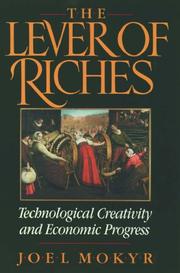
Mokyr's survey of technological creativity from classical antiquity onward, and of why bursts of invention repeatedly stalled before the eighteenth century. The right first Mokyr because it is the empirical groundwork the later two build arguments on.

The argument that the Industrial Revolution required a change in beliefs — a competitive European market for ideas and a shared conviction that nature could be understood and used. Read it after 'The Lever of Riches' because it is the explanation for the pattern that book documents.

Case studies arguing that innovation is gradual, collective and bottom-up, and that individual inventors and government programmes both get too much credit. The most contestable book in this stage — read it as a deliberate counterweight to the next stage's case for the state.
Money, the state and the cycle
IntermediateInnovation has to be financed, and the financing shapes what gets invented. Follow the argument that technological revolutions come in long financial cycles, then the sharpest dispute on the path: whether public investment is the real source of radical innovation or a story told after the fact.
▸ Study plan for this stage
Pace: Two and a half months for 898 pages, and the order given is deliberate. Perez's Technological Revolutions and Financial Capital is 216 pages and is the most compressed theoretical book on the path; three weeks, read twice if you can, because it supplies the shape the other two argue inside — five gr
- Perez's surge structure: irruption, frenzy, a turning point, synergy and maturity, with a financial bubble sitting at the hinge between installation and deployment rather than at the end.
- Why the crash matters in her model. It is the institutional recomposition after the bubble, not the technology itself, that determines whether deployment is broadly shared.
- The distinction between financial capital and production capital, which drives the whole model and explains why the same technology can produce speculation in one phase and diffusion in the next.
- Mazzucato's evidence: the specific technologies inside a smartphone, and the public agencies that funded them at the stage where private capital declined the risk.
- The returns question, which is Mazzucato's real argument rather than the funding history — that public risk-taking produced private returns with no mechanism for the public to share in them.
- The main dispute over her case. Critics accept the funding record and contest what share of the value it explains, since integration, design and commercialisation are also where value is created.
- Aghion, Antonin and Bunel's synthesis of Schumpeterian growth theory: competition raises innovation up to a point, incumbents block, and the same mechanism that drives growth generates inequality and political resistance.
- The incumbent-blocking result specifically, which connects the theory back to Phelps's dynamism and forward to the institutional pessimism of the final stage.
- Set out Perez's five phases and place two technologies from your Gordon timeline in the correct phase of the correct surge.
- Why does Perez put the bubble in the middle of a surge rather than at its end, and what does that imply about how to read a crash while it is happening?
- Which specific technologies does Mazzucato trace to public funding, and at what stage of development was the public money committed in each case?
- What is the strongest objection to The Entrepreneurial State that concedes all its historical facts?
- How do Aghion, Antonin and Bunel resolve the relationship between competition and innovation, and where does that leave incumbents?
- Read Mazzucato and Ridley against each other on the same episode. Are they disagreeing about the record, about attribution, or about policy?
- Map the last forty years onto Perez's phase structure, marking the bubble, the crash and the deployment period. Then do the same for a surge from a century earlier and compare the intervals.
- Take the list of state-driven and non-state-driven innovations you wrote in stage three and check each against Mazzucato's account. Mark which entries she overturns, which she confirms and which she does not address.
- Pick one technology in a modern smartphone and trace its funding history independently for an hour. Write down what proportion of the development you would attribute to public money and defend the number.
- Extract the incumbent-blocking argument from Aghion, Antonin and Bunel and apply it to an industry you know. Identify the specific mechanism — regulation, acquisition, standards, distribution — by which blocking happens there.
- Write a paragraph reconciling Perez's cycles with Gordon's one-off gains. If they cannot be reconciled, say exactly which claim has to give.
Next up: Every book so far assumes innovation is the thing to want, which is precisely the assumption the closing stage refuses.

Perez's model of five great surges, each with an installation phase driven by financial capital, a bubble, a crash and then a deployment phase — the most useful single framework for placing any technology in time. Read it first here because it gives the other two books a shape to argue inside.

The case that the technologies inside a smartphone were overwhelmingly funded by public agencies taking risks private capital would not, and that the returns flowed elsewhere. Widely cited and widely disputed on exactly how much the state's role explains — read it against Ridley in the previous stage and keep the disagreement open.

Aghion, Antonin and Bunel's synthesis of modern Schumpeterian growth theory for a general reader, covering competition, inequality and why incumbents block. Our record drops the leading article; it is the same book, and it is the best bridge between the classical stage and current empirical work.
The counter-case
IntermediateClose by taking seriously the possibility that the innovation economy is partly a story we tell. One book argues Western institutions have become bad at commercialising ideas; the other argues that maintenance and repair, not novelty, are where most economic value actually lives.
▸ Study plan for this stage
Pace: Six weeks for 577 pages, the shortest stage on the path and the one that reframes it. Erixon and Weigel's The innovation illusion is 305 pages; three weeks. It is an institutional diagnosis rather than a mood — corporate managerialism, regulatory complexity and shareholder short-termism producing la
- Erixon and Weigel's three mechanisms: managerial bureaucracy inside large firms, accumulated regulatory complexity, and shareholder pressure toward short horizons — each proposed as a separate cause of the same outcome.
- The distinction between an economy that cannot invent and one that cannot commercialise. Their claim is squarely the second, which is why it is compatible with Mokyr and incompatible with a pure technology-exhaustion story.
- Their argument about corporate ownership structure, in which dispersed institutional shareholding removes anyone with both the incentive and the authority to fund a decade-long bet.
- Vinsel and Russell's central move: separating innovation as a real process from innovation-speak as a rhetoric that attaches status and funding to novelty regardless of outcome.
- Maintenance as economic activity. The vast majority of work and expenditure on any technology happens after deployment, and neither the statistics nor the prestige system reflects that.
- The maintenance deficit as a measurable phenomenon in infrastructure, and the argument that deferred maintenance is a form of disinvestment that no innovation metric captures.
- What both books do to the earlier stages: if commercialisation and upkeep are where value lives, then Gordon's productivity puzzle, Mazzucato's returns question and Perez's deployment phase are all pointing at the same neglected half of the cycle.
- State Erixon and Weigel's three mechanisms and say which of them they evidence best and which is closest to assertion.
- Their claim is about commercialisation rather than invention. Which books earlier on this path does that make them compatible with, and which does it contradict?
- What is innovation-speak on Vinsel and Russell's account, and what specific institutional consequences do they attribute to it?
- How would you measure the maintenance economy, and why does it not show up in the productivity statistics from stage one?
- After both books, is the slowdown a problem of technology, of institutions, or of measurement? Answer with reference to at least three books from earlier stages.
- Which claim on this entire path do you now think is least well supported, and what evidence would settle it?
- Take one large firm you know and test Erixon and Weigel's three mechanisms against it individually. Some firms will show one and not the others, which is the useful result.
- For a technology you use daily, estimate the ratio of lifetime maintenance cost to initial purchase cost. Vinsel and Russell's argument is mostly this ratio, and doing it once is convincing.
- Find a recent public announcement that uses the word innovation and rewrite it stating only what will actually be built, funded or maintained. What survives the rewrite is the content.
- Return to your dated paragraph from stage one and rewrite it now, keeping both versions. The difference is the honest measure of what this path did.
- Build a one-page map of the whole path showing which books agree and disagree with Gordon's diagnosis, and on what grounds. This is the reference you will actually keep.
Next up: The path ends with the category itself under question, which is the right place to leave a field where the central empirical fact is still being argued over.

Erixon and Weigel argue that corporate managerialism, regulatory complexity and shareholder short-termism have made large Western firms structurally incapable of radical innovation. A specific institutional diagnosis rather than a mood, which is why it is worth reading even if you reject the conclusion.

Vinsel and Russell's attack on innovation-speak itself, and their case that maintenance and infrastructure are systematically undervalued relative to novelty. The right book to end on because it questions the category the whole path has been using.
Discussion
Keep reading
Paths that share books, cover the same subject, or open a related topic.