Best Books on Nationalism, in Reading Order
The academic study of nationalism is unusually well organised around one question — are nations modern inventions or ancient inheritances — and almost every important book takes a position on it. This path starts with the modernist canon that dominates the field, moves to the work on invented traditions and everyday national feeling, then to the ethnosymbolist and idealist challenges, then to state-centred and postcolonial accounts, and closes on why the idea is resurgent now.
The modernist canon
IntermediateMaster the three foundational statements of the modernist position — that nations are products of print capitalism, industrial society and the modern state, not of ancient ethnicity.
▸ Study plan for this stage
Pace: 6-7 weeks for roughly 650 pages, and the slowness is deliberate — these three books are the reference points every later author argues with, so anything you skim here you will have to come back for. Two to three weeks on Imagined Communities (it is short but Anderson moves fast and packs whole argum
- Anderson's definition, which is doing more work than it looks: the nation as an imagined political community, imagined as both inherently limited and sovereign
- Print capitalism — the argument that vernacular publishing markets created the readerships that could conceive of themselves as fellow nationals, and that this is why nationalism has a date
- The creole pioneers thesis: Anderson locates the first nationalisms in the Americas, not in Europe, which is a claim most later writers quietly ignore
- Homogeneous empty time and the newspaper as a daily ceremony of simultaneity — the idea most often borrowed and least often understood
- Gellner's functionalism: industrial society needs a mobile, literate, culturally standardised workforce, so it produces the education systems that produce nations. Nationalism engenders nations, not the other way round
- The high-culture/low-culture transition in Gellner, and his claim that agrarian societies had no use for cultural homogeneity at all
- Hobsbawm's periodisation — the revolutionary-democratic phase, the ethnolinguistic phase after 1870, the apogee 1918-1950 — and the precision it imposes on a vague subject
- Hobsbawm's closing wager that nationalism was past its peak, written in 1990, which is the single most instructive wrong prediction in the field
- Anderson and Gellner both date nations to modernity but explain them completely differently — one culturally, one structurally. Which mechanism does more of the explanatory work, and where do they actually contradict rather than complement each other?
- Gellner writes that nationalism invents nations where they do not exist. Anderson objects to the word invent because it implies fabrication rather than imagination. Is that a real disagreement or a quarrel about connotation?
- Why does Anderson put the Americas first, and what would the theory look like if he had started in Europe like everyone else?
- Hobsbawm predicted the decline of nationalism in 1990. Which parts of his own analysis should have told him otherwise?
- All three authors are on the political left and all three are unsentimental about nations. How much of the modernist consensus is an empirical finding and how much is a shared disposition?
- Write 200 words unpacking Anderson's four-part definition, taking each term — imagined, limited, sovereign, community — and saying what it excludes.
- Set Gellner's and Anderson's causal chains side by side on one page as two flow diagrams, from initial condition to the existence of nations. The gaps between them are where the field's later arguments happen.
- Take your own country and test Hobsbawm's periodisation against its actual national history. Note where the phases arrive early, late, or not at all.
- Find the passage where Gellner discusses Ruritania and Megalomania and write out, in plain language, exactly what the parable is claiming about language and social mobility.
- Keep a running list, from this stage onwards, of every claim about pre-modern ethnic continuity that the modernists dismiss. You will need it when Smith arrives in stage three.
Next up: The modernist trio makes its case largely at the level of theory; the next stage puts that theory under empirical pressure, showing traditions being manufactured in the archive and nationhood being reproduced in ordinary life.
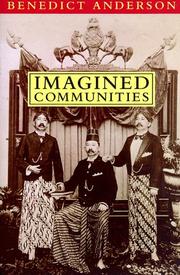
The most cited book in the field and the one that gave it a vocabulary: the nation as an imagined political community made thinkable by print capitalism. Start here; everything else is written in relation to it.

Gellner's austere functional argument that industrial society requires a mobile, literate, homogeneous population, and nationalism supplies it. Read it second as the structural explanation Anderson's cultural account leaves out.
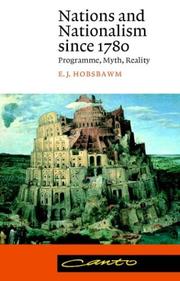
A Marxist historian's periodisation of nationalism across two centuries, with a famously sceptical conclusion about its future. It completes the modernist trio and dates the movement precisely.
Invention and everyday nationhood
IntermediateSee the modernist thesis demonstrated in detail — how national traditions were manufactured, and how nationhood is reproduced daily without anyone noticing.
▸ Study plan for this stage
Pace: 7-8 weeks, and Weber is the reason. The Invention of Tradition is an edited collection — read Hobsbawm's introduction and conclusion carefully, then Trevor-Roper on Highland tradition, Cannadine on royal ceremonial and Ranger on colonial Africa, over about two weeks. Peasants into Frenchmen is 615 p
- The invented tradition as a technical category: a practice of recent origin that claims continuity with a suitable past, formalised and ritualised in a way genuine custom rarely is
- Trevor-Roper's demolition of the Highland tradition — kilt, clan tartan, bagpipe ceremonial — as largely an eighteenth and nineteenth-century construction, which remains the most quoted chapter in the book
- Cannadine on British royal ceremonial becoming grand and solemn only as the monarchy's actual power drained away, an inverse relationship worth generalising
- Weber's mechanisms of nationalisation: roads, railways, conscription, primary schooling, market integration, and the migration of seasonal labour
- The finding that in 1870 a large share of French citizens did not speak French, and that patois, local measures and local saints persisted until the state actively displaced them
- The First World War in Weber's account as the completion rather than the cause of French national feeling
- Billig's banal nationalism: the unwaved flag, the weather map bounded by the national border, the deixis of newspaper headlines that says we without explaining who
- The consequence of Billig's move — that nationalism is not a property of extremists and other people's countries but of the ordinary daily reproduction of one's own
- What distinguishes an invented tradition from a custom that simply changed over time? Hobsbawm's introduction gives criteria — are they sharp enough to sort real cases?
- Weber shows French peasants becoming French between 1870 and 1914. Does that support Gellner's industrial mechanism, Anderson's print mechanism, or something neither of them named?
- Billig argues that the study of nationalism has been displaced onto separatists and foreigners. What does his framework make visible in your own daily life that you had not been counting?
- If national traditions are largely manufactured, does exposing the manufacture weaken people's attachment to them? What is the evidence either way?
- Which of these three books does the most damage to the ethnosymbolist position you are about to read — and which of them, read carefully, actually helps it?
- Pick one tradition in your own country that is presented as ancient and trace its documented origin. Write a page. Trevor-Roper's chapter is the template for how to do this.
- Do Billig's exercise directly: take a single day's national newspaper and mark every use of we, here, the nation, the country and the weather map's borders. Count them. The number is the point.
- Chart Weber's causal factors — schooling, conscription, roads, markets, press — against a timeline of 1870 to 1914 and mark which he thinks did the most work.
- Summarise Cannadine's argument about royal ceremonial in 150 words and then test it against any other monarchy or presidential ritual you know well.
- Write a paragraph on which of Weber's mechanisms have modern equivalents and which have no successor at all now that conscription and mass primary schooling in a single language are no longer universal.
Next up: Having seen the modernist case at its empirical strongest, you are in a position to give its two serious opponents a fair hearing rather than a dismissal.

Case studies edited with Terence Ranger showing that Highland tartan, royal ceremonial and colonial custom are mostly nineteenth-century creations. The empirical backbone of the modernist claim.

Weber shows rural France becoming French only between 1870 and 1914, through roads, schools and conscription. The single best demonstration that even the archetypal nation had to be built.

Argues nationalism is not the flag waved in a crisis but the flag hanging unnoticed outside a post office. It shifts the object of study from extremism to the ordinary, which changes what you notice everywhere else.
The challenges to modernism
BeginnerTake seriously the objection that nations draw on genuinely pre-modern ethnic material, and the older view that nationalism was a philosophical error with lethal consequences.
▸ Study plan for this stage
Pace: 4-5 weeks. Smith's The Ethnic Origins of Nations is 312 pages of careful, sometimes taxonomic argument and needs three weeks — read it with the modernist claims from stage one written down beside you, because Smith is answering specific people. Kedourie's Nationalism is only 151 pages and belongs to
- The ethnie as Smith's central unit: a named human population with shared myths of descent, a common history, a distinctive culture, an association with a territory and a sense of solidarity
- The myth-symbol complex, and Smith's claim that these durable cultural materials constrain what modern nationalists can plausibly build
- Smith's distinction between lateral aristocratic ethnies and vertical demotic ones, and the different routes to nationhood each takes
- The genuine point of disagreement: not whether nations are modern — Smith concedes a great deal — but whether nationalists work with inherited material or with anything they please
- Kedourie's derivation of nationalism from Kant's autonomous will via Fichte and the German romantics, making it a philosophical doctrine with a traceable pedigree rather than a social condition
- Kedourie's verdict that the doctrine is intellectually incoherent and historically catastrophic, and the fact that he wrote it in 1960 against the grain of decolonisation
- The methodological gulf: Kedourie explains by tracing ideas, Gellner and Smith by identifying social conditions, and the two schools barely engage each other's evidence
- Smith was Gellner's student, and the argument between them is a documented, direct and unusually civil disagreement — worth reading as a model of how a field actually adjudicates
- Where exactly does Smith concede the modernist case, and where does he refuse it? Being precise about the boundary is the whole exercise.
- Anderson says the nation is imagined; Smith says you cannot imagine just anything. Which claim does the historical record support better, and can both be true at once?
- Kedourie treats nationalism as a doctrine that could in principle have not been invented. Gellner treats it as a structural necessity of industrial society. Is there any evidence that would decide between them?
- Kedourie's book is a moral indictment as much as an analysis. Does the moral judgement damage the history, or is refusing to make one its own kind of distortion?
- Smith's ethnies are identified partly through the myths a group tells about itself. What stops that method from confirming whatever the nationalists already claim?
- Take one nation and try to identify Smith's ethnie behind it: name the myths of descent, the shared memories, the territorial association. Then ask honestly how much of that material is documented before 1800 and how much is stage-two invention.
- Write a two-page dialogue between Gellner and Smith on a single case, using only positions each actually holds. Do not let either win.
- Trace Kedourie's line from Kant to Fichte to the nineteenth-century nationalists in a diagram, marking where you think the inference is weakest.
- Compare the opening ten pages of Kedourie with the opening ten of Gellner and write 200 words on what each takes to count as an explanation.
- Return to the list of dismissed continuity claims you kept in stage one and mark which ones Smith rehabilitates and which he leaves dismissed.
Next up: With the origins argument now genuinely two-sided, the next stage stops asking where nations came from and asks how nationalism works as politics — and whether the whole canon you have read is provincial.

The ethnosymbolist rebuttal: modern nations are built from durable pre-modern ethnies, myths and memories rather than out of nothing. Smith was Gellner's student and argues with him directly.
The classic 1960 statement that nationalism is a doctrine invented in early nineteenth-century Germany out of Kantian self-determination, and that it has been a disaster. Read it for the intellectual-history approach the sociologists displaced.
States, categories and the postcolonial critique
BeginnerMove from where nations came from to how nationalism actually operates as politics, and confront the charge that the whole canon is Eurocentric.
▸ Study plan for this stage
Pace: 8-9 weeks. Breuilly's Nationalism and the State is 421 pages of comparative political history, three to four weeks, and is best read in its comparative chapters rather than cover to cover if time is short. Brubaker's Nationalism Reframed is a collection of linked essays and reads in two weeks; the t
- Breuilly's core move: nationalism is a form of politics, and the right question is what political function nationalist argument performs in a given state context
- His typology by relation to the state — separatist, reform, unification — crossed with whether the movement opposes a nation-state or a non-national empire
- The consequence that a nationalist movement's ideology may matter less than its opponent, which explains why movements with incompatible doctrines look so similar in practice
- Brubaker's triadic nexus: the nationalising state, the national minority within it, and the external national homeland, each constituting itself in relation to the other two
- Nation as a category of practice rather than a thing in the world — Brubaker's insistence that analysts should study how the category is used rather than counting nations
- Groupness as a variable and an event, not a constant, which dissolves a lot of muddled writing about ethnic conflict
- Chatterjee's spiritual and material domains: colonised elites conceded the outer domain of statecraft and technology while declaring an inner domain of language, family and religion already sovereign
- The charge against Anderson — that modular nationalism leaves the colonised only derivative copies to imagine — and Chatterjee's counter that anticolonial nationalism was creative precisely where Anderson was not looking
- Breuilly says nationalist ideology is often less important than the political situation. What evidence would show that he is understating the ideology's independent force?
- Apply Brubaker's triad to a live case — a minority, its state and its external homeland — and say which of the three is currently driving the others.
- Brubaker wants us to stop treating nations as real entities. Can you write a paragraph of political analysis under that constraint without it becoming unreadable? Should you have to?
- Chatterjee argues the inner domain was sovereign before any political independence was won. Does that claim generalise beyond Bengal, and what would count as a test?
- Is Chatterjee refuting Anderson, or extending him into territory Anderson's method could not reach? The two readings imply very different verdicts on Imagined Communities.
- Breuilly, Brubaker and Chatterjee each relocate the subject — to the state, to the category, to the colony. Which relocation costs the most in explanatory power, and what does it buy in return?
- Build Breuilly's typology as a grid and place six nationalist movements you know into its cells. The ones that resist placement are the interesting ones — write a sentence on each.
- Diagram Brubaker's triadic nexus for one post-1991 case with actual actors named in each position, and add arrows for who is reacting to whom.
- Read Chatterjee's chapters on women and the home alongside Anderson on print capitalism and write 300 words on what each method can see that the other cannot.
- Rewrite one paragraph of a news report about ethnic conflict in Brubaker's vocabulary, removing every sentence that treats a group as an actor. Note what becomes clearer and what becomes impossible to say.
- Take one anticolonial nationalist movement and ask whether its self-description fits Chatterjee's inner and outer domains or resists the division.
Next up: Every book so far has explained nationalism from the outside; the closing stage confronts the harder question of whether anything in it deserves defending.
Treats nationalism primarily as a form of politics — a way of contesting state power — rather than as a cultural condition. The most useful corrective if the earlier books left nationalism feeling stateless.

Brubaker's triadic model of nationalising states, national minorities and external homelands, developed from post-Soviet Europe. It is the analytic tool that makes contemporary ethnic conflict legible.
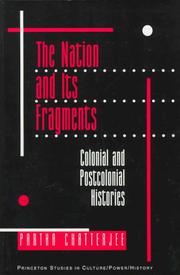
The central postcolonial objection: Anderson's modular nationalism leaves colonised peoples nothing to imagine but derivative copies. Chatterjee's answer reshaped the field and should be read against Imagined Communities.
Why it still moves people
BeginnerBring the theory to bear on the present resurgence of nationalist politics and decide what, if anything, is defensible in it.
▸ Study plan for this stage
Pace: 2-3 weeks for 224 pages. Tamir is written for a general audience and reads quickly, but the path only pays off if you read it argumentatively — with the modernists, Smith, Kedourie and Chatterjee all still in mind. Budget the extra week for going back to the passages in earlier books that Tamir is i
- Tamir's diagnosis that the post-1989 liberal order treated national attachment as a residue to be outgrown, and that the vacuum it left was filled by people offering worse versions of it
- The class argument: globalisation delivered a genuinely transnational life to a professional minority while leaving the majority dependent on the nation for security, welfare and status
- Liberal nationalism as a serious position rather than an oxymoron — the claim that redistribution and democratic solidarity have historically required a bounded community that owes each other something
- The distinction Tamir presses between nationalism as a source of solidarity and nationalism as a source of exclusion, and how much weight that distinction can actually bear
- The author's own position as a philosopher and a former Israeli education minister, which makes the book a document as well as an argument
- The move from explaining nationalism to evaluating it, which every previous book on this path avoided, and why the avoidance was itself a choice
- How Tamir's account sits against Kedourie's — the same phenomenon, one calling it a philosophical disaster and the other an unmet human need
- Tamir argues that liberals abandoned the nation and paid for it. Is the causal story right, or is nationalist resurgence better explained by factors she underweights?
- Can a liberal nationalism keep the solidarity without the exclusion, or is the boundary that produces the first necessarily the one that produces the second?
- Set Tamir beside Kedourie. They agree on almost nothing about what nationalism is for. Which of them has the better account of the twentieth century, and does that settle the twenty-first?
- Does the modernist finding that nations are recent constructions weaken Tamir's case at all, or is it simply irrelevant to a normative argument?
- Tamir writes from a specific national position with an unusually contested politics. How should that inform your reading — as bias to discount, or as evidence from someone who has had to act on the question?
- Write the strongest 300-word case against Tamir using only material from earlier books on this path, citing which author each objection comes from.
- Then write the strongest 300-word case for her, doing the same. If the second is harder to write, that is worth noticing.
- Draw up a two-column ledger for the whole path: on one side what nationalism has been shown to supply that nothing else has, on the other what it has cost. Fill both from the books, not from the news.
- Return to Anderson's definition from stage one and rewrite it in light of everything since. Note which of the four terms you now want to qualify.
- Pick one contemporary nationalist movement and write a page analysing it using one tool from each stage: Anderson or Gellner on origins, Billig on the everyday, Smith on inherited material, Brubaker on the triad, Tamir on the need being met.
Next up: You close with the field's own unresolved argument intact — which is the honest end point, since nobody in it has settled whether nationalism is a solvable problem or a permanent condition.

A liberal political theorist and former Israeli minister argues that nationalism answers real needs the liberal order abandoned. The right closing book: it refuses both the celebratory and the dismissive readings you have met so far.
Discussion
Keep reading
Paths that share books, cover the same subject, or open a related topic.


