Best Books to Learn Mathematical Biology, in Order
Mathematical biology is applied dynamical systems: ordinary and partial differential equations, difference equations and stochastic processes, pointed at populations, epidemics, physiology and pattern formation. The prerequisite that actually binds is comfort with differential equations and linear algebra — phase-plane analysis, eigenvalues and stability — not biology, which the books teach as they go. This path starts by supplying that mathematics in a form written for biologists, works through the two standard first courses, then specialises into ecology, epidemiology and evolution, and ends at the reference shelf. Note that two of the field's standard works are multi-volume sets whose volumes are catalogued unevenly; the entries below say which volume is which.
Getting the mathematics you will need
IntermediateAcquire the working dynamical-systems toolkit — equilibria, linear stability analysis, phase planes, bifurcations — and the modelling habits of mind, before meeting a biological application that assumes them.
▸ Study plan for this stage
Pace: Twelve to sixteen weeks, about 1,280 pages, and none of it is skimmable. Otto and Day's A biologist's guide to mathematical modeling in ecology and evolution is 748 pages written explicitly for biologists who need the mathematics rather than mathematicians who need the biology — it builds recursion
- Equilibria of discrete-time and continuous-time systems, and why the stability criteria differ between them
- Linear stability analysis: the Jacobian, eigenvalues, and reading stability off the trace and determinant
- Phase-plane analysis in two dimensions — nullclines, trajectories, and classifying fixed points
- Bifurcations: saddle-node, transcritical, pitchfork and Hopf, and what each looks like in a biological model
- The logistic map and the route to chaos, which is the standard demonstration that simple models are not simple
- Non-dimensionalisation, and why reducing the parameter count is the first move in every model on this path
- The modelling loop itself — assumption, formulation, analysis, and checking the result against the biology
- Given a two-dimensional system, can you find its fixed points, compute the Jacobian and classify each one without notes?
- What is the condition for stability in a discrete-time model, and why is it different from the continuous-time condition?
- What is a Hopf bifurcation, and what biological behaviour does it produce?
- Why non-dimensionalise, and what do you lose by doing it?
- At what value of r does the logistic map first period-double, and where does chaos begin?
- Work Strogatz's exercises for the one-dimensional flows and bifurcation chapters in full, then the two-dimensional phase-plane chapters. This is the specific material every later book assumes and does not re-teach.
- Take the logistic map x_{n+1} = r x_n (1 - x_n), find its fixed points, linearise, and show the non-trivial fixed point loses stability at r = 3. Then iterate numerically and locate the next two period-doublings.
- Work through Otto and Day's derivation of a recursion equation for allele frequency and then their continuous-time analogue, and confirm you can move between the two formulations.
- Non-dimensionalise the two-species Lotka-Volterra competition model by hand and count how many independent parameters remain.
- Draw the phase plane for that non-dimensionalised competition model in each of its four qualitative cases, by hand, before you meet it again in stage 2.
Next up: With stability analysis, phase planes and bifurcations under control, the standard introductory courses become applications rather than obstacles.
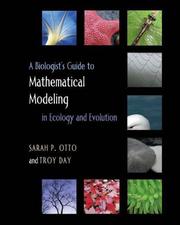
Otto and Day wrote this for biologists who need the mathematics rather than mathematicians who need the biology, and it is the gentlest genuine entry to the field. Start here: it builds recursion equations, differential equations and stability analysis from scratch with biological examples throughout, and its appendices double as a refresher on the calculus and linear algebra everything later assumes.

Not a biology book, but the standard source for the dynamical-systems machinery the rest of this path runs on, and unusually readable. Read the first two-thirds alongside Otto and Day. A separate solutions manual exists; you want the textbook.
The first course
IntermediateWork through a complete introductory treatment: population growth, interacting species, biochemical kinetics, excitable systems and the basic epidemic models, at the level of a first university course.
▸ Study plan for this stage
Pace: Sixteen to twenty weeks, about 1,333 pages. Allman and Rhodes's Mathematical models in biology is 377 pages, the most accessible of the standard courses, strongest on discrete-time models, matrix population models and molecular-evolution applications, and it assumes only calculus — read it first. Ed
- Single-species growth: exponential, logistic, and discrete models with their qualitatively different behaviour
- Matrix population models — Leslie matrices, the dominant eigenvalue as asymptotic growth rate, and stable age distribution
- Interacting species: predator-prey, competition, and the structural instability of the classical Lotka-Volterra system
- Michaelis-Menten enzyme kinetics and the quasi-steady-state approximation that produces it
- Excitable systems and the FitzHugh-Nagumo reduction of Hodgkin-Huxley
- The basic SIR model, the threshold theorem and R0, introduced here and developed properly in stage 4
- Reaction-diffusion equations and the first sight of spatial pattern, which stage 5 takes seriously
- Given a Leslie matrix, can you compute the asymptotic growth rate and the stable age distribution, and say what each means biologically?
- Why is the classical Lotka-Volterra predator-prey system structurally unstable, and what modification fixes it?
- Can you derive the Michaelis-Menten rate law from the mass-action scheme, stating the approximation you use?
- What is the threshold theorem for the SIR model, and what does it predict about an outbreak with R0 slightly above 1?
- Where do Allman and Rhodes and Edelstein-Keshet cover the same material differently, and which treatment did you find more useful?
- Build a three-stage Leslie matrix from Allman and Rhodes's data, compute its dominant eigenvalue and eigenvector by hand, then project the population forward twenty steps numerically and confirm it converges to the stable age distribution.
- Derive the Michaelis-Menten rate law from first principles, stating explicitly where the quasi-steady-state assumption enters and what would break if it failed.
- Analyse the predator-prey system with logistic prey growth from Edelstein-Keshet: find the fixed points, compute the Jacobian, and locate the Hopf bifurcation in parameter space.
- Work Britton's exercises on the SIR model and derive R0 = beta N / (gamma + mu) for yourself from the equations.
- Take one worked example from Edelstein-Keshet's chapter on molecular events and reproduce every step of the calculation using her own parameter values, checking that you recover her numbers.
Next up: One complete introductory course means the specialised literatures — ecology, epidemiology, evolution — become choices about where to go deep rather than gaps to fill.

Allman and Rhodes is the most accessible of the standard courses, strongest on discrete-time models, matrix population models and molecular-evolution applications, and it assumes only calculus. Read it before Edelstein-Keshet. Caution: it is catalogued under the same display title as the Edelstein-Keshet book below, so check the author when buying.
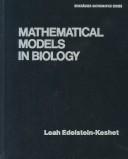
The classic course text, now a SIAM reprint, and still the best single treatment of continuous-time models — Lotka-Volterra, chemostats, molecular events, spatially distributed systems. Denser than Allman and Rhodes and worth the step up. A different book from the entry above despite the identical catalogue title.

A compact Springer undergraduate course covering single-species and interacting populations, infectious disease, biological motion and pattern formation. Placed third as the consolidating read: it is the shortest route to seeing the whole field's shape before specialising.
Population and community ecology
BeginnerSpecialise into theoretical ecology — structured populations, competition and predation theory, spatial and stochastic effects — at the level a research paper assumes.
▸ Study plan for this stage
Pace: Twelve to fourteen weeks, about 928 pages. Mark Kot's Elements of Mathematical Ecology is 464 pages and is the standard graduate text for the ecological half of the field — unstructured and structured population models, delay equations, spatial spread and harvesting theory; it assumes the stability
- Structured population models: age, stage and size structure, and the McKendrick-von Foerster formulation
- Delay differential equations and delay-induced oscillation, which is where much ecological cycling comes from
- Spatial spread and travelling waves — the Fisher-KPP equation and the classical invasion-speed result
- Competition theory, the competitive exclusion principle, and coexistence conditions
- Functional responses (Holling types) and the paradox of enrichment
- Harvesting theory, maximum sustainable yield, and why the optimum is often unstable
- Demographic and environmental stochasticity, and why small populations behave differently from the deterministic prediction
- What are the coexistence conditions for two competing species, in terms of the model's parameters, and what do they mean ecologically?
- How does a delay destabilise an otherwise stable equilibrium, and what determines the critical delay?
- What is the invasion speed predicted by the Fisher-KPP equation, and what does it depend on?
- What is the paradox of enrichment, and is it an artefact of the model or a real prediction?
- Where does Case say a model is claiming something about real communities that Kot's mathematics does not commit to?
- Analyse the two-species competition model completely: find all fixed points, classify each, and draw the four phase portraits. Then check your portraits against Case's figures.
- Derive the invasion speed for the Fisher-KPP equation from the travelling-wave ansatz, and confirm the minimum speed is 2 times the square root of rD.
- Take a delayed logistic equation, find the critical delay at which the equilibrium loses stability, and verify it by numerical simulation.
- Work Kot's harvesting chapter problems and compute the maximum sustainable yield for the logistic model, then examine the stability of the harvested equilibrium at that yield.
- Pick one model Case illustrates with real data and reproduce the fit with the book's own numbers, noting how much of the agreement is the model and how much is parameter choice.
Next up: The ecological toolkit transfers almost intact to epidemiology, where the same equations describe a pathogen moving through a host population.
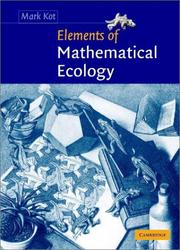
The standard graduate text for the ecological half of the field: unstructured and structured population models, delay equations, spatial spread, harvesting theory. Read after Britton; it assumes the stability analysis of stage 2 and pushes it hard.
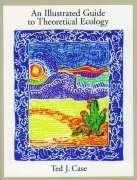
The conceptual complement to Kot — heavily figured, more biological in emphasis, and much better at explaining what the models are claiming about real communities. Read alongside rather than after.
Epidemics
BeginnerModel infectious disease properly: SIR and its variants, the basic reproduction number, heterogeneity, vaccination thresholds, and the stochastic and network extensions.
▸ Study plan for this stage
Pace: Twelve to fourteen weeks, about 1,174 pages. Anderson and May's Infectious Diseases of Humans is 766 pages, founded modern mathematical epidemiology in 1991, and is still the reference for the biology-plus-model reasoning behind R0, age structure and vaccination thresholds — read it first for the co
- R0 as a threshold quantity, its several equivalent definitions, and how it is estimated from data
- SIR, SIS, SEIR and carrier models, and which biological facts select between them
- The critical vaccination fraction 1 - 1/R0, and where herd-immunity reasoning holds and fails
- Age structure and the WAIFW matrix — heterogeneous contact rates as the main correction to homogeneous mixing
- Endemic equilibrium, epidemic cycles and the role of seasonal forcing in measles dynamics
- Stochastic epidemic models, critical community size and fadeout in small populations
- Network and metapopulation models, and how the contact structure changes the threshold
- Can you derive R0 for the SEIR model from the next-generation matrix, and say why the SIR answer is a special case?
- What is the critical vaccination fraction for a disease with R0 = 12, and what assumptions does that number rest on?
- Why do measles epidemics cycle, and what does seasonal forcing add that the autonomous model cannot produce?
- What is critical community size, and why does a stochastic model predict fadeout where a deterministic one does not?
- Where does Keeling and Rohani's treatment change a conclusion of Anderson and May's rather than merely modernising the presentation?
- Derive R0 for the SEIR model with demography using the next-generation matrix method, then reproduce Anderson and May's estimate for measles using their own parameter values and check you get their number.
- Code the deterministic SIR model and reproduce the classic epidemic curve; then vary R0 across the threshold and confirm the threshold theorem numerically.
- Implement a stochastic SIR using the Gillespie algorithm following Keeling and Rohani, run it a hundred times at a small population size, and measure the fadeout frequency.
- Build a two-patch metapopulation model, vary the coupling, and find the coupling strength at which the patches synchronise.
- Take one disease's age-stratified contact data from Anderson and May, construct the WAIFW matrix, and compute R0 from it; compare with the homogeneous-mixing estimate.
Next up: Populations and pathogens covered, the last stage reaches the two remaining research literatures — evolutionary dynamics and spatial pattern — and the reference works the field cites constantly.

Anderson and May's 1991 book founded modern mathematical epidemiology and is still the reference for the biology-plus-model reasoning behind R0, age structure and vaccination thresholds. Read first in this stage for the conceptual grounding.

Keeling and Rohani is the modern course text and the one to work with computationally — stochastic models, metapopulations, networks, and model code discussed throughout. Read second; it updates Anderson and May rather than replacing it.
Evolution, pattern, and the reference shelf
BeginnerReach the research literature: evolutionary game dynamics, reaction-diffusion and Turing patterns, and the two multi-volume references the field cites constantly.
▸ Study plan for this stage
Pace: Six months or more, and this stage is not a reading list to finish. Nowak's Evolutionary Dynamics is 384 pages and is the clearest entry to evolutionary game theory — read it first, because it explains what the mathematics is for. Hofbauer and Sigmund's Evolutionary games and population dynamics is
- The replicator equation, its relation to the Lotka-Volterra system, and evolutionarily stable strategies
- Finite-population evolutionary dynamics, the Moran process, and fixation probability
- The five mechanisms for the evolution of cooperation as Nowak organises them
- Permanence and persistence as the rigorous alternatives to stability in Hofbauer and Sigmund
- Reaction-diffusion systems and the Turing instability — the conditions under which diffusion destabilises a stable equilibrium
- Pattern selection, domain size and scale, and Murray's animal-coat-marking application
- Excitable media and cardiac dynamics, and the Hodgkin-Huxley and calcium models in Keener and Sneyd
- How to use a multi-volume reference: locate the model, check the assumptions, take the derivation
- Can you state and derive the conditions for a Turing instability in a two-species reaction-diffusion system?
- What is the relationship between the replicator equation on n strategies and the Lotka-Volterra system on n-1 species?
- What is the fixation probability of a single mutant in a Moran process, and how does selection strength enter?
- Which of Nowak's five mechanisms for cooperation is best supported mathematically, and which is weakest?
- Where does Murray volume II's pattern formation depend on the domain geometry rather than on the kinetics?
- Derive the four Turing conditions for a general two-component reaction-diffusion system from Murray volume II, then apply them to a specific activator-inhibitor kinetics and find the unstable wavenumber band.
- Simulate that same system on a one-dimensional domain, vary the domain length, and reproduce the mode-selection behaviour Murray describes.
- Work out the replicator dynamics for the Hawk-Dove game by hand, find the ESS, and then compute the same equilibrium in the finite-population Moran process from Nowak and compare.
- Prove one permanence result from Hofbauer and Sigmund in full, writing out the average Lyapunov function argument.
- Take the Hodgkin-Huxley system from Keener and Sneyd, reduce it to the two-variable FitzHugh-Nagumo form, and confirm the reduction reproduces the excitability threshold.
- Pick a recent mathematical biology paper in an area you care about and locate every model it uses in one of these four references, noting which assumptions the paper inherits without restating.
Next up: This closes the path: with the dynamical systems, two introductory courses, ecology, epidemiology, evolutionary dynamics and the reference volumes, the research literature is readable and its models are checkable rather than merely citable.
The clearest entry to evolutionary game theory, replicator dynamics, finite-population effects and the evolution of cooperation. Read it before Hofbauer and Sigmund — Nowak explains what the mathematics is for.
Hofbauer and Sigmund is the rigorous treatment Nowak's book gestures at: replicator and Lotka-Volterra equations proved properly, with the permanence results. The mathematical end of evolutionary dynamics.

Murray's two-volume treatise is the field's standard reference. This record is the first volume, Mathematical Biology I: An Introduction — single-species and interacting populations, enzyme kinetics, reaction kinetics, biological oscillators. Ask for the bare title, since the volume-numbered form resolves to the same record. Use it as a reference rather than reading straight through.

The second volume, Spatial Models and Biomedical Applications, and the reason people cite Murray at all: reaction-diffusion equations, Turing pattern formation, animal coat markings, wound healing and tumour growth. It is a genuinely separate book from the volume above and needs the PDE material stage 2 only touched.

Keener and Sneyd's two-volume work is the other standard multi-volume reference, covering cellular physiology in volume I and systems physiology in volume II — Hodgkin-Huxley, calcium dynamics, cardiac and respiratory models. Open Library carries the set under one record, so expect the single entry to stand for both volumes. Closes the path as the deepest applied treatment on this list.
Discussion
Keep reading
Paths that share books, cover the same subject, or open a related topic.