Best Books on Lasers and Laser Physics, in Order
This path moves from the human story of how stimulated emission was turned into a machine, through the optics you need before laser theory makes sense, into the standard graduate texts on gain media, resonators and pulsed operation. The early stages are readable in an armchair; the later ones assume calculus, electromagnetism and quantum mechanics, and are the books working laser physicists actually keep on the shelf.
How the laser happened
BeginnerUnderstand what a laser is, why coherent light is different from ordinary light, and how a 1950s piece of microwave physics became the most versatile instrument in the lab.
▸ Study plan for this stage
Pace: About 4 weeks, and one of these four books is not like the others. Jeff Hecht's Understanding Lasers is a technical primer: it carries real physics at algebra level and is the only book in this stage that teaches you how a laser works. Townes's How the Laser Happened (204 pages), Hecht's Beam (286)
- Stimulated versus spontaneous emission, and the Einstein A and B coefficients at a qualitative level
- Population inversion, and the proof that a two-level system pumped optically can never reach it
- Three-level and four-level schemes, and why four-level media lase far more easily
- The optical resonator: feedback, longitudinal modes, and what the cavity contributes that gain alone cannot
- Coherence, both temporal and spatial, and its distinction from monochromaticity and directionality
- The maser as the microwave predecessor and the conceptual step to optical frequencies
- Maiman's ruby laser of 1960, and why the field's consensus said ruby would not work
- Why is population inversion impossible in a two-level system driven by light, and what does the fourth level buy you?
- What does the resonator add to a gain medium, and what happens if you remove one mirror?
- What is the difference between coherence length, linewidth and monochromaticity, and how are they related?
- Both Townes and Gould had the essential idea; why did the patent fight last thirty years, and what does Taylor say that decided it?
- What did Schawlow and Townes get wrong in their 1958 paper, and what did Maiman see that they did not?
- Draw the ruby three-level scheme with the actual energies and pump wavelength, and account for where each pump photon's energy goes
- Read Maiman's one-page 1960 Nature paper, Stimulated Optical Radiation in Ruby, alongside Hecht's chapter on it in Beam, and list what the paper does not tell you that the history does
- Read Schawlow and Townes, Infrared and Optical Masers (Physical Review, 1958), and write down every prediction in it that later practice contradicted
- Build a timeline reconciling Townes's memoir with Taylor's account of Gould, and mark every point where the two sources conflict about who knew what and when
Next up: You know what a laser is and where it came from; before any laser textbook makes sense you need the wave optics it assumes without teaching.
The clearest non-mathematical explanation of gain media, population inversion and resonators, and the best single orientation before any equations appear. Start here so the later textbooks have something to attach to.
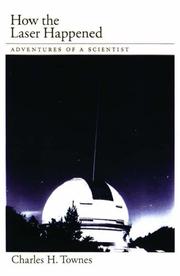
The maser and laser explained by the man who invented the first one, with the physical reasoning laid out as it actually occurred to him. Read it second, once you know what a laser does, so the discovery narrative lands as physics rather than anecdote.
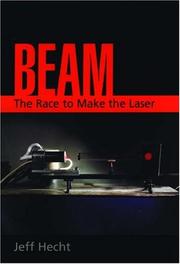
The race to build the first working laser, told from the outside — Maiman, Townes, Schawlow, Gould and the labs behind them. It supplies the competitive context Townes's own memoir necessarily downplays.

Catalogued under the bare title, this is Taylor's account of Gordon Gould's thirty-year patent war over the laser. Read last in this stage: it shows how a piece of physics becomes property, which is the part of the story no textbook covers.
The optics you need first
IntermediateAcquire the wave optics, Gaussian beam and interference vocabulary that every laser textbook assumes from page one.
▸ Study plan for this stage
Pace: Four to six months, and this is where the path stops being armchair reading. Eugene Hecht's Optics is a full undergraduate course of 676 pages assuming calculus and complex exponential notation: rather than reading it cover to cover, work the chapters on superposition, interference, diffraction, pol
- The Gaussian beam: waist, Rayleigh range, far-field divergence, and the beam quality factor
- ABCD ray matrices, and the complex beam parameter that lets you propagate a Gaussian through any optical system
- Resonator stability and the g-parameter criterion
- Longitudinal modes, free spectral range, and transverse mode patterns
- Rate equations for three- and four-level systems, and the threshold condition that gain equals round-trip loss
- Gain clamping above threshold, and saturation intensity
- Homogeneous versus inhomogeneous line broadening, and the different hole-burning behaviour of each
- The Einstein coefficients used quantitatively to relate absorption, emission and the gain cross section
- Derive the threshold condition for a laser oscillator and explain physically why the inversion clamps once threshold is exceeded
- Compute the far-field divergence of a beam with a one-millimetre waist at 633 nanometres, and explain why a smaller waist diverges faster
- What distinguishes homogeneous from inhomogeneous broadening, and how does each show up in the output spectrum?
- Why is stability of a two-mirror resonator determined by the product of the two g parameters lying between zero and one?
- For a laser with a given cavity length and gain bandwidth, how many longitudinal modes can oscillate?
- Work Svelto's rate-equation problems for a four-level laser and derive output power as a function of pump power, then identify the slope efficiency
- Propagate a Gaussian beam through a single lens using the ABCD law and the complex beam parameter, and check your answer against Hecht's closed-form imaging relations
- Compute the free spectral range of a 30-centimetre helium-neon cavity and, given a 1.5 GHz Doppler width, count how many longitudinal modes oscillate
- Plot the stability diagram for a plano-concave cavity and find the range of cavity lengths that give stable operation for a given mirror curvature
- Derive the relation between the Einstein A coefficient and the stimulated emission cross section, and use it to estimate the gain of a real medium from published spectroscopic data
Next up: With gain, threshold and resonator modes in hand you can leave the idealised laser behind and meet the engineered devices that people actually build.
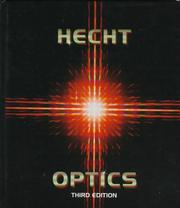
The standard undergraduate optics course, and the prerequisite the laser texts silently assume — interference, diffraction, polarization and Gaussian beams. Work the beam and resonator chapters before opening Silfvast.
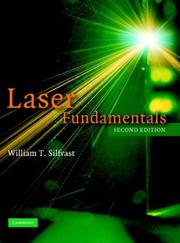
The gentlest genuine textbook treatment: it derives gain, saturation and threshold from scratch and only then discusses cavities. Positioned here because it is the bridge between an optics course and a laser course.

The most widely assigned first laser textbook, strongest on rate equations, pumping and the practical taxonomy of laser types. Read it alongside Silfvast for a second derivation of the same results.
Devices, cavities and photonics
IntermediateMove from idealized gain media to real devices: cavity design, mode selection, semiconductor and gas lasers, modulators and detectors.
▸ Study plan for this stage
Pace: Five to six months, and none of these three should be read straight through. Verdeyen's Laser Electronics (704 pages) is the closest to a course book and assumes electromagnetism and circuit theory as well as the previous stage. Saleh and Teich's Fundamentals of Photonics is 1,071 pages and is a two
- Q-switching, active and passive, and how storing then dumping the inversion produces a giant pulse
- Mode-locking, the phase relation between longitudinal modes, and the time-bandwidth limit on pulse duration
- Semiconductor diode lasers: heterostructures, threshold current, and the astigmatic, highly divergent output
- Guided modes in fibres and waveguides, numerical aperture, and single- versus multi-mode operation
- Electro-optic and acousto-optic modulation as the switching mechanisms behind Q-switching and cavity dumping
- Thermal lensing, stress birefringence and optical damage thresholds as the real limits on average power
- Amplifier chains, energy extraction efficiency, and amplified spontaneous emission as the gain ceiling
- How does Q-switching produce a peak power orders of magnitude above the continuous-wave output of the same laser?
- What sets the shortest pulse a mode-locked laser can emit, and what physical property of the gain medium is the limit?
- Why does a diode laser have such a large and asymmetric divergence, and how is it corrected in practice?
- What causes thermal lensing in a solid-state rod, and what design choices in Koechner mitigate it?
- Why does amplified spontaneous emission limit the achievable gain in a single amplifier stage?
- Compute the stored energy, output energy and peak power of a Q-switched Nd:YAG rod using Koechner's stored-energy and extraction relations, then compare to a commercial datasheet
- Estimate the minimum achievable pulse duration from the gain bandwidth of titanium-doped sapphire, and compare it against the specification of a real femtosecond oscillator
- Design a stable resonator on paper for a diode-pumped Nd:YAG laser at a specified pump power, including the thermal lens focal length from Koechner's tables, and verify stability with the g-parameter criterion
- Work Verdeyen's problems on mode competition and gain saturation, and explain why a homogeneously broadened laser tends toward single-mode operation
Next up: You can now specify and build a laser; the last stage is the physics that explains why the design rules you have been using are true.

Treats the laser as an engineered oscillator — feedback, mode competition, Q-switching and mode-locking — which is the framing an experimentalist needs and the pure-physics texts skip.
The reference that situates lasers inside the wider photonics stack: waveguides, fibres, detectors, electro-optics and semiconductor sources. Read after Verdeyen, when you want to build a system rather than a single laser.

The engineering bible for solid-state systems — pump geometries, thermal lensing, damage thresholds, amplifier chains. It is where the design constraints that textbooks idealize away finally appear.
The graduate spine
BeginnerWork through the definitive treatments of resonator theory, laser dynamics, the quantum description of the field, and what happens when the intensity is high enough to make matter respond nonlinearly.
▸ Study plan for this stage
Pace: A year or more, and every book here has real prerequisites. Siegman's Lasers is 1,283 pages and is a reference: work the chapters on resonator theory, the ABCD law and unstable cavities rather than attempting the whole. Milonni and Eberly's Laser Physics assumes quantum mechanics through time-depend
- The complex q parameter and the ABCD law applied to periodic resonators
- Unstable resonators: magnification, geometric output coupling, and why they suit high-gain large-mode lasers
- Semiclassical laser theory, the density matrix and the optical Bloch equations
- Spontaneous emission as vacuum fluctuation, and the Schawlow-Townes limit on laser linewidth
- Second- and third-order nonlinear susceptibility, and phase matching by birefringence or quasi-phase-matching
- Second harmonic generation, optical parametric amplification, self-focusing and self-phase modulation
- Group velocity dispersion, higher-order dispersion, and compression with prisms, gratings or chirped mirrors
- Carrier-envelope phase and the frequency comb as the link between optical and radio frequency standards
- Why is an unstable resonator preferable for a high-gain laser with a large mode volume, despite the diffractive output coupling?
- Derive the scaling of the Schawlow-Townes linewidth and explain which physical effect sets the floor
- What is phase matching, why does second harmonic generation fail without it, and what does quasi-phase-matching change?
- How does Kerr-lens mode-locking start from noise, and why does it favour the pulsed over the continuous solution?
- What is the time-bandwidth product for a sech-squared pulse, and what does exceeding it tell you about your pulse?
- Propagate a Gaussian beam through one period of a resonator using the ABCD law and reproduce Siegman's stability condition as a self-consistency requirement on the q parameter
- Solve the optical Bloch equations on resonance from Milonni and Eberly and confirm the Rabi frequency and the damping behaviour as the relaxation terms are switched on
- Compute the phase-matching angle for second harmonic generation of 1064 nanometres in beta barium borate using published Sellmeier coefficients, and check your angle against a crystal manufacturer's specification
- Calculate the dispersive broadening of a 20-femtosecond pulse through 5 millimetres of fused silica, then design a prism-pair compressor using Diels and Rudolph's relations to undo it
- Read one of the frequency-comb Nobel lectures (Hall or Haensch) and identify which concepts from Diels and Rudolph and from Boyd the comb depends on
Next up: This is the end of the path: with Siegman, Boyd and Diels and Rudolph on the shelf you are equipped to read the current literature on ultrafast sources, high-power amplifiers and precision metrology without an intermediary.

The standard graduate reference, unmatched on resonator modes, ABCD propagation and unstable cavities. Attempt it only after Svelto or Silfvast — it is comprehensive rather than pedagogical.

Milonni and Eberly supply the quantum-optical account Siegman deliberately keeps classical: spontaneous emission, coherence, noise and the semiclassical-to-quantized transition. The natural companion volume.
Once you have intense coherent light, the next question is what it does to matter. Boyd is the canonical text on harmonic generation, parametric amplification and self-focusing, and it presupposes everything above.
The specialist endpoint of the path: mode-locking, dispersion management and femtosecond measurement, the regime behind frequency combs and attosecond science. Read last, since it assumes both Siegman's cavity theory and Boyd's nonlinear optics.
Discussion
Keep reading
Paths that share books, cover the same subject, or open a related topic.