A laser is a simple idea with a punishing amount of physics behind it, and the books divide sharply into those that keep the physics out and those that assume you arrived with electromagnetism and quantum mechanics already in hand. There is also a trap unique to this subject: two of the best books here are by different men named Hecht, and they are not remotely the same kind of book.
The other reason order matters is that laser textbooks assume optics. Gaussian beams, cavity modes and coherence are not things you absorb alongside stimulated emission; they come first, or everything after reads as notation.
Understand what a laser is
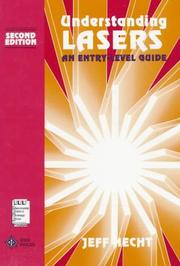
Start with Understanding lasers by Jeff Hecht. It is a technical introduction written for people who need to work with lasers rather than derive them, covering types, safety and applications with arithmetic rather than calculus. It is a better entry point than the histories because it hands you the vocabulary those histories assume you already have.
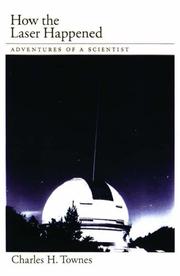
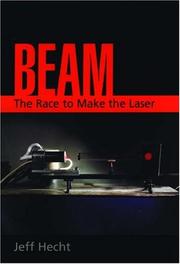
Then the invention itself, which is a genuinely good story. How the Laser Happened is the memoir of Charles Townes, who took the idea from the maser through to a Nobel and the disputes that followed. Beam by Jeff Hecht is the outside account of the 1960 race to build the first working device, and Laser by Nick Taylor covers much of the same ground with more attention to the thirty-year patent fight afterwards. Those last two overlap heavily, so pick one.
Learn optics before laser physics
Optics by Eugene Hecht is the other Hecht, and it is the standard undergraduate optics textbook: interference, diffraction, polarisation, Fourier optics. It assumes calculus and comfort with complex exponentials. Everything past this point leans on it, and skipping it is the single most common reason people bounce off laser texts.
The laser textbooks, easiest first
Laser Fundamentals by William Silfvast is the gentlest of the real laser texts and the right first one, building from atomic transitions to gain to resonators in a deliberate order. Principles of lasers by Orazio Svelto is the classic comprehensive treatment, more mathematical and broader on laser types. Laser electronics by Joseph Verdeyen approaches the same material from an electrical engineering direction, which suits some readers far better than the physics framing does.
Fundamentals of photonics by Bahaa Saleh is the wide reference for the surrounding field, from waveguides to detectors to nonlinear optics, and it is the book most likely to answer a question the laser texts leave hanging. Solid-State Laser Engineering by Walter Koechner is a practical design handbook covering thermal effects, pump geometries and real hardware, rather than a course text.
The graduate shelf
Lasers by Anthony Siegman is the monument: over a thousand pages, and still the deepest treatment of resonators, beam propagation and laser dynamics anywhere. It is a reference to live with, not a book to finish. Laser Physics by Peter Milonni comes at the subject from quantum optics and takes coherence and photon statistics seriously.
Two specialisations close the path. Nonlinear optics by Robert Boyd is the standard graduate text on what happens when the field is strong enough to change the medium it travels through, and it needs quantum mechanics. Ultrashort laser pulse phenomena by Jean-Claude Diels covers femtosecond pulse generation and measurement, the corner of the field where everything comes back to dispersion.
The full path keeps optics before laser physics and history before either, which is the order that makes the equations feel earned rather than imposed.
Follow the full ordered path here: The Best Laser Physics Books to Read First.