Best Books to Learn Knot Theory, in Order
Knot theory asks when two knotted loops in space are really the same knot, and it is unusual among research-level mathematics in having a genuinely accessible front door: you can do real work with pictures and Reidemeister moves before you meet a single group presentation. This path exploits that. It starts with books that assume almost no prerequisites, moves to a first proper course, then to the standard graduate texts, and ends with the invariants and the physics connections that made the subject explode after 1984.
No prerequisites
BeginnerBuild real intuition for knots, diagrams and invariants using nothing but pictures and careful reasoning.
▸ Study plan for this stage
Pace: 8–10 weeks for about 530 pages, but the three books have completely different demands. Colin Adams's Why Knot? (62 pages) is a short illustrated introduction packaged with a physical knot-tying manipulative and takes an evening — do the manipulations rather than reading past them. Alexei Sossinsky's
- The central problem: when are two knotted loops in space the same knot, where 'same' means ambient isotopy, and why a picture alone cannot answer it
- Knot diagrams and the three Reidemeister moves, and the fact that two diagrams represent the same knot exactly when a finite sequence of these moves connects them
- An invariant as a proof strategy — if a quantity is unchanged by all three Reidemeister moves and differs on two diagrams, the knots are genuinely different
- Tricolourability as the simplest working invariant, and the proof that it distinguishes the trefoil from the unknot
- Numerical invariants: crossing number, bridge number, unknotting number, genus, and how each is defined as a minimum over all diagrams
- Seifert surfaces and Seifert's algorithm, which turn a diagram into an orientable surface and give genus a computable handle
- The Alexander and Jones polynomials introduced via skein relations, computable by hand from a diagram before you know where either comes from
- Applications as motivation rather than decoration — DNA topology, enzyme action, and knotted polymers, all covered in Adams
- Why is 'same knot' defined by ambient isotopy rather than by picture, and what goes wrong if you allow the knot to shrink a tangle to a point?
- Prove that tricolourability is unchanged by each of the three Reidemeister moves. What does that establish about the trefoil?
- Crossing number is defined as a minimum over all diagrams. What makes such definitions hard to compute with, and how does Adams get around it?
- Run Seifert's algorithm on a diagram of the figure-eight knot. What surface do you get, and what is its genus?
- State the skein relation for the Jones polynomial and use it to compute the polynomial of the Hopf link from the unknot.
- Which of these three books could you cite in a proof, and which are narrative accounts you could not?
- Tie the knots in Why Knot? with the supplied cord and physically perform each of the three Reidemeister moves on a real loop until you can recognise them instantly in a diagram
- Work through Adams's exercises on tricolourability, then prove by hand that the trefoil is not the unknot and that the figure-eight is not tricolourable
- Apply Seifert's algorithm to at least four diagrams from Adams's tables, draw the resulting surfaces, and compute the genus of each
- Compute the Jones polynomial of the trefoil, the figure-eight and the Hopf link by hand from the skein relation, and check your answers against Adams's tables
- Take the knot table in The Knot Book and, for every knot up to seven crossings, record crossing number, tricolourability and genus in your own table; you will keep adding columns to it for the rest of the path
- Read Sossinsky's historical chapters and write a one-page timeline of who introduced which invariant and in response to what problem
Next up: Adams gives you the objects and the computations without proofs of the hard theorems; the next stage supplies the proofs and the algebra those computations were quietly standing on.

A short illustrated introduction packaged with a physical knot-tying manipulative. The lowest-barrier entry to the subject and useful even to a reader who will later take the graduate texts.
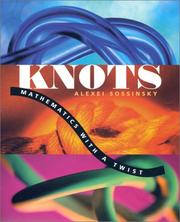
A slim popular account of the history and the main invariants, published in English as Knots: Mathematics with a Twist. Note that 'Knots' alone is a common book title; this is the Sossinsky. Read it for the story, not the technique.
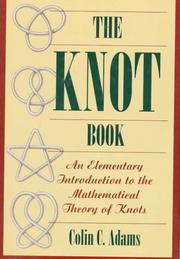
The standard elementary introduction — knot diagrams, the Reidemeister moves, crossing and bridge numbers, the Alexander and Jones polynomials, and the DNA and physics applications — with essentially no prerequisites. This is the book to work through rather than read.
A first real course
IntermediateMove to a text with proofs, where the pictures start being backed by algebra.
▸ Study plan for this stage
Pace: 3 months for about 510 pages, which is slow on purpose — this is where the reading becomes proof-driven. Charles Livingston's Knot Theory (240 pages) is a Carus Mathematical Monograph pitched at an undergraduate who has met linear algebra; it is the first book here that expects you to do the exercis
- Ambient isotopy formalised, and the difference between the topological, piecewise-linear and smooth settings — and why the PL category avoids wild knots
- The knot group as the fundamental group of the knot complement, and the Wirtinger presentation that computes it directly from a diagram
- Seifert matrices from Seifert surfaces, and the Alexander polynomial defined as a determinant rather than as a skein rule
- The signature and other invariants extracted from the Seifert matrix, which is where the linear algebra prerequisite earns its place
- Surface classification and how genus, orientability and Euler characteristic are used on Seifert surfaces
- Covering spaces of the knot complement and cyclic branched covers as the source of the classical invariants
- Connected sum of knots, prime knots, and the fact that knots factor uniquely
- Why an invariant can be complete for some purposes and blind for others — the Alexander polynomial's failure to detect the unknot's mirror relatives is instructive
- Compute the Wirtinger presentation of the trefoil's knot group from a diagram and simplify it. What group is it?
- Build the Seifert matrix of the figure-eight from your Seifert surface and compute the Alexander polynomial as a determinant. Does it agree with the skein computation from stage one?
- Why does the Alexander polynomial from a Seifert matrix not depend on which Seifert surface you chose?
- What does the signature of a knot measure, and which pairs of knots does it separate that the Alexander polynomial does not?
- State the classification of compact surfaces and explain exactly where it is used in the theory of Seifert surfaces.
- What does 'wild knot' mean, and what would break in this stage's theorems if wild knots were allowed?
- Compute Wirtinger presentations for every knot up to six crossings and add a knot-group column to your table from stage one
- Derive the Seifert matrix for at least three knots and compute the Alexander polynomial and the signature from each; verify the Alexander polynomials against Adams's tables
- Prove that the Alexander polynomial is well defined up to units, following Livingston's argument, writing out every step he leaves to the reader
- Work the Gilbert and Porter exercises on surface classification and on presentations of groups, and use them to re-derive one of Livingston's results by a different route
- Compute the Alexander polynomial of a connected sum of two knots and confirm that it is the product of the two polynomials
- Find a pair of distinct knots with the same Alexander polynomial in the tables, and determine which invariant you already have that separates them
Next up: With knot groups, Seifert matrices and surface topology in hand, you have the exact prerequisites the three standard graduate texts assume without stating.
A Carus Mathematical Monograph pitched at an undergraduate who has met linear algebra. It is the natural next step after Adams and the first book here that expects you to do the exercises.

Gilbert and Porter's introduction connecting knot theory to surface topology and combinatorial group theory. Read it second in this stage: it supplies the topological vocabulary the graduate texts assume.
The standard graduate texts
IntermediateTake on the three books a working topologist would name, each with a different emphasis.
▸ Study plan for this stage
Pace: 6 months for about 890 pages, and the three books differ sharply in what they assume. Kunio Murasugi's Knot Theory and Its Applications (341 pages) is the most self-contained and should be read first: two months, comprehensive on the classical invariants — Alexander polynomial, Seifert matrices, bra
- Braid groups, Artin's presentation, and the Alexander and Markov theorems connecting braids to links
- The Burau representation and the route from braids to the Alexander polynomial
- Kauffman's bracket polynomial and its normalisation by writhe to produce the Jones polynomial, which is Lickorish's central construction
- Skein theory proper — the skein module, the Homflypt and Kauffman two-variable polynomials, and what a skein relation is really doing
- Temperley–Lieb algebras and the representation-theoretic origin of the Jones polynomial
- Tangles, rational tangles and Conway's classification, which Cromwell develops geometrically
- Polygonal knots, stick number and the geometric side of the subject that the algebraic treatments suppress
- Applications treated seriously: DNA recombination modelled by tangle surgery, and the statistical-mechanical connections Murasugi introduces
- State Markov's theorem. Why is it exactly what is needed to turn a braid invariant into a link invariant?
- Derive the Jones polynomial from the Kauffman bracket, showing precisely where the writhe normalisation is required and why the unnormalised bracket fails.
- What does the Homflypt polynomial detect that the Jones polynomial does not, and are there pairs of knots neither separates?
- How does Lickorish's skein-theoretic development differ from Murasugi's Seifert-matrix development in what it makes easy and what it makes hard?
- Classify a rational tangle by its continued fraction following Cromwell, and explain why the classification works.
- Which of Lickorish's proofs did you have to reconstruct from Murasugi or Cromwell, and what does that tell you about the level each book is pitched at?
- Write every knot up to eight crossings as a braid closure, compute its braid word, and verify Markov equivalence on at least one pair of different words for the same knot
- Compute the Kauffman bracket of the trefoil and the figure-eight from scratch by resolving every crossing, then normalise by writhe and confirm you recover the Jones polynomials you computed in stage one
- Compute the Homflypt polynomial for three knots and add a column for it to your growing knot table
- Work through Lickorish's Temperley–Lieb chapter and construct the algebra's generators explicitly for small n, checking the defining relations by hand
- Follow Cromwell's tangle chapters and perform a tangle-surgery calculation on a rational tangle, then read Murasugi's DNA application and identify which biological operation each surgery models
- Take one theorem proved in all three books and write the three proofs side by side, noting what each author assumes the reader already knows
Next up: The classical and skein-theoretic machinery is now in place, which is the minimum needed to read the books that connect knot invariants to physics and to three-manifold topology.
Comprehensive on the classical invariants — the Alexander polynomial, Seifert matrices, braids — with the applications developed properly. The most self-contained of the three.
The Springer graduate text, terse and complete, and the standard reference for the Jones polynomial and the skein-theoretic approach. Read after Murasugi; Lickorish assumes far more.
The most geometric of the three, with real attention to knot diagrams, polygonal knots and the history. Useful as a corrective if Lickorish's abstraction has outrun your intuition.
Invariants, physics and the research frontier
IntermediateFinish with the books that connect knots to statistical mechanics, quantum field theory and three-manifolds.
▸ Study plan for this stage
Pace: 6 months or more for about 1,630 pages, and this stage is read selectively rather than cover to cover. Louis Kauffman's On Knots (480 pages) is his own development of the bracket polynomial and his combinatorial route to the Jones polynomial — the clearest primary source for the construction that re
- The bracket polynomial as a state sum, and the direct analogy between a state sum over crossing resolutions and a partition function in statistical mechanics
- Yang–Baxter equations and R-matrices as the algebraic structure common to solvable lattice models and link invariants
- Witten's construction of the Jones polynomial from Chern–Simons theory, and what a topological quantum field theory is required to satisfy
- Jones–Witten invariants and the passage from a link in a three-manifold to an invariant of the manifold itself
- Dehn surgery on links, the Lickorish–Wallace theorem, and Kirby calculus — the route by which every closed orientable three-manifold arises from a link
- Quantum invariants of three-manifolds constructed from link invariants via surgery presentations
- The difference between a physicist's derivation and a mathematician's proof, which is unavoidable in Kauffman's Knots and Physics and in Atiyah
- Where knot theory stops being a subject and becomes a tool for low-dimensional topology
- Write the bracket polynomial explicitly as a state sum. In what precise sense is it a partition function, and what plays the role of energy?
- State the Yang–Baxter equation and verify that a specific R-matrix satisfies it. How does a solution produce a link invariant?
- What does Witten's Chern–Simons construction explain about the Jones polynomial that the combinatorial definition does not?
- State the Lickorish–Wallace theorem and explain why it makes surgery on links a viable route to all three-manifolds.
- Which steps in Atiyah's lectures are rigorous and which are physics arguments awaiting a proof? Identify at least two of each.
- After the whole path: given two knot diagrams, describe your actual decision procedure for deciding whether they are the same knot, and say where it fails.
- Write out the bracket polynomial of the trefoil as an explicit state sum over all 2^n resolutions and check the total against the closed form you computed in stage three
- Verify the Yang–Baxter equation by hand for the R-matrix Kauffman uses, then trace exactly how it yields the Jones polynomial
- Take a surgery presentation of a familiar three-manifold — the Poincaré sphere or a lens space — from Prasolov and perform the Kirby moves that connect two different presentations of it
- Work through Atiyah's lectures with a text on Chern–Simons theory beside them and write a two-page summary of the argument, marking every point where a physical heuristic replaces a proof
- Compute a quantum three-manifold invariant for one simple example from a surgery presentation, following Prasolov's construction
- Close your knot table by adding columns for the Jones, Homflypt and Kauffman polynomials for every knot up to eight crossings, and identify which pairs in the table remain unseparated by everything you can now compute
Next up: This is the end of the path: from Reidemeister moves done with a piece of cord to state sums, Yang–Baxter equations and surgery on three-manifolds, with knot theory functioning as a tool for the topology and physics beyond it.
Kauffman's own development of the bracket polynomial and his combinatorial route to the Jones polynomial. The clearest primary source for the construction that reshaped the field.

The full statement of the connection between knot invariants and statistical mechanics and quantum field theory. Demanding, idiosyncratic and the reason many physicists know this subject at all.
Atiyah's short lecture series linking Jones-Witten invariants to topological quantum field theory. Under a hundred pages and dense on every one of them.

Prasolov and Sossinsky's route from knots into three-manifold topology via surgery. Read last: it is where knot theory stops being a subject and becomes a tool.
Discussion
Keep reading
Paths that share books, cover the same subject, or open a related topic.