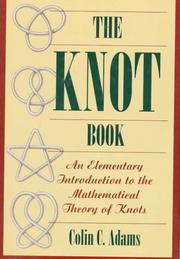
Start with Colin Adams and The Knot Book. It is the standard elementary introduction — knot diagrams, the Reidemeister moves, crossing and bridge numbers, the Alexander and Jones polynomials, plus the DNA and physics applications — and it assumes essentially no prerequisites beyond willingness to draw. It is a book to work through with a pencil rather than read.
The reason to be careful about order in this subject is that its accessible front door is unusually far from its research frontier. You can do genuine knot theory with pictures and careful reasoning, and then the graduate texts assume algebraic topology, homology and covering spaces without warning. Below, each book carries the honest prerequisite level, because the gap between step three and step four is where most self-teachers stall.
No prerequisites at all
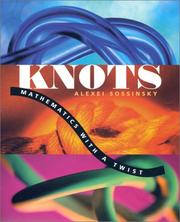
Why Knot? is Adams again, a short illustrated introduction packaged with a physical knot-tying manipulative. It is the lowest-barrier item here and is still useful to someone who will later take the graduate texts. Knots is Alexei Sossinsky's slim popular account of the history and the main invariants, published in English as Knots: Mathematics with a Twist — read it for the story rather than for technique, and note that Knots alone is a common book title, so check the author when buying. Then work The Knot Book.
A first real course
Knot theory by Charles Livingston is a Carus Mathematical Monograph pitched at an undergraduate who has met linear algebra and is comfortable with proofs. It is the natural next step after Adams and the first book here that expects you to do the exercises rather than admire them.
Knots and surfaces by N. D. Gilbert and Timothy Porter connects knot theory to surface topology and combinatorial group theory. It assumes a first course in abstract algebra — you should know what a group presentation is — and it supplies exactly the topological vocabulary the graduate texts take for granted.
The three graduate texts
Knot theory and its applications by Kunio Murasugi is the most self-contained of the three: comprehensive on the classical invariants, the Alexander polynomial, Seifert matrices and braids, with the applications developed properly. A strong undergraduate can read it.
An introduction to knot theory by W. B. Raymond Lickorish is the Springer graduate text — terse, complete, and the standard reference for the Jones polynomial and the skein-theoretic approach. It assumes algebraic topology at graduate level and moves fast. Read it after Murasugi.
Knots and Links by Peter R. Cromwell is the most geometric of the three, with real attention to knot diagrams, polygonal knots and the history of the subject. It is the corrective to reach for if Lickorish's abstraction has outrun your intuition; the prerequisites sit between Livingston and Lickorish.
Invariants, physics and the frontier
On knots is Louis H. Kauffman's own development of the bracket polynomial and his combinatorial route to the Jones polynomial — the clearest primary source for the construction that reshaped the field after 1984. Knots and Physics is the full statement of the link between knot invariants, statistical mechanics and quantum field theory; it is long, idiosyncratic, and assumes physics background rather than supplying it.
The geometry and physics of knots is Michael Atiyah's lecture series connecting Jones-Witten invariants to topological quantum field theory. It is under eighty pages and dense on every one of them; it presumes gauge theory. Knots, links, braids and 3-manifolds by V. V. Prasolov and Sossinsky takes the route from knots into three-manifold topology via surgery, and is where the subject stops being a topic and becomes a tool. Read it last.
For a comparable ordered climb through another algebraic subject, see Galois theory.
Follow the full ordered path here: The Best Knot Theory Books to Read First.