Hellboy Reading Order: Where to Start
Hellboy looks intimidating because it has been running since 1993 across several parallel series, but the actual reading order is simple: read the collected Hellboy volumes in numbered order and ignore everything else until you have finished them. The spin-offs, chiefly B.P.R.D., branch off partway through and can be started later without confusion. This path takes you through the core run in order, then opens the door to the wider Mignolaverse.
Start here
BeginnerRead the two volumes that establish the character, the Bureau and the occult-Nazi backstory the whole run turns on.
▸ Study plan for this stage
Pace: One week, or two long evenings. Each collected volume is 130–150 pages of comics and reads in about ninety minutes — but read them slower than that. Mignola's storytelling lives in panel transitions and in pages where nothing is said, and a reader who skims dialogue balloons will finish volume one c
- The reading order for Hellboy is genuinely simple: read the collected volumes in numbered order and ignore every spin-off until the core run is finished
- Volume one is the origin — Hellboy's arrival, Rasputin, the occult-Nazi backstory and the Bureau — and it is scripted with John Byrne, which makes it markedly wordier than everything after it
- Volume two is the first Mignola writes alone, and the difference is the whole point of reading them adjacently: less exposition, more folklore, far more silence
- Mignola's page design is the storytelling — heavy blacks, flat shapes, figures placed rather than posed — and it carries information that the script deliberately does not
- The series draws on real folk material (Baba Yaga, European folk tales, pulp occultism) rather than inventing a mythology from scratch, which is why individual stories feel older than the comic
- Our catalogue's records for the first two volumes are Spanish-language editions of the collected Hellboy — check the edition before you buy if you want the English collection; that is a limitation of our catalogue, not of the series
- The tone is horror-adjacent rather than horror: monsters, Nazis and grim endings, but with a deadpan lead who is closer to a working man than a superhero
- Comics reading pace is a learned skill; if this is your first trade paperback, expect the first thirty pages to feel too fast and the rest to slow down as you start reading the art
- What does volume one explain about Hellboy's origin, and how much of it does the series later treat as unreliable?
- Read volume one and volume two back to back: what specifically changes once Mignola is writing alone as well as drawing?
- How much of the plot in volume two reaches you through art rather than dialogue? Find a page that carries a story beat with no words.
- What role do the Nazis and Rasputin play — villains, or a framing device for something older?
- Why does the Bureau matter to the series structurally, given that Hellboy spends much of the run working away from it?
- Reread one action sequence from volume two looking only at panel shapes and black areas. Mignola composes in silhouette, and this is the fastest way to see it.
- Note every folk tale or historical figure you recognise. Look one up. The series rewards the reader who checks, because the sources are real.
- Write a one-line summary of each story in volume two. Several are self-contained, and noticing that prepares you for volume three, which is all short stories.
- Confirm which edition and which numbered volume you are holding before you buy the next one — Hellboy has been collected and re-collected under several schemes, and mixing them is the main way readers lose the thread.
Next up: You now know the two registers — Byrne's exposition and Mignola's silence — which is exactly what you need for a volume built entirely from short stories.

The first collected volume and the only correct starting point — it is where Hellboy's origin, Rasputin and the Bureau are all set up. Scripted with John Byrne, which makes it wordier than what follows.

The first volume Mignola writes alone, and the moment the series finds its real voice: less exposition, more folklore and silence. Read it straight after volume one.
The short stories that build the myth
BeginnerLearn that Hellboy's mythology is assembled from folk tales rather than plot arcs, and read the two collections that do most of that work.
▸ Study plan for this stage
Pace: Two or three evenings for around 170 pages. This is a collection of short stories, not a single arc, so it can be read a story at a time over a week without losing anything — and it is the only volume in the path where that works. Do not treat it as a break from the main sequence.
- Volume three is short stories rather than a continuous plot, and readers routinely mistake it for filler and skip it — it contains some of the most important pieces of Hellboy's origin
- The short-story form is how Mignola builds mythology: a folk tale told once, dropped, and then load-bearing four volumes later
- Individual stories here work as standalone horror pieces, which makes this the single best volume to hand to someone who wants to sample the series
- The comic is not building toward a shared universe in the Marvel sense — the accumulation is atmospheric, and the connections are made by the reader as much as by the plot
- Mignola's economy peaks in short form: several of these stories run under twenty pages and still land a full arc
- The Arthurian and Eastern European folk threads that dominate the later run are seeded in this kind of material rather than announced
- Reading pace matters more here than anywhere: a short story read in four minutes reads as slight, and the same story read in ten does not
- Which of these short stories turns out to carry origin information, and how would you have known while reading it?
- What does the short-story form let Mignola do with folklore that a continuous plot would not?
- Pick the story you found slightest and reread it. Does it hold anything you missed?
- How does Hellboy behave differently in a twenty-page story than in a full-length arc, and which suits the character better?
- If you were introducing someone to the series with one story rather than one volume, which would you choose and why?
- Read one story a night rather than the volume in a sitting, and note the difference in what you retain.
- Keep a list of every named entity — creatures, places, historical figures — for use as a reference when the long arc starts calling back to them.
- Time yourself on a single ten-page story, then reread it at half speed. The second reading is where the art stops being decoration.
- Write down what you now believe Hellboy's origin to be. The long arc is going to complicate it.
Next up: The myth is assembled; the next volumes stop telling folk tales and start using them as plot.

A collection of short stories rather than a single arc, and it contains the most important pieces of Hellboy's origin. Do not skip it because it looks like filler.
The long arc
IntermediateFollow the continuous story that runs from Hellboy leaving the Bureau to the end of his time on Earth.
▸ Study plan for this stage
Pace: Two weeks for the two volumes in this stage — around 300 pages of comics — but read them a week apart rather than together, because they are tonally opposite. Volume five is the busiest, most plot-heavy book in the run; volume six is the quietest. Be aware before you start that our catalogue's Hellb
- Conqueror Worm, the fifth volume, is the turning point of the whole series and the volume where Hellboy quits the B.P.R.D. — which is precisely where the spin-off series branch away
- Everything before Conqueror Worm is Hellboy as a Bureau agent; everything after is Hellboy adrift, and the change in the comic is structural rather than cosmetic
- Volume six sends Hellboy to Africa and is the most purely visual stretch of the run: long wordless sequences that only function because you already know how the character moves and thinks
- The near-silent storytelling in volume six is the payoff for having learned to read Mignola's art in the earlier volumes; a reader starting here would find it opaque
- Our catalogue is missing volume four and does not currently carry the volumes that complete Hellboy's story on Earth — that is a gap in our catalogue, not in the series, which was published complete
- Because of that gap, this path takes you through the pivot and its immediate aftermath rather than to the ending; the numbered volumes continue and are widely available
- The Arthurian material teased across the earlier volumes is what the later run pays off, so keep it in mind even though this path stops short of it
- Reading the run out of numbered order is the one thing that genuinely damages Hellboy, so use the numbers on the spines rather than titles when you continue
- What changes about Hellboy as a character the moment he walks out of the Bureau in Conqueror Worm?
- Volume six tells long stretches without dialogue. Reconstruct one such sequence in prose — what did you actually understand, and from what?
- How does the African setting of volume six change what the folklore is doing compared with the European material in the earlier volumes?
- Conqueror Worm resolves threads laid down in volume one. Which ones, and were they visible as threads at the time?
- Having reached the pivot, what do you expect the rest of Hellboy's story to be about, and what has the series promised you it will deliver?
- Before reading Conqueror Worm, reread the last few pages of volume three. The numbering gap in our catalogue means you are jumping a volume, and this closes some of it.
- Track the Bureau's presence across the two volumes: it goes from institution to absence, and the comic never states the change outright.
- Pick the longest wordless sequence in volume six and count the panels. Then write what happens in it. The gap between those two numbers is Mignola's whole method.
- Note the numbered volumes this path could not include, and check their numbers before buying so you continue in sequence rather than by title.
Next up: Hellboy has left the Bureau, which is the exact point at which the wider Mignolaverse splits off into its own series.

The turning point of the whole series and the volume where Hellboy quits the B.P.R.D., which is exactly where the spin-offs branch away. Read it fifth, in order.
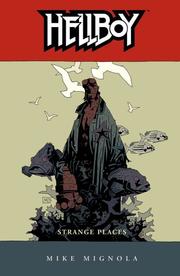
Hellboy adrift in Africa, and the most purely visual stretch of the run — long wordless sequences that only work if you already know the character.
Discussion
Keep reading
Paths that share books, cover the same subject, or open a related topic.