Grant Morrison Reading Order: Where to Start and What Order to Read Their Comics In
Almost everyone who bounces off Grant Morrison starts with The Invisibles, and almost everyone who loves Morrison started somewhere else. This path is ordered so the weird books arrive once you have absorbed the grammar they are playing with: the tightly constructed superhero comics first, then the DC reinventions where the strangeness starts leaking in, then the long superhero epics, and only then the psychedelic long-form work. Every book here is a collected edition and resolves under its bare title; where a catalogue record is undifferentiated across a series, the note says so.
The tightly built ones
BeginnerSee Morrison at their most disciplined, and learn the compression that makes the later books legible
▸ Study plan for this stage
Pace: 1-2 weeks. These are short — All-Star Superman 160pp, We3 114pp, Arkham Asylum 216pp — and comics read fast, but Arkham Asylum in particular is a book you slow down for: McKean's painted collage often makes the lettering hard to read on purpose, and a page can take longer than a chapter of prose. Re
- Compression: Morrison routinely puts a whole story's worth of idea in a single issue, and All-Star Superman does it twelve times over
- The panel grid as an argument — Quitely's shattered layouts in We3 are the animal's perception, not decoration
- Silver Age material taken seriously rather than parodied, which is Morrison's basic move
- Superhero as myth rather than genre character, stated plainly here before it becomes the thesis of Supergods
- Painted, non-linear comics art as a mode: Arkham Asylum reads more like a poem than a procedural
- The distinction between formal ambition serving emotion (All-Star Superman) and formal ambition as the point (later books)
- How does All-Star Superman get twelve self-contained stories to add up to one arc — what carries across issues if the plots do not?
- What is Quitely's fractured grid in We3 doing that a conventional layout could not, and where specifically does it change how a scene reads?
- Arkham Asylum tells its Batman story as psychological case study. What does that cost it as a plot, and what does it buy?
- Which of these three would you hand to someone who says they do not like superhero comics, and what is the argument?
- Where in these books does Morrison signal that the story knows it is a comic — and how differently is that handled from Animal Man in the next stage?
- Pick any single issue of All-Star Superman and write down every distinct idea in it. Compare your count against a typical modern superhero issue; the gap is what people mean by Morrison's compression.
- Read the escape sequence in We3 once for story, then again tracking only panel shape and page architecture. Note where the grid breaks and what is happening in the story at that moment.
- Read Arkham Asylum once straight through, then once reading only Two-Face's thread. It is legible as a coherent arc in a book that otherwise resists linear reading — which tells you the difficulty is chosen, not accidental.
- Compare the Quitely pages in All-Star Superman with the Quitely pages in We3. Same artist, two entirely different grammars; identify three specific choices that differ.
Next up: These three establish that Morrison's oddness is deliberate and controllable — which is the assurance you need before Animal Man starts dismantling the fourth wall in earnest.

Twelve issues, twelve ideas, drawn by Frank Quitely, and widely called the best Superman story ever written. The perfect first Morrison because the formal ambition is completely in service of the emotion, which is not always true later.
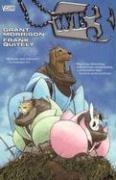
Three weaponised pets escaping a lab, told in Quitely's shattered panel grids. The shortest book on the list and the clearest demonstration of Morrison's page design as storytelling rather than decoration.
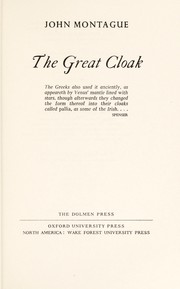
Their 1989 breakthrough with Dave McKean, and the first sign of what was coming: Batman as a psychological case study, told in painted collage. The catalogue record carries a nonsense publication year, but it is the right book.
The DC reinventions
IntermediateWatch Morrison take three moribund properties apart and understand the method — take the silliest premise seriously and follow it all the way down
▸ Study plan for this stage
Pace: 4-5 weeks. Animal Man 236pp, Doom Patrol Book 1 308pp and Book 2 229pp, JLA 189pp. Read the two Doom Patrol volumes back to back with no gap — they are one arc, and the catalogue record for Book 2 gives no page count trouble but does end mid-run. JLA is the fastest and the lightest of the four. Note
- Take the silliest premise entirely seriously and follow it down: the method behind all three runs
- Metafiction as emotional argument — Animal Man's ending is about authorship and cruelty, not about being clever
- Surrealism promoted from ornament to plot engine (Danny the Street, the Brotherhood of Dada, the painting that eats Paris)
- Vertigo-era DC as a context: adult imprints let mainstream superhero characters be used for things they were never built for
- The team book as a structure, and what JLA does with scale — gods-and-icons plotting, one big idea per arc
- Trauma and dissociation written as literal superpower in Crazy Jane's story, which is Doom Patrol Book 2's centre
- How much continuity a run assumes: Animal Man and Doom Patrol assume almost none, JLA assumes a working knowledge of the DC roster
- What is Animal Man's ending actually accusing the writer of, and why does it need the preceding twenty issues to land?
- How does the Brotherhood of Dada differ from an ordinary supervillain team — what are they trying to do, and why is it a joke and a threat at once?
- Doom Patrol Book 2 gives Crazy Jane's story over to her. What changes about the run when it does?
- JLA is the straightest superhero comic here. What does reading it after Doom Patrol tell you about Morrison's range that reading it first would not?
- Where do these three runs put their strangeness — in the world, in the characters, or in the storytelling itself? Give an example of each.
- Track the coyote in Animal Man from first appearance to the final issue. It is the clearest single thread through the metafictional turn, and following it makes the ending legible rather than merely startling.
- List every element in Doom Patrol Book 1 that a conventional editor would have cut, then ask what the run would be without them. This is the fastest way to see why the surrealism is structural rather than decorative.
- Read JLA's opening New World Order arc directly after finishing Doom Patrol Book 2 and note your own reaction to the tonal drop. Write down what JLA is doing well; it is a genuinely different craft.
- Compare Animal Man's use of the fourth wall with Flex Mentallo's in the final stage. Same device, ten years apart, aimed at completely different targets.
Next up: Having seen Morrison rebuild three properties at run length, you are ready for the books designed as single objects from the first page — where the unit of construction is no longer the issue or the arc but the whole run.
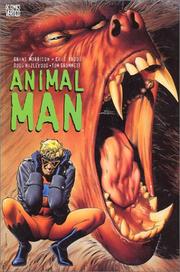
A C-list hero who talks to animals, turned into a book about authorship and cruelty, ending with the character meeting Morrison. The origin of every metafictional move in the later work — read it before The Invisibles or Flex Mentallo.
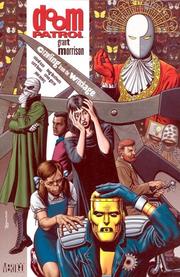
The most inventive superhero comic of its era: Danny the Street, the Brotherhood of Dada, a painting that eats Paris. Start of the run proper, and where surrealism stops being an ornament and becomes the plot engine.
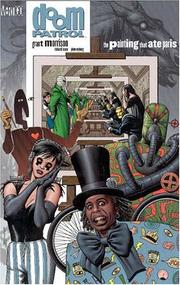
The run deepens and Crazy Jane's story takes over. Read it directly after Book 1 — the two halves are one arc, and stopping at the first gives a badly wrong impression of what the run is doing.
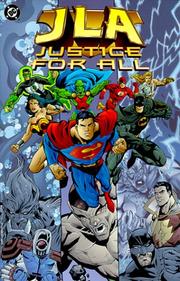
Their 1997 relaunch with Howard Porter, opening with New World Order. The straightest superhero comic Morrison ever wrote, and a useful counterweight — proof that the strangeness elsewhere is a choice. The record is the first collection of the run.
The long superhero epics
IntermediateHandle Morrison's book-length structures, where a run is designed as a single object rather than a sequence of stories
▸ Study plan for this stage
Pace: 3-4 weeks, but with a real caveat: these are all first volumes of longer works. New X-Men Vol. 1 is 264pp of a three-year run; Batman and Robin Vol. 1 is 174pp of a project that runs through several more collections; Seven Soldiers of Victory is 176pp of what is really seven miniseries across two la
- The run as a single designed object rather than a sequence of arcs
- Mutants reconceived as a culture with fashion, drugs and slang rather than a persecuted minority in costume — New X-Men's central reframing
- Inversion as a generator: a light Batman and a vicious Robin, which is the whole engine of Batman and Robin
- Distributed narrative — Seven Soldiers tells one story through seven miniseries whose protagonists never meet and cannot see the plot they are in
- How much prior continuity each demands: Batman and Robin sits inside Morrison's longer Batman project and assumes Bruce Wayne's absence, which happens elsewhere; Seven Soldiers plays with decades of obscure DC characters; New X-Men assumes essentially nothing
- Pattern reading as a skill the reader is being trained in, and which the next stage requires
- What does New X-Men's reframing of mutants as a subculture change about the stories that become tellable?
- Batman and Robin swaps the usual temperaments between the two leads. What does that reveal about how the standard dynamic was working?
- In Seven Soldiers, what is the connective tissue if the characters never meet — and at what point in your reading did you notice it?
- Which of these three assumes the most prior DC continuity, and what specifically would a new reader miss?
- All three are first volumes. What is each one deferring, and does it work as a reading experience on its own?
- Keep a running list of every cross-reference you catch between the Seven Soldiers miniseries — a background figure, a repeated object, a date. Compare your list to the story you thought you were reading; the gap is the book's whole design.
- Read the first and last issues collected in New X-Men Vol. 1 back to back, then read the middle. The run is built so the ends comment on each other.
- Note every point in Batman and Robin Vol. 1 where the story assumes you know why Bruce Wayne is not Batman. Then decide whether the volume works without that knowledge — this is the practical test of how much continuity Morrison's mainstream work requires.
- Diagram Seven Soldiers as seven parallel lines and mark where each intersects the others. Doing it on paper makes visible a structure that is deliberately invisible in the reading.
Next up: You have now read a story that only exists in the reader's head across seven separate books — which is precisely the reading muscle The Invisibles and The Filth demand and the reason people bounce off them when they start there.
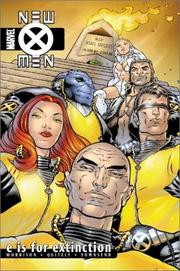
The three-year X-Men run that reset the franchise: mutants as a culture with fashion and drugs rather than a persecuted minority in spandex. Note that a bare New X-Men query returns volume 4, so this is pinned to the first collection.
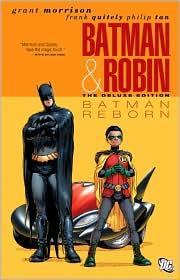
Dick Grayson as Batman with Damian Wayne as Robin, drawn by Quitely — an inversion of the usual dynamic and the most purely enjoyable stretch of Morrison's long Batman project. A bare title query returns the later Batman and Robin Must Die, so start with volume 1.
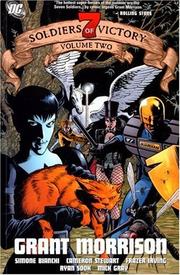
Seven separate miniseries that form one story none of the seven characters can see. The most formally ambitious thing in mainstream superhero comics, and it needs the pattern-reading the previous six books have trained.
The weird ones you have now earned
IntermediateRead the psychedelic long-form work with enough context to follow it, and hear Morrison explain the project in their own words
▸ Study plan for this stage
Pace: 6-8 weeks, and the page counts understate it. Flex Mentallo is 144pp and takes an evening; The Filth is 320pp and is deliberately unpleasant, so read it in short sittings; Supergods is 480pp of prose and reads like ordinary nonfiction. The Invisibles is the problem — the catalogue record here is an
- The superhero as an argument about human potential — Flex Mentallo's explicit thesis and the key to everything else Morrison writes
- Occult conspiracy fiction as autobiography: The Invisibles is openly built on Morrison's own experiences, including the Kathmandu episode described in Supergods
- The Filth as rebuttal — same author, same territory, deliberately reversed conclusions, thirteen issues instead of sixty
- Magic treated as a working method rather than a plot device, which Supergods states outright and asks you to take on the author's own account
- Comics as a medium capable of arguing about itself, from Animal Man through Flex Mentallo to Supergods
- The difference between formal difficulty that rewards (Seven Soldiers) and formal difficulty that repels on purpose (The Filth)
- Autobiography and criticism blended in Supergods, which means its claims about the work are the author's own and are not neutral
- What is Flex Mentallo's argument about why superhero comics matter, and how does it use a character invented as a joke to make it?
- The Filth is explicitly a reply to The Invisibles. What is it disagreeing with, and does reading it second change your view of the earlier book?
- Supergods is half criticism and half memoir. Where does that make it unreliable as history, and where does it make it more valuable than a neutral account would be?
- The Invisibles is the book most people start with and bounce off. Having read the previous three stages, what specifically were they missing?
- Across the whole path, what stays constant in Morrison's work from All-Star Superman to The Filth?
- Read Flex Mentallo immediately after Doom Patrol Book 2 rather than in isolation — the joke character's origin is there, and the four issues are unreadable as intended without it.
- Read The Invisibles in the collected editions in publication order starting with Say You Want a Revolution, and keep a list of what you do not understand rather than stopping. Most of it resolves; a running list turns confusion into a tracked question.
- After finishing Supergods, go back to one book from stage one and one from stage three and check Morrison's stated intention against what is on the page. Where they diverge is the most interesting thing on this path.
- Read The Filth's final issue against The Invisibles' final issue in a single sitting and write down the two conclusions side by side. This is the argument the two books are having.
- Take Flex Mentallo's central claim about superheroes and test it against All-Star Superman. The two books are separated by a decade and are making the same case in opposite registers.
Next up: This is the end of the path — Supergods closes it by explaining the intention behind everything above, which means the natural next move is rereading stage one with the whole argument in hand.

The bridge book and the right first step into the difficult work: a four-issue argument about why superhero comics matter, using a character created as a joke in Doom Patrol. Read it directly after the Doom Patrol volumes.
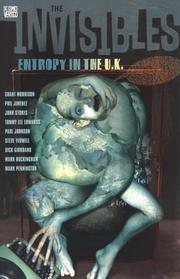
The sixty-issue occult conspiracy epic, and the book most people wrongly start with. The catalogue record is an undifferentiated series entry rather than a specific volume, so treat it as the entry point to the run and read the collected editions in order from Say You Want a Revolution.
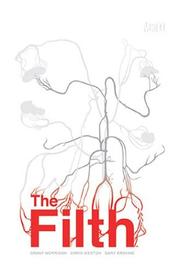
The Invisibles' hangover — bleaker, uglier, and formally tighter at thirteen issues. Read it after The Invisibles; it is explicitly a rebuttal to it, and reversing the order wastes both.

Their prose history of superheroes, half criticism and half autobiography, including the Kathmandu experience that shaped The Invisibles. The closing book because it retroactively explains the intention behind almost everything above.