Start with All-star Superman. It runs twelve issues, it assumes nothing beyond knowing that Superman is strong and that Lex Luthor hates him, and it is the Morrison comic that the widest range of readers agree on. Superman is dying of solar radiation poisoning and spends what is left doing final things. Frank Quitely draws it. You do not need to have read a DC comic before.
The obvious alternative is Arkham Asylum, which sold enormously and is the title most people have heard of. It is a poor entry: a dense symbol-map painted by Dave McKean, deliberately hard to follow from panel to panel, and it will leave you believing Morrison is impenetrable when in fact they are often very direct. The Invisibles is a worse first read still, for reasons below.
What "formally experimental" means in practice
Morrison writes superhero comics that keep pointing at the fact that they are superhero comics. Animal Man takes a forgotten C-list hero and turns his run into an argument about what it is to be a fictional character, ending with the writer walking on stage to meet him. Flex Mentallo takes a joke character from a Charles Atlas advertisement and builds a thesis that superhero comics are a technology for producing better people. Seven Soldiers of Victory is seven separate miniseries about obscure characters who never meet, and the structure only resolves when you read all of it. Supergods is where Morrison sets out the thinking directly, in prose.
None of this is difficult prose. What makes Morrison hard is compression and, in the DC work specifically, the assumption that you have been reading DC comics for years.
The entry tier: no continuity at all
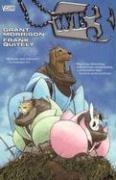
All-star Superman and We3 are the two books you can hand to anyone. We3 is three issues in which a dog, a cat and a rabbit, surgically turned into armoured weapons, escape a military laboratory. The dialogue is minimal and broken; almost all the storytelling happens in how the panels are cut. It is short and it is violent — animals are killed on the page and the animals themselves speak in damaged fragments.
The Vertigo run
Animal Man is the metafictional one described above, and it is also plainly an animal-rights argument, argued in the text rather than implied.
Doom Patrol, Book 1 and Doom Patrol, Book 2 collect the run that made Morrison's reputation: a superhero team book rebuilt as Dadaism, with a sentient street, a villain group named after an art movement, and a protagonist whose sixty-four personalities each have a different power. Those personalities originate in childhood sexual abuse, which the comic states directly rather than implying. Continuity requirements are close to zero.
Flex Mentallo spins out of Doom Patrol and was unavailable for over a decade because of a legal dispute over the Charles Atlas character it parodies; it was finally reprinted in 2012.
The continuity walls
JLA is big-canvas Justice League and works if you know the seven core characters. New X-Men, Vol. 1 is Morrison's Marvel run, and it is more accessible than most X-Men comics because it deliberately resets the premise — mutants as a subculture, the school as an actual school — but it still assumes you know Xavier, Cyclops, Jean Grey, Wolverine and Magneto.
Batman and Robin Vol. 1 is the one that genuinely requires homework. It opens with Bruce Wayne removed from play, Dick Grayson wearing the cowl and Damian Wayne as Robin, and it follows directly from Batman R.I.P. and Final Crisis, neither of which is in this list. Read it last of the superhero material, or read a plot summary of those two first. Seven Soldiers of Victory is the other structural demand: ambitious, and the least rewarding thing here to read cold.
The difficult books
The Invisibles ran from 1994 to 2000 and is a conspiracy story about time travel, occultism and an anarchist cell, told deliberately out of order. Its opening arc is the weakest stretch and the most likely to lose you; a great many of its admirers report bouncing off it once before it took. It contains torture, drug use and explicit sex and violence. The Filth is thirteen issues of deliberate repellence — bodily fluids, cruelty and pornography as its literal subject. Most readers find it the least pleasant thing Morrison has written; a smaller group consider it the best. Neither is a starting point.
Where to stop
All-star Superman plus We3 is a complete and satisfying experience, and stopping there is a reasonable outcome. If you want one more, make it Doom Patrol, Book 1. Browse more comics reading orders on Discover, or see what else sits under Grant Morrison.
Follow the full ordered path here: Grant Morrison Reading Order: Where to Start and What Order to Read Their Comics In.