Best Books on Glaciers, Ice Sheets and Glaciology
Ice is a rock that flows, an archive that records the atmosphere layer by layer, and currently the largest single uncertainty in sea-level projections. This path starts with narrative books that make ice physical rather than abstract, moves through the ice-age problem and the ice-core record, spends a stage on the Greenland and Antarctic ice sheets as they are behaving now, and ends with the glaciology textbooks that let you calculate mass balance and ice flow yourself.
Meeting the ice
BeginnerUnderstand how a glacier forms, moves and retreats, and why ice behaves as a fluid on long timescales
▸ Study plan for this stage
Pace: About 3 weeks. Wadham's Ice Rivers and Gosnell's Ice are trade non-fiction and read at 30-40 pages a day; Gosnell is 560 pages and discursive, covering lake ice, sea ice and permafrost as well as glaciers, so skim the non-glacial chapters if you are impatient. Hambrey and Alean's Glaciers is a diffe
- Accumulation zone, ablation zone and the equilibrium line altitude that separates them
- Ice as a polycrystalline solid that deforms by creep on long timescales, so a glacier is a very slow fluid
- The two ways a glacier moves: internal deformation of the ice, and sliding over its bed
- The glacier taxonomy Hambrey and Alean photograph: cirque, valley, piedmont, ice cap, ice sheet, ice shelf
- Crevasses as brittle failure confined to roughly the top 30 metres, where ice cannot creep fast enough to relieve stress
- Response time: why a terminus position reflects a climate signal from years or decades ago
- Wadham's subglacial environment as a living habitat and a chemical reactor, not a sterile base
- Why does a valley glacier flow fastest at the surface along its centreline, and slowest at the bed and margins?
- What is the equilibrium line altitude, and what does a rising one tell you about a glacier's future?
- What is the difference between a cold-based, temperate and polythermal glacier, and why does the thermal regime control whether the glacier slides?
- From Wadham's fieldwork, what lives under a glacier and what is it doing to the water chemistry downstream?
- Given a photograph from Hambrey and Alean, can you name the landform and say what process made it?
- Pick a real glacier on satellite imagery (Google Earth has good coverage of the Alps, Alaska and Patagonia) and mark the terminus, the medial moraines, the crevasse fields and your best estimate of the equilibrium line, using Hambrey and Alean's plates as a key
- Find a repeat-photography pair for one of the Alpine glaciers Hambrey and Alean photographed in 1992 and compare it to current imagery; estimate the retreat in metres per year
- Keep a running glossary from Hambrey and Alean of every term you cannot define without looking it up, and close it out before the technical stage
- Write 300 words on Wadham's claim that glaciers are ecosystems, and note which parts are her own measurements and which are the field's consensus
Next up: You now have the vocabulary and the physical picture of a single glacier, which is what you need before asking the much larger question of why whole continents of ice grow and vanish.

A glaciologist's fieldwork memoir across six ice masses, and the most engaging way in: the science arrives attached to the crevasses she was standing on. Read it first to get a feel for what glaciology actually involves.

A long, discursive natural history of frozen water in all its forms, from lake ice to permafrost to glaciers. It gives you the physical properties of the material itself, which the more technical books later assume you already have.
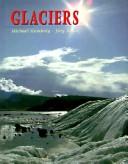
Hambrey and Alean's photographic survey by two working glaciologists: glacier types, landforms and processes, explained beside pictures of each. The bridge from narrative reading to the vocabulary of the discipline.
Ice ages and the deep record
BeginnerExplain what causes glacial cycles, and how orbital forcing was established as the pacemaker of the Pleistocene
▸ Study plan for this stage
Pace: About 3 weeks. All three are written for general readers, but they are not equally easy: Macdougall's Frozen Earth and Alley's The Two-Mile Time Machine read at 40 pages a day, while Imbrie and Imbrie's Ice Ages is from 1979 and takes the reader through real spectral analysis of core data, so slow d
- Snowball Earth and the fact that glaciation is a recurring state of the planet, not a Pleistocene peculiarity
- The three Milankovitch parameters: eccentricity (~100 kyr), obliquity (~41 kyr), precession (~23 and 19 kyr)
- The 100,000-year problem: the strongest cycle in the record corresponds to the weakest insolation forcing
- Oxygen isotope ratios in benthic foraminifera as a proxy for global ice volume
- The Hays, Imbrie and Shackleton pacemaker result, and what spectral analysis of a core actually shows
- Dansgaard-Oeschger events and the Younger Dryas: climate changing faster than the orbital pacing can explain
- Annual layer counting in Greenland ice, and Alley's point that a decade-scale shift is visible in a single core
- What are the three orbital cycles, their approximate periods, and which latitudes and seasons does each one affect most?
- Why is the dominance of the 100,000-year cycle a problem, given how weak eccentricity's direct insolation effect is?
- What exactly did Hays, Imbrie and Shackleton demonstrate in 1976, and by what method?
- How fast is abrupt, in Alley's account, and what physical mechanism could move climate that fast?
- Why does the oxygen isotope ratio in a seafloor shell record global ice volume rather than local temperature?
- Read the original Hays, Imbrie and Shackleton paper, Variations in the Earth's Orbit: Pacemaker of the Ice Ages (Science, 1976), alongside Imbrie's own chapter on it; Imbrie is a co-author, so you get to watch a scientist narrate his own result
- Sketch the three orbital cycles on a common time axis and superimpose them, then mark where they reinforce and where they cancel
- Download the GISP2 or NGRIP oxygen isotope series from the NOAA paleoclimatology archive and locate the end of the Younger Dryas yourself; count how many years the transition takes and check your number against Alley's
- Write a paragraph on what the Snowball Earth episodes in Macdougall have in common with the Pleistocene cycles, and what they do not
Next up: Everything in this stage rests on the ice-core record being trustworthy, so the next stage takes that record apart and asks how a chronology and a chemistry are actually built from a cylinder of ice.

The history of ice ages across the whole of Earth history, including Snowball Earth, written for a general reader by a geochemist. Start here for the long view before narrowing to the Pleistocene.
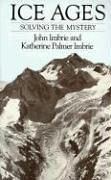
Catalogued as Ice Ages. The classic account of how Milankovitch orbital cycles were confirmed in deep-sea cores, by one of the scientists who did it. Read it after Macdougall as the detailed case study.
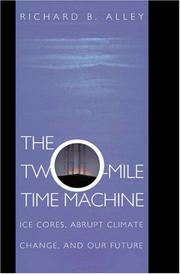
The Greenland ice cores and the discovery that climate can shift dramatically within a decade. Alley drilled the cores he writes about, and this is the single most important book here for understanding why ice matters to climate science.
Reading the cores
IntermediateUnderstand what an ice core actually measures, how its chronology is built, and how core records are combined with other proxies
▸ Study plan for this stage
Pace: About 3 weeks. Mayewski and White's The Ice Chronicles is semi-technical, written by the GISP2 chief scientist, with real detail on drilling, dating and chemical series: 249 pages, but read it slowly and with the figures. Gertner's The Ice at the End of the World is 448 pages of narrative history an
- Annual layer counting versus flow-model dating, and the depth at which counting fails
- Electrical conductivity measurement (ECM) as a fast, continuous dating and volcanic-marker tool
- Glaciochemical series: sea salt sodium, calcium and dust as proxies for atmospheric circulation, not just temperature
- The gas age / ice age difference: air is trapped at the base of the firn, so a bubble is younger than the ice around it
- Replication as verification, and what the GRIP and GISP2 disagreement in the deep Eemian section revealed about flow disturbance
- The mechanics of deep drilling: fluid-filled boreholes, the brittle ice zone, core handling and contamination
- Greenland as an object of exploration before it was an object of science, and why the two histories are the same history
- Why is the air in an ice-core bubble younger than the ice enclosing it, and how large is that offset in Greenland versus central Antarctica?
- How does an electrical conductivity trace let you date a core, and what chemical signal is it actually responding to?
- What does a sulfate spike in a core mean, and how is it used to tie separate cores to a common timescale?
- What do the dust and sea-salt series tell you about wind and storm tracks that the isotope series does not?
- Why did GRIP and GISP2 stop agreeing near the bed, and what did that teach the field about deep-core reliability?
- Pull the GISP2 or NGRIP isotope and chemistry series from the NOAA NCEI paleoclimate archive and reproduce the last-glacial-to-Holocene transition figure Mayewski discusses
- Write a one-page comparison of Mayewski's technical account of core interpretation against Alley's popular one, and list three places where Alley simplifies
- Take one volcanic marker (Laki 1783 is well documented) and find it in a published core chemistry series, then explain how it would be used to synchronise two cores
- Using Gertner, build a timeline from Nansen's crossing to modern satellite altimetry and mark which technique replaced which
Next up: With the proxy record established and its uncertainties visible, you can turn from what the ice remembers to what the ice sheets are doing right now.
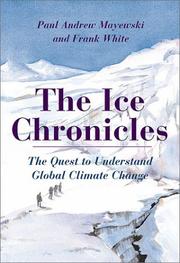
The GISP2 project told by its chief scientist, with much more detail on drilling, dating and chemical analysis than Alley gives. Read it directly after The Two-Mile Time Machine as the technical companion to the same record.

The history of Greenland exploration and science from Nansen to modern satellite altimetry, which is how the drilling projects came to be possible at all. Note the record carries a misspelled author field; the book is Gertner's.
Ice sheets and sea level now
IntermediateAssess the stability arguments for the Greenland and Antarctic ice sheets, and understand why glaciers have become a legal and political object
▸ Study plan for this stage
Pace: About 2 weeks. Conkling and colleagues' The Fate of Greenland is 224 pages of accessible science writing, and Taillant's Glaciers is 334 pages of policy and law rather than physics. Both are non-technical. Note the dates: Conkling is from 2011 and predates a decade of satellite mass-balance results,
- Mass balance as accumulation minus surface melt minus discharge across the grounding line
- Marine ice sheet instability: why an ice sheet grounded below sea level on a retrograde bed can retreat unstably
- Grounding line, buttressing, and why the loss of a floating ice shelf accelerates the grounded ice behind it
- Surface meltwater, moulins and the seasonal speed-up, and why its long-term effect turned out smaller than first feared
- Sea-level equivalent: roughly 7 metres in Greenland, 3 in West Antarctica, and far more in East Antarctica
- Glaciers as water towers, and the resulting legal and political fights over mining and water rights that Taillant documents
- What is marine ice sheet instability, and why is West Antarctica exposed to it in a way Greenland mostly is not?
- What does a floating ice shelf do mechanically for the grounded ice upstream, given that it is already displacing its own weight of water?
- How much sea-level rise is stored in Greenland, West Antarctica and East Antarctica respectively, and which is the near-term risk?
- What was Argentina's glacier protection law meant to stop, and what does Taillant say happened in practice?
- Which of Conkling's 2011 conclusions have been overtaken by later observations, and which have held?
- Check the mass-balance numbers in The Fate of Greenland against the current IMBIE assessment and the GRACE and GRACE-FO records, and write down explicitly where the 2011 book is now out of date
- Draw a cross-section of an ice sheet grounded on a retrograde bed, mark the grounding line, and work through why a small retreat increases the flux across it
- Read one primary document from the Pascua-Lama dispute or the Argentine glacier law that Taillant discusses, and compare the legal definition of a glacier there with the physical definition you learned in stage one
- Estimate the sea-level contribution of a hypothetical 1 percent annual loss from Greenland, and compare it to observed recent rates
Next up: You have now met every claim in the public debate about ice and sea level; the final stage gives you the equations to check those claims yourself instead of taking them on authority.

Written with Alley and other researchers, this connects the core record directly to what is currently happening to the Greenland ice sheet. It is the pivot from past climate to present change.

Catalogued simply as Glaciers, and a very different book from Hambrey's. Taillant covers glacier protection law, mining impacts and water security, which is where glaciology meets policy. Read it as the human consequence of the physical material.
Glaciology proper
IntermediateWork quantitatively with mass balance, ice rheology and flow, and identify glacial landforms in the field or on a map
▸ Study plan for this stage
Pace: Four to six months, and the pace splits in two. Bennett and Glasser's Glacial Geology and Benn and Evans's Glaciers and Glaciation are descriptive earth-science texts: heavily illustrated, readable at a chapter a week, assuming an undergraduate geology background but very little mathematics. Hooke's
- Glen's flow law and the exponent n around 3, which makes ice deformation strongly nonlinear in stress
- Driving stress from ice thickness and surface slope, and the shallow ice approximation built on it
- Basal sliding: Weertman regelation and enhanced creep, cavity formation, and the control of effective pressure
- The thermal regime: strain heating, geothermal flux, and why a bed at the pressure melting point changes everything
- Subglacial hydrology as channelised versus distributed drainage, and its feedback on sliding speed
- The continuity equation and mass balance as the bookkeeping that ties flow to thickness change
- Landform assemblages as a record of past ice: drumlins, eskers, lodgement and melt-out till, moraine sequences
- Where the shallow ice approximation fails: ice streams, shear margins and grounding lines, and what replaces it
- Write down the driving stress for a slab of ice, and explain why the surface velocity scales roughly as the fourth power of thickness
- What happens to basal sliding as subglacial water pressure approaches the ice overburden pressure, and why?
- How do you distinguish lodgement till from melt-out till in an exposure, and what does each tell you about the former ice?
- Where does the shallow ice approximation break down, and what stress terms have to be restored there?
- Given a mass-balance profile and a surface elevation profile, how would you compute the flux through a cross-section?
- Work Hooke's problems on driving stress and the laminar-flow velocity profile for an inclined slab until you can derive the profile without the book
- Compute the surface velocity for a real glacier using measured thickness, surface slope and a plausible rate factor, then compare your number against a published velocity from remote sensing
- Take a deglaciated landscape you can get map or lidar coverage of, and use Bennett and Glasser plus Benn and Evans to map the landform assemblage and write a short deglaciation history
- Read one recent ice-sheet model paper and identify which of Cuffey and Paterson's equations it discretises, and which terms it drops
- Reproduce a published mass-balance calculation for a monitored glacier from the raw stake and snow-pit data available through the World Glacier Monitoring Service
Next up: This is the end of the path: with Cuffey and Paterson on the shelf and Hooke's problems worked, the next thing you read is the current literature on ice-sheet models and sea-level projection, and you will be reading it as a participant.

Bennett and Glasser on ice sheets and landforms: erosion, deposition, moraines and the sediment record. Start the technical stage here because reading the landscape requires less mathematics than modelling the ice.

Benn and Evans is the standard comprehensive glaciology text, covering process, landform and sediment in one volume. Catalogued here as the second edition; it is the book the field teaches from.
The step into the physics: stress, strain, Glen's flow law, thermal regime and sliding, with problems. Read it after Benn, whose descriptions it turns into equations.

The definitive technical reference, now Cuffey and Paterson, covering ice flow, hydrology, ice-core physics and ice-sheet dynamics at research level. The right summit, and the book to consult for anything the others left open.
Discussion
Keep reading
Paths that share books, cover the same subject, or open a related topic.