Chinese Painting and Calligraphy: The Best Books to Read, in Order
Chinese painting is hard to enter from a Western art-historical training because the things that carry value are different: the brushstroke rather than the image, the handscroll rather than the framed picture, the colophons and seals accumulated on the mounting rather than the composition alone. This path builds that vocabulary in order — a broad survey first, then calligraphy, because writing is the parent art and painting is read through it, then the literati texts in translation, then a period-by-period deep dive with James Cahill, and finally the recent scholarship on who was actually looking at these objects and why. Note that two different books here are both catalogued as Chinese calligraphy; the authors distinguish them.
The Survey
BeginnerGet three thousand years into rough chronological order and learn the basic formats — handscroll, hanging scroll, album leaf, fan.
▸ Study plan for this stage
Pace: Five to six weeks. Three Thousand Years of Chinese Painting is a large-format Yale volume written by a team of Chinese and American scholars and is best read a dynasty at a time with the plates open beside the text — three or four weeks at a chapter a sitting. Clunas's Art in China is a compact Oxfo
- The four formats and what each one does to viewing: handscroll (unrolled in sections, never seen whole), hanging scroll (displayed and rotated seasonally), album leaf, and fan — format is not packaging here, it is the terms of the encounter
- Brushwork as the primary carrier of value. The subject of a Chinese painting is frequently conventional; what is being judged is the trace of the loaded brush across the surface
- Ink monochrome as a full range rather than an absence of colour, and the vocabulary of wet, dry, split and flying-white strokes
- The rough dynastic spine — Six Dynasties, Tang, Song, Yuan, Ming, Qing — and which format and which subject dominates in each
- Clunas's functional categories (art for the tomb, the temple, the court, the literati, the market, the nation) as an alternative to chronology, and what shifting to them reveals
- Why the European periodisation of art history fits badly: no Renaissance-style rupture, a canon built by copying rather than by overthrow, and 'originality' meaning something different
- The painting as an accreting object — colophons, seals, remountings — rather than a fixed picture, which is the point Cahill's compact survey sets up for later stages
- Describe the physical experience of viewing a handscroll. Why can it never be seen the way a framed painting is seen, and what does a painter do with that fact?
- Take one Song landscape reproduced in Barnhart and one in Clunas: what does the chronological account say about it that the functional account does not, and vice versa?
- What does Clunas gain by refusing dynastic order, and what does he lose? Name a specific thing that becomes harder to see.
- What is the difference between a court painter, an academy painter and a literati amateur in the Song and Yuan, in terms of who paid them and what they were expected to produce?
- Cahill's Skira book takes a single painting apart. Reproduce his method on a different plate in Barnhart: what does he actually look at first?
- Take any handscroll plate in Three Thousand Years of Chinese Painting and cover it with two sheets of paper, exposing about a shoulder's width at a time from right to left. Write down what you expected next at each stop. This is the closest reproduction of handscroll viewing you can manage from a book, and it changes what you think the composition is doing.
- Build a one-page chronology table from Barnhart — dynasty, dates, dominant format, dominant subject, two named painters. You will be filling gaps in this table for the rest of the path.
- Pick a single object that appears in both Barnhart and Clunas and write the two captions each author would have written. The exercise makes the methodological disagreement concrete rather than abstract.
- Using Cahill's Skira survey as the model, write 200 words on a plate of your choice describing only the brushwork — no subject matter, no dynasty, no biography.
- List every format term you meet in the three books and where you first met it. Handscroll, hanging scroll, album leaf, fan, screen, mural; you will need them precise later.
Next up: You can now place a painting in time and name what you are looking at, which is the minimum needed before turning to calligraphy — the art that trained the eye doing all that judging.
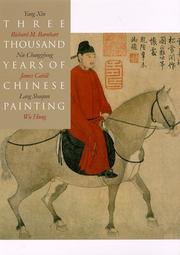
The Yale survey, written by a team of Chinese and American scholars, and the best single overview in English. Large plates and a genuine chronology; this is the spine of the whole path.
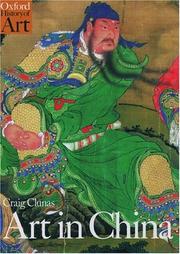
Deliberately not organised by dynasty — Clunas arranges by function, from art for tombs to art for the market. Read it second as the corrective to Barnhart's chronology; it stops you assuming Chinese art history has the same shape as European.

Cahill's compact Skira survey, decades old and still one of the most lucid short accounts of how a Chinese painting is put together. The natural bridge into his longer period volumes later on.
The Brush and the Writing
BeginnerLearn calligraphy as an art with its own history and criteria, because that is what trained the eye that judged painting.
▸ Study plan for this stage
Pace: Four to five weeks. Chiang Yee's Chinese Calligraphy, first published in the 1930s, is the readable one and should come first — about two weeks, and it rewards having a brush in your hand. Billeter's The Chinese Art of Writing is short but theoretically dense and assumes Chiang Yee's practical groun
- The five script types — seal, clerical, regular, running and cursive — as a historical sequence that also remains a live stylistic choice, so a Ming calligrapher writing seal script is making a statement
- Stroke order and the fact that a character is a timed performance: the viewer reconstructs the sequence and the speed from the finished mark
- Bone, flesh, sinew and blood as the standard critical vocabulary for a stroke, and what it implies that the metaphors are anatomical
- The brush as a recording instrument: pressure, angle, speed and the moment of lifting are all legible, which is Billeter's central claim about why a stroke is judged as a gesture rather than a shape
- Copying as the training method and as an art form — lin (free copy), mo (traced copy), and the transmission of models through rubbings and engraved compendia rather than originals
- Wang Xizhi and the Orchid Pavilion Preface as the canonical model whose original has not survived, so that the entire tradition descends from copies of copies
- Why calligraphy is the parent art: the criteria a Chinese connoisseur applies to a painting — line quality, rhythm, the visible record of the hand — are calligraphic criteria first
- The character as neither pure image nor pure text, and what that does to the idea that painting and writing are separate practices
- Name the five script types in historical order and give one visual feature that identifies each on sight.
- Billeter says a stroke records a gesture. What specifically in the mark carries the information about speed, and how would you point it out to someone else on a plate?
- Why does copying carry prestige in this tradition rather than shame, and what does the Orchid Pavilion transmission history do to the idea of an original?
- Chiang Yee writes as a practitioner for readers with no Chinese; the Yale volume writes as scholarship. Pick one calligrapher covered by both and state what each account can say that the other cannot.
- How would you apply the bone/flesh/sinew vocabulary to a landscape painting from the previous stage? Try it on a specific plate.
- Get a brush and ink and copy the character yong through Chiang Yee's account of the eight strokes, ten times. You are not learning calligraphy; you are learning why the critical vocabulary is about pressure and lifting, and thirty minutes of failing at it teaches that faster than any amount of reading.
- Find the Orchid Pavilion Preface in the Yale volume's plates and, using Billeter's method, describe five consecutive characters purely as a record of the hand's movement — where it accelerated, where it paused, where it lifted.
- Take one canonical model reproduced in the Yale volume and write down Chiang Yee's likely account of it and Billeter's likely account of it side by side. Where they diverge is the difference between practice and theory.
- Return to the landscape plate you wrote about in the last stage and rewrite your 200 words using only calligraphic vocabulary. That rewrite is the transition the whole stage exists to produce.
- Index the Yale volume for yourself: note the page for each script type's fullest treatment, so it functions as the reference book it is meant to be for the rest of the path.
Next up: With the calligraphic criteria in hand you can read the literati's own writing about painting as arguments made by people who judged pictures the way they judged handwriting.
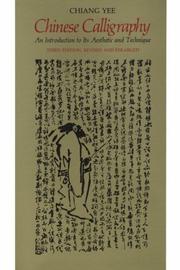
Chiang Yee's book, first published in the 1930s and never really superseded as an introduction: script types, stroke order, the aesthetics of the individual line, written by a practitioner for readers with no Chinese.

The theoretical account — why a stroke is judged as a record of a gesture and a temperament rather than as a shape. Read after Chiang Yee, whose practical grounding it assumes.

The Yale Culture and Civilization of China volume, and the scholarly reference of the three: full historical coverage with excellent reproductions of the canonical models. Use it to look things up rather than to read straight through.
The Literati in Their Own Words
IntermediateRead the primary Chinese criticism in translation, so the literati ideal is something you have met first-hand rather than a modern summary.
▸ Study plan for this stage
Pace: Six to seven weeks, and the slowest reading on the path because most of it is primary material in translation. Start with Bush and Shih's Early Chinese Texts on Painting, the standard anthology from the fourth century onward — read it in short sittings over three weeks, not straight through. Then Su
- Xie He's six principles (liufa), especially the first — spirit resonance, life-motion — and the fact that every subsequent Chinese critic is either glossing or arguing with them
- The literati (wenren) ideal: painting as the by-product of a scholar's cultivation, explicitly not a trade, with amateur status as the guarantee of sincerity
- Su Shi's argument that likeness is a child's criterion, and the elevation of expressive intent over descriptive accuracy
- The class politics under the aesthetics — the amateur ideal is a claim about who is entitled to judge, made by men who could afford not to sell
- Dong Qichang's Northern and Southern schools as a retrospective reorganisation of the whole canon into a legitimate literati line and an illegitimate professional one
- The set repertoire: the Mustard Seed Garden manual teaches rocks, trees, bamboo, plum and figures as codified forms to be learned and recombined, which is the practical reality behind the rhetoric of spontaneity
- Primary source versus modern synthesis. Bush and Shih give you the texts; Bush's monograph and Sze's essay are interpretations, and Sze in particular reads the tradition through a philosophical lens later scholars consider tendentious
- The gap between what literati writers said they were doing and what the surviving paintings show them doing, which is the tension Cahill's volumes exploit
- State Xie He's six principles and explain why the first has been the most argued-over for fifteen hundred years.
- What is Su Shi's actual objection to likeness, and what does he propose as the criterion instead? Quote the passage from Bush and Shih.
- How does Dong Qichang's Northern/Southern division work, who does it exclude, and what interest does it serve?
- The Mustard Seed Garden manual teaches painting as a repertoire of set forms. How is that compatible with the literati insistence on spontaneous self-expression — or is it?
- Where does Sze's philosophical reading go further than the primary texts support? Point to one claim in The Way of Chinese Painting that Bush and Shih's sources do not carry.
- Copy out the six principles in full from Bush and Shih and keep the page beside you for the rest of the path. Every time a later author invokes one, mark it. You will end up with a map of which principles remained live and which quietly died.
- Work through the Mustard Seed Garden manual's rock section and actually draw six rocks from its models with pencil or brush. The manual was a teaching instrument, and using it as one is the only way to feel how much of literati painting is learned vocabulary.
- Trace one idea — likeness, or the amateur ideal — from Bush and Shih's earliest texts through to Dong Qichang, noting each author who restates it. Bush's monograph gives you the chain; the exercise is building it yourself.
- Take a painting you looked at in stage one and write the colophon a Su Shi admirer would have added to it. This forces the vocabulary into active use.
- List every point where Sze's essay makes a claim about Daoism or cosmology that the anthology's primary texts do not directly support. Do not settle whether she is right; just build the list.
Next up: The ideology is now first-hand rather than summarised, which is the equipment Cahill's period volumes assume you already have when they show you what the paintings actually did with it.

The standard anthology of primary sources, edited with Hsio-yen Shih, from the fourth century onward — including Xie He's six principles, which every later account argues with. Start here.

Bush's study of the amateur-scholar theory of painting from Su Shi to Dong Qichang, which is the ideology behind almost everything Cahill discusses in the next stage. The long catalogue title is the real one.
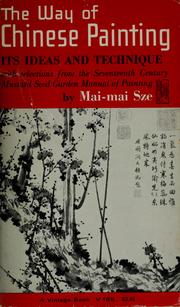
Sze's long essay on the philosophical grounding of brushwork. It was written as the introduction to her translation of the Mustard Seed Garden manual and is best read as one half of that project.
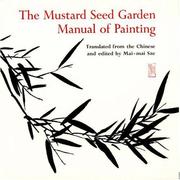
The seventeenth-century instruction manual itself, in Sze's translation, showing how rocks, bamboo, plum and figures were actually taught as a repertoire of set forms. Our catalogue display title is truncated mid-line; the work is the complete Jieziyuan Huazhuan.
Period Depth with Cahill
IntermediateWork through the Yuan to late Ming in detail with the scholar who mapped the period for English readers.
▸ Study plan for this stage
Pace: Eight to ten weeks. These are three substantial illustrated scholarly volumes and each takes about three weeks read at a chapter a sitting with the plates open. Read them in the order Cahill wrote them: Hills Beyond a River (Yuan, 1279-1368), then Parting at the Shore (early and middle Ming, 1368-15
- The Yuan as the hinge: with the Song academy gone and Mongol rule closing official careers, the literati amateur mode becomes the dominant practice rather than a gentleman's pose
- The Four Masters of the Yuan — Huang Gongwang, Wu Zhen, Ni Zan, Wang Meng — and the very different things each does with dry brush and disengaged landscape
- Ni Zan's austerity as an extreme case: near-empty compositions where the value is entirely in line quality, which is the clearest possible demonstration of the calligraphic criteria from stage two
- The Zhe school and the professional Ming painters the literati despised, and Cahill's insistence on taking them seriously — one of the arguments the series is remembered for
- The Wu school at Suzhou (Shen Zhou, Wen Zhengming) and the professionalisation of amateurism, where scholar-painters sold work while maintaining they did not
- Late Ming eclecticism and archaism: quoting an eleventh-century master's manner as a deliberate, legible act rather than as imitation
- Dong Qichang as painter and as theorist, and the way The Distant Mountains shows the Northern/Southern theory being built by someone with a position to defend
- Cahill's own method — style analysis, attribution, and a willingness to say a famous painting is not what the label claims, which is disputed territory and he tells you so
- What changed for painters at the fall of the Southern Song, and how is that change visible in a Huang Gongwang handscroll rather than merely stated in the biography?
- Ni Zan's compositions are nearly empty. Using stage two's vocabulary, say what is actually being judged in one.
- Why did the literati despise the Zhe school painters, and what does Cahill think they got wrong about them?
- How does a late Ming painter signal that he is quoting a Yuan master? Name the visual cues, on a specific plate.
- Cahill sometimes doubts an attribution. Pick one such case and state his evidence and the counter-case, without deciding it.
- Where does Bush's literati material from the previous stage pay off most directly in The Distant Mountains?
- Extend your stage-one chronology table across the Yuan and Ming with Cahill's named painters, school affiliation, and one identifying stylistic habit each. By the end of the three volumes it should be the densest page you have.
- Take Ni Zan and Wang Meng plates side by side and write 300 words on what each does with the same nominal subject. Both are Yuan literati; the difference between them is the reason 'literati style' is a nearly useless label.
- Find a Zhe school plate in Parting at the Shore and write the dismissal a literati critic would have given it, then Cahill's defence. Doing both is the point.
- For one late Ming painting in The Distant Mountains, identify the earlier master being quoted and find that master's work in Barnhart or in Hills Beyond a River. The archaism is only legible if you can put the two images next to each other.
- Pick one attribution Cahill questions and write a paragraph laying out the evidence on each side without concluding. Connoisseurship arguments are a skill and this is how you practise one.
Next up: You have a real period map and a working sense of how attributions are argued, so the last stage can move off the paintings themselves and onto the collectors, markets and catalogues that decided which ones survived to be argued about.

Yuan dynasty painting, and the moment the literati ideal becomes the dominant practice rather than an amateur pose. First of Cahill's period volumes and the one to read first.

Early and middle Ming, including the professional Zhe school painters the literati despised. Cahill's willingness to take them seriously is one of the arguments the series is remembered for.
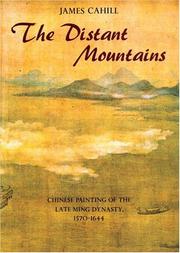
Late Ming, up to Dong Qichang and the theory of Northern and Southern schools that reorganised the entire canon. It closes the series and it is where Bush's literati material pays off.
Who Was Looking
IntermediateMove from the objects to their circulation — collectors, markets, colophons, imperial catalogues and the making of the canon.
▸ Study plan for this stage
Pace: Four to five weeks. Possessing the Past is a very large exhibition catalogue from the Metropolitan Museum and the National Palace Museum, written with James C. Y. Watt, and should be used as a viewing book — three weeks of working through plates and entries rather than reading front to back. Clunas'
- The imperial collection as an actor in art history: what the Qianlong emperor collected, catalogued and stamped shaped which works survived and which were believed genuine
- Colophons and seals as an accumulating public record — each owner's mark is a claim about authenticity and about the owner's own taste, written onto the object
- Remounting as an editorial act: scrolls are cut, rejoined, extended and re-silked, so the object you see is a composite of centuries of custody
- Clunas's five audiences — the emperor, the gentleman, the merchant, the nation, the people — and the argument that each one produced a different kind of painting
- The art market as a constant rather than a modern intrusion, with forgery, workshop production and reputation-trading present throughout the periods Cahill covered
- The museum and the nation as the most recent audience, and the way twentieth-century display conventions (framed, flat, lit, permanent) misrepresent objects made for other viewing conditions
- Canon formation as a traceable process with named agents — Dong Qichang, the imperial catalogues, Western collectors, the two Palace Museums — rather than a natural settling of quality
- The politics of the split collection between Beijing and Taipei, which is why this catalogue exists in the form it does
- Take one scroll in Possessing the Past with heavy colophon accumulation. Who added what, when, and what was each addition claiming?
- What does an imperial seal do to a painting — legally, physically and to its later reception?
- Clunas asks who a painting was for. Apply the question to a Ni Zan from stage four and to a Zhe school work: do you get different answers, and does that change how you rank them?
- How does the fact of remounting complicate Cahill's kind of style analysis?
- Which parts of the canon you have spent this path learning does Clunas suggest were assembled for reasons other than quality? Are you persuaded?
- Choose one heavily inscribed scroll in Possessing the Past and reconstruct its custody history from the seals and colophons alone, in a numbered list. This is the single best exercise on the path for understanding what a Chinese painting is as an object.
- Go back through your chronology table and add a column: intended audience, in Clunas's terms. The gaps you cannot fill are the honest measure of what the survey books left out.
- Find one work reproduced in both Possessing the Past and one of Cahill's volumes and compare the two entries. A catalogue entry and a period-history discussion of the same object are doing different jobs, and seeing them side by side is the clearest lesson in art-historical genre on this path.
- Write 500 words answering Clunas's question about a painting you now know well: who was it for, what evidence do you have, and what would change if you were wrong.
- List the five works you would keep from everything on this path and state, for each, whether you are choosing it on brushwork, on historical importance, or because the canon told you to. Being honest about the third category is the point of ending here.
Next up: You can now look at a Chinese painting as an object with a history of ownership and use, not just an image with a date — which means you can walk into a museum and disagree with the wall text on grounds you can defend.
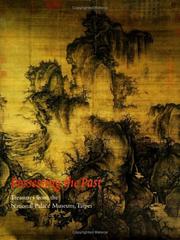
The Metropolitan and Palace Museum exhibition catalogue written with James C. Y. Watt, covering the imperial collection itself. It is the best place to see how colophons, seals and remountings accumulate on a single scroll over centuries.

Clunas's Mellon Lectures, asking who each kind of painting was actually made for — the emperor, the gentleman, the merchant, the nation, the people. The right book to end on, because it puts the whole path's canon in question.
Discussion
Keep reading
Paths that share books, cover the same subject, or open a related topic.