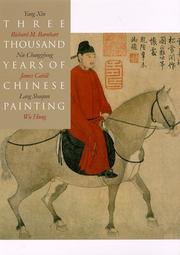
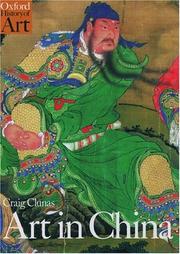
If you want one book, read Three thousand years of Chinese painting — the Yale survey written by Richard Barnhart with Yang Xin, Nie Chongzheng, Lang Shaojun and James Cahill, chronological, heavily illustrated, and the closest thing to a standard reference in English. If you would rather have the argument than the sweep, read Art in China by Craig Clunas instead: it is an Oxford History of Art volume that organises the material by function — art for tombs, for temples, for the court, for the market — rather than by dynasty, and it will make you suspicious of the tidy story the survey tells.
What trips readers here is that painting and calligraphy in China are one practice with one set of tools and one critical vocabulary, but the English-language books split them apart. And the calligraphy shelf has a specific trap: two very different books both display in our catalogue as Chinese calligraphy.
Getting oriented
After Barnhart or Clunas, Chinese painting by James Cahill is the compact older introduction — a Skira volume, strong on plates, and useful mainly as a way into Cahill before his big series.
For calligraphy, the two identically-titled books are not interchangeable. Chinese calligraphy by Chiang Yee, first published in 1938, is a practitioner's introduction to aesthetics and technique, written by an artist for Western readers who had never held a brush, and still the friendliest entry point. Chinese calligraphy by Ouyang Zhongshi is the large Yale volume in the Culture and Civilization of China series, a scholarly multi-author history with full apparatus — a reference book, not a first read. The Chinese art of writing by Jean François Billeter sits between them: an essay on what the practice actually is, more theoretical than Chiang and more readable than Ouyang.
The primary sources
This is where the subject gets genuinely rewarding, and where most readers never go. Early Chinese texts on painting, edited by Susan Bush and Hsio-yen Shih, is an anthology of translated Chinese critical writing from the Han through the Song — the texts the tradition argued with for a millennium. The Chinese literati on painting is Bush's study of the scholar-amateur ideal from Su Shi to Dong Qichang, and it explains why Chinese criticism prizes the painter's character over the finished picture.
The way of Chinese painting by Mai-mai Sze is her essay extracted from The Tao of Painting, and it comes paired with The Mustard Seed Garden Manual of Painting, the seventeenth-century instruction manual itself — a real primary source that teaches you to paint rocks, bamboo and plum branches by prescribed strokes. Read the manual as evidence about how the tradition was transmitted, not as a how-to, unless you have brushes.
Going deep
Cahill's dynasty-by-dynasty series is the serious commitment: Hills beyond a river on Yuan painting, Parting at the shore on the early and middle Ming, and The distant mountains on the late Ming. He planned five volumes and completed three, so the series stops in 1644 — worth knowing before you start. They assume you already know the periods and the major names.
Possessing the Past is an exhibition catalogue from the 1996 Metropolitan Museum and National Palace Museum show, co-edited by Wen Fong — enormous, superbly reproduced, with scholarly essays attached to objects rather than to a narrative. Catalogues age well for pictures and badly for arguments. Finally, Chinese painting and its audiences by Clunas asks who actually looked at these paintings and under what circumstances, which is the question the connoisseurship tradition tends to skip.
If you only read Cahill you will come away with the literati story; if you only read Clunas you will come away sceptical of it. The disagreement between them is real and is a reasonable place for a reader to end up sitting. Follow the full path and you will have heard both sides.
Follow the full ordered path here: The Best Books on Chinese Painting and Calligraphy, in Reading Order.