Best Books to Learn Biophysics, in Order
Biophysics is what happens when you insist on asking how much rather than how: how many piconewtons a motor protein pulls with, how long a protein takes to fold, how few molecules a cell can reliably count. This path is built for someone with undergraduate physics who wants the real courses, so it starts with the orders of magnitude and the classic essays, spends a stage on diffusion and low Reynolds number physics because everything at cell scale depends on them, then works through the two standard textbooks before reaching statistical mechanics of macromolecules and the theoretical view.
Scales, numbers and the founding question
BeginnerInternalise the characteristic lengths, times, energies and forces of the cell, and be able to make order-of-magnitude estimates before doing any calculation
▸ Study plan for this stage
Pace: 4-5 weeks, and none of it is mathematically demanding. Schrodinger's What Is Life? is 178 pages of lectures and takes two evenings. Goodsell's The Machinery of Life is 140 pages of illustration to be studied rather than read - a week. Milo and Phillips's Cell Biology by the Numbers is a 400-page ref
- The characteristic scales of the cell: nanometre to micrometre lengths, microsecond to second times, piconewton forces, and kT as the natural unit of energy
- kT at room temperature in useful units, and why every biological energy scale is quoted against it
- Molecular crowding - Goodsell's drawings at consistent scale show a cytoplasm that is nothing like a dilute solution
- Order-of-magnitude estimation as the discipline's core skill, in Milo and Phillips's explicit sense: how big, how many, how fast, how much energy
- Schrodinger's aperiodic crystal and negative entropy arguments, and which parts turned out right for the wrong reasons
- Thermal noise as the environment molecular machines work in and against, which is the central puzzle Hoffmann names
- Why a physicist's picture failure, not an algebra failure, is the usual source of a wrong biophysical answer
- How many proteins are in an E. coli cell, how big is a ribosome, and how fast does a typical protein diffuse across a bacterium?
- What is kT in piconewton-nanometres, and why does that combination matter for motor proteins?
- Which of Schrodinger's arguments survived, and which were superseded by the molecular biology that followed?
- What does Goodsell's crowding picture change about your intuition for diffusion-limited reactions?
- State the central puzzle Hoffmann poses about directed motion from thermal noise, precisely enough that it could be answered with physics rather than words.
- Work twenty estimation problems out of Cell Biology by the Numbers with the answers covered, then check; keep a tally of the ones you missed by more than an order of magnitude and note what assumption failed.
- Compute kT at 300 K in joules, in pN nm and in units of the energy released by ATP hydrolysis, and write the three numbers somewhere you will keep seeing them.
- Redraw one of Goodsell's cross-sections by hand at his stated scale, placing at least six named molecular species correctly sized relative to one another.
- Estimate, from first principles and then against Milo and Phillips's published figures, how long a small protein takes to diffuse the length of an E. coli cell and the length of a neuron's axon.
- Read Schrodinger with a pen and mark every prediction; write beside each what is now known, using Cell Biology by the Numbers for the quantities.
Next up: With the numbers internalised, the diffusion physics of the next stage is something you can sanity-check rather than take on trust.

The 1944 lectures that argued heredity had to be carried by an aperiodic crystal and that life runs on negative entropy. Catalogued with its subtitle, The Physical Aspect of the Living Cell; read it first because it is the document that made physicists think biology was theirs to attack.

Goodsell's molecular illustrations drawn to consistent scale are the fastest way to acquire an accurate mental picture of how crowded a cell actually is. Read it before any equations, because most biophysical intuition failures are picture failures.

A reference organised entirely around quantities: how big, how many, how fast, how much energy. It is the numerical companion to Goodsell's pictures and the single most useful book here for estimation problems.

A popular but physically serious account of how molecular machines extract directed motion from thermal noise. Read it last in this stage: it names the central puzzle that the textbooks later in the path answer formally.
Diffusion and the physics of being small
IntermediateWork fluently with random walks, diffusive transport and low Reynolds number flow, and understand why swimming and sensing are hard at micron scale
▸ Study plan for this stage
Pace: 6-8 weeks. Berg's Random Walks in Biology is only 147 pages but is a working text - do every derivation, at maybe 10 pages a day, over three weeks. It assumes calculus and no more. E. coli in Motion is a short companion volume and can be read in a week alongside it. Vogel's Life in Moving Fluids is
- The random walk and its mean square displacement, and why diffusion times scale as the square of distance
- The diffusion equation, Fick's laws, and the diffusion-limited reaction rate
- The Einstein relation connecting diffusion, mobility and temperature
- Reynolds number at micron scale, life at low Reynolds number, and the reversibility that makes scallop-like swimming impossible
- Chemotaxis by temporal comparison: how E. coli measures a gradient it is far too small to sense spatially
- The flagellar motor as a rotary machine and what is measurable about it
- Vogel's extension of the same reasoning to whole organisms, where inertia returns and the rules change again
- How long does a molecule with D of 10^-9 m^2/s take to diffuse 1 micrometre, 1 millimetre and 1 metre - and what does the third answer imply about the need for circulatory systems?
- Why can a bacterium not swim by a reciprocal motion, and what strategy does it use instead?
- How does E. coli decide whether conditions are improving, and what physical limit sets the precision of that decision?
- State the Einstein relation and explain in words what it says about the relationship between fluctuation and dissipation.
- Where does the Reynolds number change the rules rather than just the constants, in Vogel's sense, and give two biological examples.
- Derive the mean square displacement of a one-dimensional random walk from scratch, then extend it to three dimensions, without looking at Berg.
- Reproduce Berg's calculation of the diffusion-limited rate for a spherical absorber and compare it with a real published enzyme rate to see how close to the limit enzymes get.
- Work through Berg's treatment of chemotactic sensing and derive the accuracy limit set by counting fluctuations, then compare it with the measured performance of E. coli quoted in E. coli in Motion.
- Simulate a two-dimensional random walk in any language you like, plot mean square displacement against time for a few thousand walkers, and confirm the slope matches 2dDt.
- Compute Reynolds numbers for a swimming bacterium, a sperm cell, a tadpole and a trout using Vogel's data, and write a paragraph on what changes physically as the number crosses one.
Next up: Diffusion, low Reynolds number flow and the fluctuation-dissipation logic are the tools both standard textbooks assume from page one, so this stage is what makes them readable.
A short and famously clear book on diffusion, sedimentation and chemotaxis with almost no prerequisites beyond calculus. Everything else in this path assumes what Berg teaches here, so it comes first.

The companion volume: one organism, its flagellar motor, and how it computes a chemical gradient by comparing concentrations over time. Read it straight after Random Walks as the worked case study of the same physics.
Vogel's classic on biological fluid dynamics, from bacteria to trees, and the best treatment of why the Reynolds number changes the rules rather than just the constants. It extends Berg's scale-thinking to whole organisms.
The two standard courses
IntermediateComplete a full biophysics course: entropic forces, polymer physics of DNA, membranes, molecular motors and the statistical mechanics behind them
▸ Study plan for this stage
Pace: 9-12 months, and treat the two books as one long course rather than two reads. Nelson's Biological Physics is 600 pages and is the more approachable - it develops the statistical mechanics rather than assuming it. Plan a chapter every one to two weeks and do the problems; without the problems the bo
- Entropic forces: why a polymer resists stretching for reasons that have nothing to do with bonds
- The freely jointed and worm-like chain models of DNA, persistence length, and the force-extension curves measured in single-molecule experiments
- Partition functions and free energy as the working tools of the field, applied to binding, folding and conformational change
- Membranes as fluid elastic sheets: bending rigidity, tension, and the energetics of shape
- Molecular motors and the two-state and ratchet models of directed motion
- The Boltzmann distribution used quantitatively - ion channels, receptor occupancy, gene regulation
- Phillips's estimate-first, model-second method, and how it differs from the derive-everything approach
- Nerve impulses and the Hodgkin-Huxley description as a physical rather than merely descriptive model
- Derive the force-extension relation for a freely jointed chain and explain why the restoring force is entropic.
- What is the persistence length of double-stranded DNA, how is it measured, and what does it imply about looping in gene regulation?
- Set up the partition function for a simple two-state receptor and obtain the occupancy as a function of ligand concentration.
- How does a thermal ratchet produce directed motion without violating the second law?
- What sets the bending rigidity of a lipid bilayer, and how does that number constrain vesicle size?
- Where do Nelson and Phillips treat the same problem differently, and what does the difference tell you about the two styles of the field?
- Do at least half the end-of-chapter problems in Nelson; the derivations are the content, and a chapter read without them has not been read.
- Reproduce a published single-molecule DNA force-extension curve by fitting the worm-like chain model to digitised data from the original paper, and report the persistence length you extract.
- Work Phillips's estimate-first treatment of one problem - the packing of DNA in a phage capsid is the classic - before reading his solution, and compare your order of magnitude with his.
- Build a simple two-state model of an ion channel with a voltage-dependent energy difference, plot open probability against voltage, and compare it with measured data from a Hodgkin-Huxley-era paper.
- Keep a single notebook of every dimensionless group and characteristic number you meet across both books, with the physical meaning of each in one line.
Next up: Having completed a full course, the next stage can go straight to the statistical thermodynamics of macromolecules at the level the research literature actually uses.

The most approachable of the standard texts, building from thermal motion and entropy to molecular machines and nerve impulses. Read it before Phillips because Nelson develops the statistical mechanics you need rather than assuming it.

The other standard course, and the more demanding one: model-building throughout, with estimates first and detail second. It covers the same ground as Nelson at higher intensity, so read it second and treat the two as one long course.
Molecules, forces and motors
BeginnerHandle the statistical thermodynamics of macromolecules, protein folding and the mechanochemistry of motor proteins at research level
▸ Study plan for this stage
Pace: 8-10 months. Dill and Bromberg's Molecular Driving Forces is 756 pages and is a genuine statistical thermodynamics course - a chapter a week with the problems, over about five months. Finkelstein and Ptitsyn's Protein Physics is 528 pages of a lecture course and reads faster than Dill but assumes hi
- Entropy, free energy and chemical potential derived rather than quoted, and the conditions under which each is the right thermodynamic potential
- The hydrophobic effect as an entropic phenomenon of water, not an attraction between oils
- Electrostatics in solution: Debye screening, the Poisson-Boltzmann equation, and why charge in water behaves so unlike charge in vacuum
- Cooperativity and allostery treated with statistical mechanics rather than by analogy
- Protein folding thermodynamics and kinetics: the folding funnel, two-state folding, the Levinthal problem and how it dissolves
- Motor protein mechanochemistry: step size, stall force, duty ratio, and the coupling of ATP hydrolysis to mechanical work
- Cytoskeletal filament mechanics: persistence length of actin and microtubules, dynamic instability, and polymerisation forces
- Derive the Boltzmann distribution from the statistical definition of entropy, as Dill does, and state exactly what assumptions the derivation needs.
- Explain the hydrophobic effect in terms of water entropy, and say what experimental signature distinguishes it from an enthalpic attraction.
- What is the Debye length in physiological salt, and what does it imply about the range of electrostatic interactions between proteins?
- Why is the Levinthal paradox not a paradox, and what does the folding funnel picture add quantitatively rather than metaphorically?
- What are kinesin's step size, stall force and duty ratio, and how was each measured?
- How does the persistence length of a microtubule compare with that of actin and of DNA, and what does the comparison explain about their cellular roles?
- Work the problems in Dill's chapters on entropy, free energy, binding and electrostatics; this book is unusable as a read-only text.
- Compute the Debye length at 10 mM, 100 mM and 1 M ionic strength and check your numbers against the values quoted in Dill.
- Take a published protein melting curve, fit a two-state model, and extract the enthalpy and entropy of unfolding; compare with the values reported in the original paper.
- Reproduce Howard's estimate of the force a single kinesin can produce from the free energy of ATP hydrolysis and the measured step size, and compare it with the measured stall force.
- Derive the polymerisation force of an actin filament from the Brownian ratchet argument and compare with published measurements.
- Pick one motor protein and write a two-page account of its mechanochemical cycle citing the specific measurements in Howard that constrain each step.
Next up: With the thermodynamics and the machines in hand, you can finally ask Bialek's question - whether biology operates near physical limits - as a quantitative rather than a rhetorical question.

The statistical thermodynamics text written for people who will apply it to biomolecules: entropy, free energy, binding, electrostatics and the hydrophobic effect from first principles. It is the theoretical backbone of this stage.
A lecture course on protein structure, stability and folding kinetics, unusually explicit about the physics rather than the bioinformatics. Read it after Dill, whose free-energy machinery it uses throughout.
The standard monograph on kinesin, myosin, dynein and cytoskeletal filaments, written by an experimentalist who measured many of the numbers in it. It is where the diffusion physics and the thermodynamics finally meet in one machine.
The theoretical view
BeginnerAsk whether biological systems operate near physical limits, and acquire the computational tools to test such claims
▸ Study plan for this stage
Pace: 6-9 months. Bialek's Biophysics: Searching for Principles is 640 pages of a demanding graduate course that assumes statistical mechanics, information theory and a real tolerance for open problems - a chapter every one to two weeks, and read the problems, which are often research questions rather tha
- Physical limits on biological function: photon counting in vision, molecular counting in chemotaxis, and the Berg-Purcell limit
- Information theory as a biological tool - entropy, mutual information, channel capacity - applied to signalling and to gene regulation
- Optimality arguments: what it would take to show that a biological system is near a limit rather than merely good
- Bialek's methodological insistence that a principle must make quantitative predictions that could fail
- Ensembles and sampling: why an equilibrium average is a statement about a distribution and not about a structure
- Free-energy methods - umbrella sampling, thermodynamic integration, free-energy perturbation - and what each actually computes
- The gap between what a molecular dynamics simulation samples and what a measurement measures
- State the Berg-Purcell limit and derive it, then name a system claimed to approach it and assess the claim.
- How many photons must a rod cell absorb before a reliable signal is produced, and what evidence establishes the number?
- What is mutual information between an input and an output, and what does it mean to say a genetic regulatory element operates near channel capacity?
- What would falsify an optimality claim about a biological system?
- Why can free energy differences not be read straight off a molecular dynamics trajectory, and what does umbrella sampling actually fix?
- Where do Bialek's principles and Zuckerman's computational methods meet, and where do they simply not connect yet?
- Derive the Berg-Purcell concentration-sensing limit yourself and compare it with the measured precision of bacterial chemotaxis from Berg's data in stage two.
- Compute the mutual information between input and output for a published gene-expression input-output dataset, and compare your figure with the value reported in the literature.
- Work at least one of Bialek's extended problems to a written answer, treating it as a small research project rather than an exercise.
- Run a short molecular dynamics simulation of a small peptide with any open package, then compute a free-energy profile along one coordinate using umbrella sampling as Zuckerman describes, and write an honest paragraph on whether your sampling was converged.
- Take one published optimality claim from the recent literature and write 1,000 words assessing it against Bialek's own criteria for what a principle must do.
Next up: Finishing the path leaves you able to read and criticise the current biophysics literature and to set up your own quantitative problem, which is where the textbooks stop and research begins.
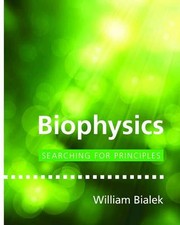
Catalogued under the bare title Biophysics. Bialek's course argues that living systems are often close to fundamental physical limits on signalling, and treats information theory as a central biological tool. The natural summit of the path.

The bridge from Bialek's principles to actual computation: ensembles, sampling, free-energy methods and molecular simulation, explained conceptually rather than as software documentation. Read it last, as the entry into doing your own research.
Discussion
Keep reading
Paths that share books, cover the same subject, or open a related topic.