Biophysics has the widest difficulty range of any subject on this site. The same shelf holds a short wartime essay containing no mathematics at all and a graduate textbook whose exercises are close to research problems. Both are correctly labelled biophysics. A reader who enjoys the essay, orders the well-reviewed textbook next and opens it onto partition functions has been badly served, and that is by far the most common way people give up on this field.
So the useful thing an ordering can do here is state, for each book, what it is and what mathematics it assumes. That is what this path does. The other reason for order is conceptual: biophysics is mostly the physics of the very small and very wet, where thermal noise is enormous, inertia is irrelevant and everything is a statistics problem. Until that picture is in place, the equations look arbitrary.
No mathematics required
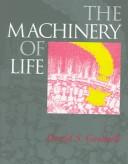
Start with The machinery of life by David S. Goodsell, not with the famous essay. Goodsell is a molecular illustrator, and the book draws cells and their contents at consistent scale, so you see how crowded the interior actually is. That single image of molecular crowding is the intuition every later chapter depends on, and you can absorb it in an evening.
What is life? is Erwin Schrödinger's 1944 lecture series, and it is a historical document rather than a current account. It is short, elegant, wrong in interesting places, and it influenced the founders of molecular biology. Read it for the origin story, not for the science. Life's Ratchet by Peter M. Hoffmann is the popular treatment of the central idea: that molecular machines extract useful work from thermal chaos. No equations, and a good bridge to the technical books.
Arithmetic and first-year calculus
Cell Biology by the Numbers by Ron Milo and Rob Phillips is the hinge of this whole path. It asks how big, how many, how fast, how long — and answers with order-of-magnitude estimates you can check on paper. The mathematics is arithmetic and unit conversion; the skill it builds is the one that makes the real textbooks tractable.
Random walks in biology by Howard C. Berg is short, cheap and the classic first technical book on diffusion, sedimentation and chemotaxis. It assumes calculus and a little probability, nothing more, and it is the gentlest possible introduction to thinking about biology statistically. E. Coli in Motion, also by Berg, is the follow-up monograph on how bacteria swim and steer — narrow, beautiful and still readable at the same level. Life in Moving Fluids by Steven Vogel handles biological fluid mechanics with unusual wit; algebra and dimensional analysis are enough for most of it.
The textbooks, and what they demand
Biological Physics by Philip Nelson is the standard undergraduate course text and the right first real textbook. It assumes calculus-based introductory physics and some probability, and then builds statistical mechanics from scratch rather than assuming it. It is genuinely well written, and it is a course, not a read.
Physical Biology of the Cell by Rob Phillips and colleagues covers similar ground at greater length and with a stronger estimate-first philosophy; it is heavier and more expensive, and either it or Nelson is enough. Molecular driving forces by Ken A. Dill and Sarina Bromberg is the statistical thermodynamics engine underneath both — take it if the entropy and free-energy arguments in Nelson felt like assertions.
Graduate level
These assume the previous section. Protein physics by Alexei V. Finkelstein and Oleg Ptitsyn is a lecture course on folding and structure. Mechanics of Motor Proteins and the Cytoskeleton by Jonathon Howard is the standard graduate treatment of molecular motors and polymer mechanics. Statistical physics of biomolecules by Daniel M. Zuckerman is the bridge to simulation, and unusually careful about what the formalism means. Biophysics by William S. Bialek is the hardest book here by a distance: it argues that living systems operate near physical limits, and it expects fluency in statistical mechanics and information theory. It is a wonderful book in the wrong hands and a wall in any others.
Work the ordered path and each book arrives with the mathematics it needs already in place.
Follow the full ordered path here: Best Books to Learn Biophysics, in Order — With the Maths Each One Assumes.