Billiards and pool: the best books to run the table with confidence
This curriculum takes a beginner from the very basics of stance, grip, and stroke all the way through advanced position play, English (spin), and competitive strategy. Each stage builds on the last — you must own the fundamentals before spin and position make sense, and you must master position before table-running strategy becomes actionable.
Foundations: Stance, Stroke & the Basics
BeginnerBuild a repeatable, correct stance, grip, bridge, and stroke — the physical bedrock everything else rests on.
▸ Study plan for this stage
Pace: 4–5 weeks, ~40–50 pages/day with 2–3 practice sessions per week at a pool table
- Proper stance and body alignment for stability and consistency
- Grip pressure and hand positioning for control and follow-through
- Bridge types (open, closed, rail bridge) and when to use each
- Stroke mechanics: arm motion, cue angle, and acceleration
- The relationship between stance, bridge, and stroke as an integrated system
- Aiming fundamentals and how body position affects shot accuracy
- Cue ball control through speed and spin application
- What are the key elements of a proper stance, and why does body alignment matter for consistency?
- How do grip pressure and hand position differ between a stable bridge and a loose grip, and what are the consequences of each?
- What are the three main bridge types described in Byrne's book, and when should you use each one?
- Describe the complete stroke motion from setup to follow-through, and how does arm acceleration affect shot quality?
- How do the 99 critical shots in Martin's book demonstrate the importance of foundational stance and stroke?
- What is the relationship between cue angle, body position, and shot accuracy?
- Practice the stance and bridge setup 50 times without shooting, focusing on alignment and comfort
- Shoot 20 straight shots (center-to-center) from various distances using only your basic stroke, tracking consistency
- Practice all three bridge types (open, closed, rail) on 10 different table positions each
- Execute 10 shots from Byrne's fundamentals section, filming yourself to compare against the book's descriptions
- Work through 5–10 of the 99 critical shots from Martin's book, focusing on how proper stance enables the shot rather than compensating with arm motion
- Shoot 30 cue-ball-only shots (no object balls) to develop pure stroke mechanics without aiming variables
- Practice speed control: shoot the same shot at three different speeds (soft, medium, firm) and observe cue ball travel
Next up: This stage establishes the non-negotiable physical foundation—once stance, grip, bridge, and stroke are repeatable and correct, you're ready to layer in aiming systems, shot selection, and game strategy in the next stage.
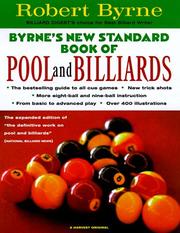
The single most respected all-around reference for beginners and beyond. Start here to get accurate vocabulary, equipment knowledge, and a clear introduction to every shot type before diving into specialized topics.
A highly visual, shot-by-shot guide that reinforces the fundamentals with concrete, repeatable drills — ideal for cementing what Byrne introduces and building muscle memory early.
Aiming Systems & Cue Ball Control
BeginnerUnderstand and apply reliable aiming systems (ghost ball, fractional ball, contact points) and begin controlling where the cue ball travels after contact.
▸ Study plan for this stage
Pace: 2–3 weeks, ~20–25 pages/day, with 2–3 practice sessions per week at a pool table
- Ghost ball method: visualizing the contact point by imagining where the cue ball would need to be to pocket the object ball
- Fractional ball aiming: using the visible portion of the object ball to determine the precise contact point and aim line
- Contact point geometry: understanding how the angle of approach determines where the cue ball contacts the object ball
- Cue ball control through speed and stroke: how velocity and follow-through affect cue ball trajectory after impact
- The relationship between object ball motion and cue ball motion: predicting where each ball travels based on impact geometry
- Stance, alignment, and bridge fundamentals: establishing a consistent foundation for accurate aim and stroke delivery
- Reading the table: assessing angles, distances, and ball positions to select the most reliable aiming system for each shot
- How does the ghost ball method work, and when is it most effective compared to other aiming systems?
- What is fractional ball aiming, and how do you use the visible edge of the object ball to determine your contact point?
- How does the angle of cue ball approach affect where the object ball travels, and what does this tell you about contact point selection?
- What is the relationship between cue ball speed and cue ball control after impact, and how do you adjust your stroke to achieve desired post-contact movement?
- How do stance, bridge, and alignment directly influence your ability to aim accurately and execute consistent strokes?
- Given a specific table layout, how would you choose between the ghost ball method and fractional ball aiming, and why?
- Ghost ball drill: Set up 5–10 object balls at various angles on the table. For each, visualize and mark (with chalk or mentally) where the cue ball would need to be to pocket the object ball, then attempt the shot. Record your success rate.
- Fractional ball aiming practice: Place an object ball near a pocket and practice hitting it at different fractions (full ball, 3/4, 1/2, 1/4) to develop feel for contact points. Aim for 10 consecutive successful pockets at each fraction.
- Contact point mapping: Draw or visualize a grid on an object ball (12 contact points around its circumference). Practice hitting each contact point deliberately to understand how angle of approach changes the object ball's direction.
- Speed control and cue ball path: Execute the same shot 5 times with varying cue ball speeds (soft, medium, firm). Observe and document how cue ball speed affects its post-impact trajectory and final resting position.
- One-pocket aiming challenge: Set up 3–5 shots of increasing difficulty that require accurate aiming to pocket balls in a designated pocket. Use both ghost ball and fractional methods, comparing which feels more reliable for each shot.
- Stance and alignment consistency check: Take 10 shots at the same object ball from the same position. Video record or have a partner observe your stance, bridge, and alignment. Identify any inconsistencies and drill the corrected form until it feels automatic.
Next up: Mastering aiming systems and cue ball control establishes the foundation for the next stage—advanced shot selection and break techniques—where you'll apply these fundamentals to plan multi-shot sequences and execute powerful, controlled breaks.
Capelle's systematic approach to aiming, angles, and cue ball paths is unmatched for a player moving past raw basics. Read this after Byrne to layer a logical aiming framework onto your newly formed stroke.
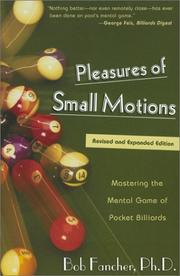
A unique book focused on the mental and physical discipline of a consistent, small, repeatable stroke — bridges the gap between mechanical aiming and internalizing feel and touch.
English, Spin & Advanced Cue Ball Control
IntermediateMaster topspin, backspin, and left/right English (sidespin), understand throw and deflection, and use spin purposefully to shape position.
▸ Study plan for this stage
Pace: 4–5 weeks, ~25–30 pages/day, with 2–3 practice sessions per week at the table
- Topspin mechanics: how hitting above center creates forward roll and affects cue ball trajectory after contact
- Backspin mechanics: how hitting below center creates reverse rotation and enables draw shots and stop shots
- English (sidespin): how hitting left or right of center affects cue ball path, object ball deflection, and throw
- Throw and deflection: how sidespin on the cue ball causes the object ball to deviate from the expected contact line
- Spin transfer and object ball behavior: how different spins affect the object ball's path, speed, and final position
- Cue ball control in position play: using spin combinations to shape the cue ball's path and achieve specific leave angles
- Speed and spin interaction: how speed modulates the effects of topspin, backspin, and English on table geometry
- Reading the table: predicting cue ball and object ball movement based on spin application and speed
- What is the difference between topspin and follow, and how does each affect the cue ball's motion after object ball contact?
- How does backspin (draw) work mechanically, and what are three distinct uses for draw in position play?
- Explain the concept of throw: why does English on the cue ball cause the object ball to travel at an angle different from the contact line?
- What is the relationship between cue ball speed and the effectiveness of English? How does speed change the magnitude of deflection?
- How can you use a combination of topspin and English to control the cue ball's path and achieve a specific position for the next shot?
- Describe the difference between natural angle and throw angle, and how understanding this distinction improves position play.
- Drill: Hit 20 shots with pure topspin (follow) at various speeds on a practice table, noting how the cue ball behaves after contact—observe the difference between soft and hard follow
- Drill: Execute 20 draw shots (backspin) at different speeds and distances, focusing on achieving a complete stop or controlled backward motion
- Drill: Practice left and right English on the cue ball by hitting 15 shots with each, observing how the object ball deflects and the cue ball curves
- Drill: Set up a simple two-ball position play scenario and use throw to intentionally move the object ball off its natural line; repeat 10 times with different English applications
- Drill: Practice the 'speed control with spin' exercise: use the same English but vary speed across three shots to see how speed modulates deflection and throw
- Game simulation: Play a series of 3–4 practice games focusing solely on using spin for position, not on making balls—track how often you achieve your intended cue ball position
- Drill: Set up 10 different cue ball and object ball positions and predict the throw angle before shooting; compare prediction to actual result and adjust understanding
- Drill: Practice 'spin combinations': execute shots that use both topspin and English (or backspin and English) to achieve complex position plays
Next up: Mastery of spin and cue ball control establishes the foundation for advanced position play and break strategy, enabling you to move the cue ball with precision and intention to set up high-percentage shots in competitive play.
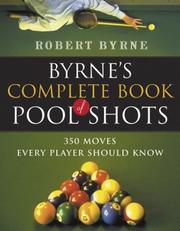
Byrne's deep-dive companion volume covers hundreds of specific shots with spin and English explained shot by shot — the natural next step once you have a solid stroke and basic aiming down.
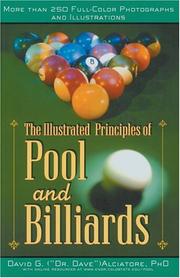
Written by an engineering professor, this book explains the physics of spin, deflection, throw, and cue ball paths with scientific precision — gives you the 'why' behind English so you can predict and control results.
Position Play & Running Racks
IntermediateThink in sequences rather than single shots — plan routes, use zones, and develop the pattern recognition needed to run multiple balls or full racks.
Capelle applies his systematic thinking specifically to 8-ball strategy, pattern play, and safety play — the most-played game worldwide, and the ideal format for learning position sequencing.
Strategy, Competition & the Mental Game
ExpertIntegrate physical skill with competitive strategy, safety play, shot selection under pressure, and the mental discipline needed to win matches consistently.
▸ Study plan for this stage
Pace: 4–5 weeks, ~20–25 pages/day, with 2–3 practice sessions per week at the table
- One-pocket as a strategic framework: how the single pocket constraint forces deliberate shot selection and long-term planning
- Position play and cue ball control as the foundation of competitive strategy
- Safety play and defensive positioning: using the table geometry to limit opponent options
- Shot selection under pressure: evaluating risk/reward and committing to high-percentage plays
- The mental discipline of match play: managing emotion, maintaining focus, and adapting strategy mid-match
- Reading the table and opponent tendencies: gathering information to inform tactical decisions
- Endgame execution: converting position advantage into wins when pressure is highest
- How does the one-pocket format force a different approach to strategy compared to other pool games, and what principles from one-pocket apply to your overall competitive play?
- What is the relationship between position play, cue ball control, and safety play in Robin's strategic framework?
- How do you evaluate risk versus reward when selecting a shot during a match, and what criteria should guide that decision?
- Describe a defensive safety strategy and explain how it limits your opponent's options on the table.
- What mental adjustments should you make when playing under pressure, and how does Robin address the psychological aspects of winning?
- How can you read your opponent's tendencies and adjust your strategy mid-match based on what you observe?
- Play 10 one-pocket practice games against yourself or an opponent, focusing solely on position play and cue ball control—do not worry about scoring, only about leaving yourself in position for the next shot
- Drill 20 safety shots in one-pocket: practice leaving the cue ball in defensive positions that minimize your opponent's options, then analyze why each safety is effective
- Study 5 match scenarios from Robin's book: for each, identify the best shot selection and explain your reasoning based on risk, position, and opponent tendencies
- Play 5 full one-pocket matches (to completion) and record your shot selections, noting which decisions were high-percentage and which were risky—review afterward to identify patterns in your decision-making under pressure
- Practice the endgame: set up 10 scenarios where you have 2–4 balls remaining in one-pocket and work on converting position advantage into wins with precision and composure
- Analyze one of your recorded matches or watch a professional one-pocket match, pausing after each shot to predict the next player's options and evaluate the quality of position play
Next up: This stage equips you with the strategic and mental tools to compete at an advanced level; the next stage will likely deepen specialization in specific game formats or refine your ability to teach and mentor others using these principles.

One-pocket is the ultimate strategy game in billiards; studying its deep safety and counter-safety logic elevates your strategic thinking across all pool formats.
Discussion
Keep reading
Paths that share books, cover the same subject, or open a related topic.