Annie Proulx Reading Order: Where to Start with the Novels and Stories
Proulx is known for one Pulitzer novel and one short story that became a film, and both give a misleading impression of a writer whose real subject is land being used up by the people on it. She also published nothing until she was fifty-three, so there is no juvenilia to wade through. This path starts with the two famous books because they are genuinely the best doorways, then goes back to the beginning, then follows the widening geography of the middle novels, and ends with the seven-hundred-page forest epic.
The Two Famous Ones, and They Are the Right Start
BeginnerGet Proulx's compressed, verb-heavy, deliberately strange prose in the two books where it is most welcoming, and see her doing both forms she works in.
▸ Study plan for this stage
Pace: Four to five weeks. The Shipping News is 345 pages and the prose slows you down more than the plot does — three weeks at 20 pages a sitting, and read the epigraph at the head of each chapter. Close Range is 296 pages in eleven stories; one story a sitting, and do not read Brokeback Mountain out of o
- Proulx's sentences run on verbs and nouns with the connective tissue cut out — fragments, dropped articles, compound coinages. It reads as difficulty for the first fifty pages and then as speed. Do not smooth it out in your head; the omissions are load-bearing.
- The Shipping News is her warmest book and therefore atypical. Quoyle is a failure who becomes competent, and the novel actually lets him — an arc she almost never grants anyone else.
- Every chapter of The Shipping News is headed by a knot, with a description of what the knot does. The knot is a comment on the chapter and sometimes a prediction, and skipping them removes a whole layer of the book.
- The ancestral house dragged across the ice and lashed to the rock is the book's central image: an inheritance that has to be physically held down against the place it came from, and that the place eventually takes back.
- Close Range opens with The Half-Skinned Steer, an old man driving back to Wyoming into a blizzard with a story from his childhood surfacing as he goes, and it establishes the collection's rule — the landscape gets the last word.
- Brokeback Mountain works by restraint: two decades compressed into thirty pages, the crucial events reported flatly and at a distance. That restraint only registers because the stories around it are so brutal, which is why the collection has to be read whole.
- The Wyoming of Close Range is an economy, not a backdrop. Ranch failure, wage work, injury and the sale of land are the engine of nearly every story, and the physical damage the work does to bodies is described without any softening.
- Take one paragraph of The Shipping News and rewrite it in ordinary complete sentences. What is lost, and is anything gained?
- What do the knot epigraphs do that a plain chapter number would not? Point to a chapter where the knot changes your reading of the events.
- The Shipping News allows Quoyle to end up better off. Reading Close Range immediately after, why does that ending feel like a departure rather than a template?
- In The Half-Skinned Steer, what exactly does the childhood story have to do with the drive? The connection is never stated.
- Brokeback Mountain reports its two decisive events almost in passing. What does that flatness achieve that a dramatised scene would not?
- Across Close Range, who or what is usually responsible for a character's ruin — a person, an economy, or a place?
- Copy out a Proulx paragraph by hand and mark every verb. The density is the point and it does not register at reading speed.
- List the eleven stories of Close Range with a one-line note on how each ends. Read the list back; the pattern in the endings is the collection's argument.
- Reread the last two pages of The Shipping News, then write 200 words on whether the closing claim about love is earned by what precedes it or asserted over it.
- Read Brokeback Mountain a second time immediately, marking every time-jump. Count how many years the story covers and how many scenes it uses to do it.
Next up: You now have the writer at her most welcoming; the first two books show the same technique with the warmth removed, which is closer to what she actually does.
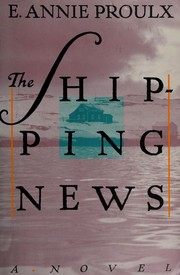
A failed newspaperman takes his daughters to ancestral Newfoundland and slowly becomes competent. Her Pulitzer and National Book Award winner, and by some distance her warmest book, which makes it the correct entry even though it is atypical.
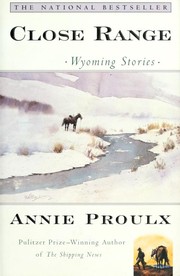
The first Wyoming Stories collection, and the one containing Brokeback Mountain and The Half-Skinned Steer. Read the whole book rather than the famous story alone: the story's restraint only registers against the brutality of the ones surrounding it. Often catalogued as Close Range: Wyoming Stories.
Back to the Beginning
IntermediateRead the first two books and find the harsher writer underneath The Shipping News — rural New England as a place of failure rather than of picturesque hardship.
▸ Study plan for this stage
Pace: Four weeks. Heart Songs is 192 pages in a handful of stories — a week and a half, one story a sitting. Postcards is 346 pages and covers forty years, so it moves in jumps; two and a half weeks, and keep a note of who is where, because the family scatters early and the novel does not remind you.
- Heart Songs was her first book, published in her fifties, and the style is already complete — the compression, the verbs, the refusal of sentiment. There is no apprentice work to read past, which is unusual and worth noticing.
- The New England of Heart Songs is a class landscape: people who have always been there and people who have bought in, with the newcomers consistently misreading what they are looking at. The comedy and the cruelty both come from that gap.
- Postcards opens with a killing in a field on the first page and then declines to make the novel about it. What follows is forty years of a man moving west and a farm dying behind him, and the murder functions as the thing that set both in motion rather than as a mystery.
- The structure is announced by the title: each section opens with a postcard, often barely literate, often from someone whose situation the reader has to infer. It is a novel told partly in the gaps between documents.
- Loyal Blood cannot go home and cannot settle, and the jobs he takes — trapping, prospecting, bone hunting, wage labour — trace the twentieth-century rural economy from the outside. His inability to be near a woman is the one psychological fact the book supplies, and it supplies it without explanatio
- The family left behind is the other half and the harder half: the farm failing by increments, the mother and brother and sister absorbing it in different ways. This is the thesis The Shipping News softened — a rural America that does not survive the century.
- Read chronologically by publication and you can see her scale expanding: stories about a valley, then a novel about a continent crossed on foot.
- In the Heart Songs stories, what does an incomer typically get wrong, and what does the story do to them for it?
- Postcards refuses to be a crime novel after page one. What kind of novel does it become instead, and when did you realise it?
- What do the postcards tell you that the narrative does not? Pick two and say what each reveals about its writer.
- Loyal cannot go back and cannot stay anywhere. Does the novel offer a reason, or only the fact?
- Set Postcards beside The Shipping News. Both are about a family and a place. What has Proulx allowed in one book that she withholds in the other?
- Draw a timeline of Postcards with Loyal's movements on one line and the farm on the other. The novel cuts between them without transitions and the timeline is how you keep it.
- Take the first paragraph of Heart Songs' opening story and the first paragraph of The Shipping News. Write 200 words on what has and has not changed in the prose over a decade.
- Copy out three of the postcards verbatim and write a paragraph on each about the person who wrote it, using only what is on the card.
- Note every job Loyal takes and the year. That list is a short economic history and it is the book's least visible achievement.
Next up: Postcards moves one man across a continent; the middle novels take the same restlessness and make the continent itself the protagonist.

Her first book, stories of back-country Vermont and New Hampshire, published when she was fifty-three. Read it third: it shows the style already fully formed and the sentiment entirely absent.

A Vermont farm boy kills a woman on the first page and spends forty years drifting west while the farm dies behind him. Her first novel and the winner of the PEN/Faulkner. This is the real Proulx thesis — a rural America that does not survive the century — stated before The Shipping News softened it.
The Sprawling Middle Novels
IntermediateFollow her out of New England and into the continental-scale books, where the protagonist is an object or a landscape rather than a person.
▸ Study plan for this stage
Pace: Six weeks. Accordion Crimes is 408 pages but functions as linked novellas — read one family's section a sitting and do not push through two. That Old Ace in the Hole is 384 pages and much the easiest reading on this path; two weeks.
- Accordion Crimes follows a single green button accordion, built by a Sicilian immigrant, as it passes through immigrant families across a century of American life. The object is the protagonist and the people are episodes, which is the structural risk the whole book takes.
- Each section is a different immigrant group in a different region, and the recurring subject is what the receiving country does to arrivals — the violence in the first section is not an outlier, it is the pattern the rest of the book repeats in other keys.
- Proulx kills characters off abruptly, often mid-clause or in a parenthesis, with no dramatic weight. Readers divide sharply on this. It is deliberate: the accordion's story continues and no individual life is allowed to become the story.
- Music is the connective tissue — polka, conjunto, zydeco, Cajun, Tejano — and the book is partly an argument that American vernacular music is what immigrant traditions turned into under pressure.
- That Old Ace in the Hole is the comic novel and the most explicit statement of her real subject. A young man is sent to the Texas panhandle to scout sites for industrial hog operations and falls in love with the community he is there to buy out.
- The panhandle is delivered through talk: long digressive stories from the people Bob Dollar boards with and interviews. The oral-history texture is where the novel does its work, and the plot is mostly an excuse for it.
- Land use is the through-line of the whole career, and this is the book where she says it outright — what the ground is for, who decides, and what happens to the people standing on it when the decision is made elsewhere.
- The accordion survives everyone who owns it. What does using an object as protagonist let Proulx show that a family saga could not?
- Characters in Accordion Crimes die in throwaway clauses. Is that a moral position, a formal device, or a failure of proportion? Argue it either way with examples.
- Which section of Accordion Crimes worked least well for you, and is the weakness in that section or in the structure that requires it?
- In That Old Ace in the Hole, Bob Dollar changes his mind. What actually changes it — an argument, a person, or the accumulation of stories?
- The comedy of That Old Ace in the Hole sits on top of the same material as Postcards. What does the lighter register make possible, and what does it cost?
- Keep a one-line log of each Accordion Crimes section: family, region, decade, fate. Read the log back at the end — it is the book's argument in a page.
- Mark every parenthetical death as you go. Count them. Then write 200 words on whether the accumulation reads as callousness or as the point.
- Listen to one recording of each musical tradition the novel passes through, in reading order. It takes an hour and it converts a list of genres into an audible sequence.
- In That Old Ace in the Hole, pick three of the long stories told to Bob Dollar and write down what each is doing to his position. None of them argue with him directly.
Next up: You have the wide-continental Proulx; the last stage returns to one state, finishes the trilogy that made her name in it, and then goes wider than anything here.
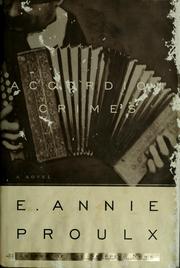
A single green accordion passes through immigrant families across a century of American violence. Structurally her boldest book, and the one that most divides readers; read it fifth, when you already trust her.

A young man scouts the Texas panhandle for industrial hog-farm sites and falls for the place he is meant to buy. The funniest of the novels, and the most explicit about her real interest in land use.
The Later Wyoming and the Epic
IntermediateFinish the Wyoming trilogy, read the memoir of the house she built there, and take on the three-hundred-year forest novel that is her final statement.
▸ Study plan for this stage
Pace: Ten to twelve weeks, most of it the last book. Bad Dirt and Fine Just the Way It Is are 240 pages each in short stories — two weeks apiece, one story a sitting. Bird Cloud is 288 pages and reads quickly. Barkskins is 736 pages across three centuries; give it five weeks at 25 pages a day and keep a f
- Bad Dirt is the deliberate lightening of the trilogy: tall tales, absurdist premises, a game warden with a hole in the ground that disposes of offenders. The comedy is real and it is also a setup for how dark the third volume goes.
- Fine Just the Way It Is is the bleakest of the three, and two of its stories are set in Hell as a going concern with management problems. Reading the trilogy in order matters because the cumulative portrait of a state — the same towns, the same failing economics, three tonal registers — is the actua
- The trilogy's historical stories reach back to the open-range period, and the modern ones reach forward to soldiers coming home from Iraq. The state is presented as one continuous economy of hard use across a century and a half.
- Bird Cloud is a memoir of buying several hundred acres on the North Platte and building a house there, and of the road, the winter, the contractors and the wildlife. It is slight beside the fiction and reviewers said so, and it is the only direct account of the landscape the stories circle.
- The eagles, the cliff and the inaccessibility in Bird Cloud are the same forces the fiction uses, met by the author in person and with a cheque book. Read it as a control experiment rather than as a masterwork.
- Barkskins begins in 1693 with two indentured Frenchmen arriving in New France and follows their descendants for three hundred years while North America is cut down. One line becomes a timber dynasty; the other is Mi'kmaq and is dispossessed by the same industry.
- The book's method is its argument: individual characters get a chapter and die, the forest and the company outlive them all, and the reader is meant to feel the scale rather than attach to a protagonist. That is why it is her hardest book to love and the right place to end.
- The through-line from Heart Songs to Barkskins is one subject at increasing magnification — land being used up by the people living on it — which is only visible once you have read the sequence.
- What does Bad Dirt's comedy make possible in the third volume that a uniformly bleak trilogy could not have achieved?
- The two Hell stories in Fine Just the Way It Is are broad satire in an otherwise realist collection. What are they for?
- Across the three Wyoming volumes, what changes about the state and what stays the same? Give a concrete example of each.
- Bird Cloud shows Proulx paying for the difficulty her characters endure. Does knowing that change how you read the fiction, and should it?
- In Barkskins, no character survives long enough to be the hero. What does the book gain by that, and what does it ask the reader to give up?
- Barkskins ends in the present day. Is the ending a conclusion, a warning, or a refusal to conclude? Cite the last chapter.
- Read the three Wyoming volumes back to back and keep a single list of every story with its decade. The chronological spread is invisible within any one book.
- Build the Barkskins family tree yourself as you read, adding names in the chapter they appear. Trying to do it retrospectively at page 500 does not work.
- Write 300 words on Barkskins as the endpoint of the career: name three things in it that were already present in Heart Songs.
- Take one Bird Cloud passage about the land and one Close Range passage about the same kind of country. Set them side by side and write a paragraph on what the fiction does that the memoir does not.
- Pick the single story from the trilogy you would give someone who had read nothing by her, and write out your reason in five sentences.
Next up: This is the end of the path: the two famous books, the harsh beginnings, the continental novels and the three-century epic, which together show one subject pursued for thirty years at ever-larger scale.

The second Wyoming Stories volume, lighter and more comic than Close Range, with tall tales alongside the bleakness. A deliberate step down in intensity before the last two books.
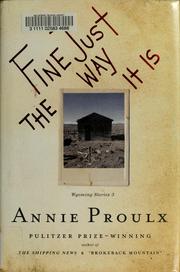
The third and final Wyoming Stories collection, and the darkest, including two stories set in Hell. It completes a trilogy that is best read in order because the cumulative portrait of the state is the point.
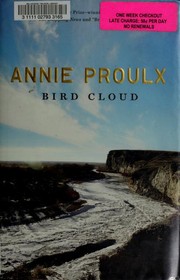
A memoir of buying land and building a house on the North Platte in Wyoming, and of everything that went wrong. Slight compared with the fiction, but it is the direct account of the landscape the stories keep circling.

Seven hundred pages, two families, three hundred years, and the deforestation of North America. It is her most ambitious book and her hardest to love, which is exactly why it belongs at the end rather than anywhere else in the sequence.
Discussion
Keep reading
Paths that share books, cover the same subject, or open a related topic.