Adrienne Rich Reading Order: Where to Start with the Poems and the Essays
Rich changed her poetics several times across fifty years, so a Collected Poems read front to back gives most readers three different writers in sequence with no explanation. This path enters at the point where her voice and her politics had fused, works outward to the prose that argues the same case in a different register, and only then goes back to the formal early work — which is far more interesting once you can hear what she was about to break away from.
Start here: the two central collections
BeginnerMeet Rich at the moment her poetry and her politics became the same project.
▸ Study plan for this stage
Pace: About 2 weeks. Diving into the Wreck and The Dream of a Common Language are 60-80 page collections, so the constraint is not length but density: five or six poems a sitting, and plan to reread the title poem of Diving into the Wreck and the whole Twenty-One Love Poems sequence at least twice before
- The dive as Rich's central method: going down to look at the wreck itself rather than the story told about it
- The book of myths in which our names do not appear - the claim that the received record is not neutral but authored
- The androgynous diver of the title poem, who is both 'she' and 'he' and finally 'we'
- Twenty-One Love Poems in The Dream of a Common Language as a sequence, not a set of separate lyrics, with 'The Floating Poem, Unnumbered' deliberately outside the count
- 'A common language' as a demand rather than a description - the language does not yet exist in these poems
- How Rich uses the line break against the sentence, so syntax and lineation pull in different directions
- The move from the private lyric 'I' to a plural, addressed 'you' and 'we'
- In the title poem of Diving into the Wreck, what exactly is the difference between 'the wreck' and 'the story of the wreck', and why does the poem insist on it?
- Where do the pronouns shift in that poem, and what has changed by the time the speaker arrives at 'we'?
- Why is 'The Floating Poem, Unnumbered' left out of the numbering of Twenty-One Love Poems, and what would be lost if it were numbered?
- What does Rich mean by a 'common language', and does The Dream of a Common Language claim to have found one or to be reaching for one?
- Both collections were written within five years of each other - what does the second book do that the first could not?
- Read the title poem of Diving into the Wreck aloud twice: once following the sentences through the line breaks, once stopping at every line end. Note the three or four places where the two readings produce different meanings.
- Mark every pronoun in that poem in the margin and track the sequence - I, she, he, we - then write two sentences on what the poem argues by making that move rather than stating it.
- Read all of Twenty-One Love Poems straight through in one sitting, then go back and read only 'The Floating Poem, Unnumbered'. Write a paragraph on why the sequence needed a poem standing outside its own order.
- Copy out one stanza from The Dream of a Common Language by hand and mark where each line ends mid-phrase. This is the fastest way to hear what her lineation is doing.
- Pick one poem from each collection and put them side by side - the two books are five years apart and the change in the voice is audible over that gap.
Next up: Having heard the arguments made as poems, you are ready to read Rich stating them outright in prose, where the claims the poems compress become explicit.

The book that won the National Book Award in 1974 — which Rich accepted on behalf of all women rather than herself. The title poem is the clearest statement of her method: a descent to look at the damage directly rather than at the story told about it.
The next collection and, for many readers, the essential one. The Twenty-One Love Poems sequence is here, and it is where her love poetry and her political argument stop being separable.
The prose that makes the case
IntermediateRead the arguments in the form where Rich states them outright, and see how much of the poetry they explain.
▸ Study plan for this stage
Pace: 3-4 weeks. Of Woman Born and On Lies, Secrets, and Silence are both around 310-320 pages of argument, so roughly 20 pages a day. Read Of Woman Born straight through, but treat On Lies, Secrets, and Silence as a collection to work through essay by essay rather than cover to cover.
- Of Woman Born's founding distinction: motherhood as experience versus motherhood as institution
- That the institution can be attacked without attacking the experience - the argument most often misreported
- 'Compulsory Heterosexuality and Lesbian Existence' and its central move: treating heterosexuality as an institution requiring enforcement rather than a default
- The 'lesbian continuum' and why Rich built a term broad enough to include women who would not have used it of themselves
- 'When We Dead Awaken: Writing as Re-Vision' and re-vision as looking back at received texts with fresh eyes rather than rejecting them
- Rich's habit of writing autobiography and argument in the same paragraph, and why she thought the separation was itself ideological
- How much of the poetry in stage one these essays turn out to explain
- What exactly does Of Woman Born mean by the 'institution' of motherhood, and what does Rich claim it takes from women who mother?
- In 'Compulsory Heterosexuality', what is the evidence Rich offers that heterosexuality requires enforcement rather than simply occurring?
- The 'lesbian continuum' has been criticised for being too capacious. What is Rich buying with that breadth, and what is she paying for it?
- What does 'writing as re-vision' ask a reader to do that ordinary criticism does not?
- After reading these essays, which poems from stage one read differently - and does the prose enrich them or reduce them to illustration?
- Read 'Compulsory Heterosexuality and Lesbian Existence' in On Lies, Secrets, and Silence, then immediately reread Twenty-One Love Poems. Write half a page on what the essay makes visible in the sequence and what the sequence does that the essay cannot.
- Read 'When We Dead Awaken: Writing as Re-Vision' and mark every passage where Rich is describing her own earlier practice. Keep those pages bookmarked - they are the argument for the next stage's reading order.
- In Of Woman Born, find three places where Rich shifts from research to her own experience of mothering. Note what the shift does to the authority of the claim on either side of it.
- Take one paragraph of Of Woman Born and one stanza from The Dream of a Common Language that make the same claim, and write out what the poem gets to leave unsaid.
Next up: 'When We Dead Awaken' describes the formal poet Rich was before the break, which is exactly the writer you meet in the next stage.

Her study of motherhood as experience and as institution, and the book that reaches readers who never read poetry. Read it after the two collections and the poems stop being obscure.
The essays, including the widely taught Compulsory Heterosexuality piece. It is the argumentative spine underneath the poems of the same decade.
Backwards, to the formal poet
IntermediateHear what she sounded like before the break, which is what makes the break legible.
▸ Study plan for this stage
Pace: About a week. Snapshots of a Daughter-in-Law runs to roughly 65 pages, so the reading is short - the work is in reading it twice, once for the poems and once against everything in stages one and two.
- The title poem's structure: ten numbered sections, studded with quotations from other writers, rather than a single sustained lyric
- That Rich began dating her poems with this book - an insistence that a poem belongs to a moment rather than to eternity
- The audible tension between inherited formal skill and material that the forms cannot hold
- Why the volume reads as a document of impatience rather than an apprentice work, once you already know what came after
- The gap between the third-person distance of these poems and the first-person insistence of Diving into the Wreck
- Where in the title poem does the metre loosen, and does it loosen where the argument gets hardest?
- Why does Rich quote other writers throughout the title poem instead of speaking in her own voice, and who is being quoted against whom?
- What does dating her poems commit her to that an undated poem does not?
- Reading this after Diving into the Wreck rather than before, what looks like a limitation and what looks like deliberate restraint?
- In 'When We Dead Awaken' Rich describes writing this poem in fragments over years - can you see the seams?
- Read the title poem's ten sections in order and mark each of the quoted or borrowed voices. Then read only the sections in Rich's own voice, in sequence, and see whether the argument still holds.
- Take the most formally regular poem in the collection and the least regular, and read them back to back aloud. Write two sentences on what the looser poem could say that the tighter one could not.
- Reread 'When We Dead Awaken' from the previous stage alongside this book, marking the passages where Rich is describing these specific poems.
- Set one page of Snapshots of a Daughter-in-Law beside one page of The Dream of a Common Language and list the concrete differences: line length, pronouns, punctuation, the presence or absence of an addressee.
Next up: With the early formal voice and the mid-career break both in your ear, the long historical poems of the last decades stop sounding like a third unrelated writer.

The 1963 collection where the formal early manner starts to crack. Reading it third rather than first turns it from a stiff apprentice book into a document of a writer becoming impatient with her own skill.
The later work
IntermediateFollow the long, public, historically-minded poetry of her last decades.
▸ Study plan for this stage
Pace: 2-3 weeks. Both books are around 60 pages, but An Atlas of the Difficult World is built around a thirteen-part title poem that should be read in one sitting and then returned to across several days.
- The turn outward: history and the country itself become the subject rather than the self or the couple
- A Wild Patience Has Taken Me This Far as the quieter, more elegiac book - poems that take real historical women as their subjects, including 'For Ethel Rosenberg'
- An Atlas of the Difficult World's title poem in thirteen sections, moving across American geography and American violence
- The closing litany, 'I know you are reading this poem...', which addresses the reader directly and by circumstance
- How the long serial poem lets Rich hold public history and private address in the same structure
- Patience and difficulty as the two words that name what changed in her late work
- What is the 'wild patience' of the title, and what has it been patient with?
- In 'For Ethel Rosenberg', what does Rich do with a historical woman that a straightforward elegy would not?
- How does the thirteen-part structure of 'An Atlas of the Difficult World' work - is it a sequence, an argument, or a map?
- Who is the 'you' of the closing litany, and what does the poem gain by refusing to specify?
- Is the late Rich more political than the Rich of Diving into the Wreck, or political in a different register?
- Read 'An Atlas of the Difficult World' in one sitting, then write down the place or subject of each of the thirteen sections. The list is the argument.
- Read the final section's 'I know you are reading this poem' litany aloud, and note the moment where it stops describing readers in general and starts describing you.
- Put the title poem of Diving into the Wreck and the title poem of An Atlas of the Difficult World side by side. Both are descents into damage; write a paragraph on what eighteen years changed about the descent.
- Pick one poem from A Wild Patience Has Taken Me This Far that takes a historical figure as its subject and write a short paragraph in Rich's late register about a person you know - the exercise is to feel how much of that voice is restraint.
Next up: With the four phases in place - the formal poet, the break, the prose, the late public poetry - a Collected Poems read front to back finally makes sense, because you now know where the seams are.
The early-eighties collection, quieter and more historical than the books that made her name.
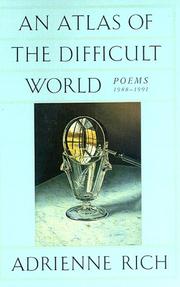
The late masterpiece — a long poem about America that is angrier and more spacious than anything before it. This is where to end.
Discussion
Keep reading
Paths that share books, cover the same subject, or open a related topic.