Start with Diving into the wreck. It is the book where Rich stopped being an admired formalist and became the poet people still argue about, and the title poem — a diver going down to a sunken ship with a knife, a camera and a book of myths — is the single best introduction to how her mind works.
The obvious alternative is to begin at the beginning, with the early collections that Auden praised. Do not. Rich later described her youthful formality as a pair of asbestos gloves, a way of handling material too hot to touch directly, and reading that work first gives you a poet who no longer exists by 1970. Start at the break. Then go back and watch it happen.
The entry point
Diving into the wreck came out in 1973 and shared the National Book Award the following year. Rich refused the prize as an individual and accepted it jointly with Audre Lorde and Alice Walker in the name of all women, which tells you as much about the book as a close reading would. It is short and it is legible: no obscurity, no private mythology. An honest warning — several of the overtly polemical poems have dated, and some readers find the man-versus-woman schema of the middle section blunt. The title poem has not dated at all.
Go back to the hinge
Snapshots of a daughter-in-law (1963) is where the change starts, and it is much better read second than first. The title sequence is her first poem in a loose line, her first to quote other women, and by her own account the first she wrote as herself rather than as a poet. Read alongside Diving into the wreck it stops being a period piece and becomes the moment the fuse was lit.
The summit
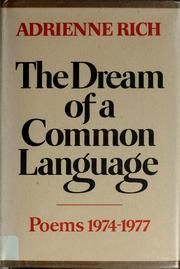
The dream of a common language (1978) is the collection most readers end up calling her best, and it contains the Twenty-One Love Poems, the sequence that made her a love poet as well as a political one. Nothing else in her work balances tenderness and argument this well. If you read only two books of Rich, make them this and Diving into the wreck.
The prose is not optional
Rich is one of the rare poets whose essays are as durable as the poems. Of Woman Born (1976) separates motherhood as an experience from motherhood as an institution, an argument now so absorbed into ordinary language that it is easy to forget someone had to make it. On lies, secrets, and silence collects the essays of the same decade, including the ones on women writers and on what she called compulsory heterosexuality — the most contested thing she wrote, and worth reading in her own words rather than in summary. Read either after The dream of a common language, when you already trust the voice.
Late Rich
A wild patience has taken me this far (1981) is the quieter book that follows the peak, more historical and less declarative. An atlas of the difficult world (1991) is the late masterpiece and the one to end on: a long poem about the United States that is angry without being certain, and formally the most ambitious thing she attempted after the 1970s. Readers who gave up on Rich in the polemical years often come back through this book.
Where to stop
Four books give you the whole writer: Diving into the wreck, The dream of a common language, Of Woman Born and An atlas of the difficult world. Her Collected Poems runs to well over a thousand pages and is a reference work, not a reading experience — it is not in our catalogue, and you do not need it to have read Rich properly. If you want more after the four, add Snapshots of a daughter-in-law for the origin and On lies, secrets, and silence for the argument.
More poetry paths are on Discover.
Follow the full ordered path here: Adrienne Rich Reading Order: Where to Start with the Poems and the Essays.
Ready to learn something deeply?
Build a reading path — free