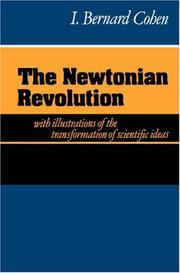
The Newtonian revolution
I. Bernard Cohen · 1980 · 404 pages
As an Amazon Associate we earn from qualifying purchases. Some book links are affiliate links; you pay the same price and we may earn a small commission.
About this book
This volume presents Professor Cohen's original interpretation of the revolution that marked the beginnings of modern science and set Newtonian science as the model for the highest level of achievement in other branches of science. It shows that Newton developed a special kind of relation between abstract mathematical constructs and the physical systems that we observe in the world around us by means of experiment and critical observation. The heart of the radical Newtonian style is the construction on the mind of a mathematical system that has some features in common with the physical world; this system was then modified when the deductions and conclusions drawn from it are tested against the physical universe. Using this system Newton was able to make his revolutionary innovations in celestial mechanics and, ultimately, create a new physics of central forces and the law of universal gravitation. Building on his analysis of Newton's methodology, Professor Cohen explores the fine structure of revolutionary change and scientific creativity in general. This is done by developing the concept of scientific change as a series of transformations of existing ideas. It is shown that such transformation is characteristic of many aspects of the sciences and that the concept of scientific change by transformation suggests a new way of examining the very nature of scientific creativity.
Appears in these reading paths


Best Books About Isaac Newton, in Reading Order
Related reading guides
Reader reviews
Ratings and notes from readers — tagged with how deep into the subject they were.
Loading reviews…