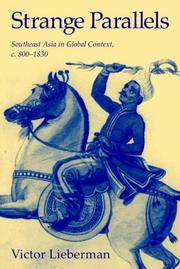
Strange parallels
Victor B. Lieberman, Michael Adas, Edmund Burke III, Philip D. Curtin · 2003 · 510 pages
As an Amazon Associate we earn from qualifying purchases. Some book links are affiliate links; you pay the same price and we may earn a small commission.
About this book
Blending fine-grained case studies with overarching theory, this book seeks both to integrate Southeast Asia into world history and to rethink much of Eurasia's premodern past. It argues that Southeast Asia, Europe, Japan, China, and South Asia all embodied idiosyncratic versions of a Eurasian-wide pattern whereby local isolates cohered to form ever larger, more stable, more complex political and cultural systems. With accelerating force, climatic, commercial, and military stimuli joined to produce patterns of linear-cum-cyclic construction that became remarkably synchronized even between regions that had no contact with one another. Yet this study also distinguishes between two zones of integration, one where indigenous groups remained in control and a second where agency gravitated to external conquest elites. Here, then, is a fundamentally original view of Eurasia during a 1,000-year period that speaks to both historians of individual regions and those interested in global trends.
Appears in these reading paths

The Khmer Empire and Angkor: books to read, in order
Related reading guides
Reader reviews
Ratings and notes from readers — tagged with how deep into the subject they were.
Loading reviews…