Zoroastrianism is a hard subject to read into casually, and not because the material is scarce. The problem is that almost every foundational question is disputed by specialists: when Zarathustra lived, what the Gathas actually say, how much of later Zoroastrian doctrine he would have recognised, and how much the religion shaped ideas that later appear in Judaism, Christianity and Islam. A reader who picks up one confident book first will absorb one side of several arguments without knowing an argument was happening.
So the order here matters more than the length of the list suggests. Read a recent, deliberately even-handed introduction first. Then the standard scholarly treatment of belief and practice. Then the older classic, read as a position rather than a summary.
The introduction to start with
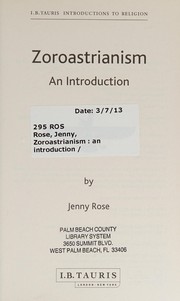
Jenny Rose's Zoroastrianism is the modern entry point: a compact survey covering the textual sources, the historical development from ancient Iran through the Achaemenid, Parthian and Sasanian periods, the impact of the Islamic conquest, and the living communities today in Iran, India and the diaspora. Its most useful quality for a newcomer is that it flags where scholars disagree rather than smoothing the disagreements over, which gives you a map of the contested ground before you step onto it.
The standard scholarly treatment
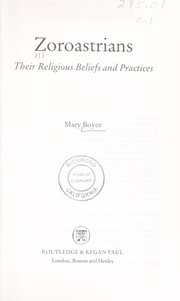
Mary Boyce's Zoroastrians, their religious beliefs and practices is the book most reading lists build around, and Boyce is the dominant figure in twentieth-century Zoroastrian studies. It traces the faith from its Indo-Iranian prehistory through its imperial phases to the Parsi community in India and the modern period, with real attention to ritual, purity law, festivals and the texture of practice rather than doctrine alone.
Boyce also has a distinct position, and it is worth knowing what it is. She argued for a very early date for Zarathustra — much earlier than the traditional figure of roughly the sixth century BCE — and for a strong continuity between the prophet's teaching and later Zoroastrian orthodoxy. She also drew heavily on her fieldwork among living Iranian Zoroastrians to reconstruct earlier practice, a method that some scholars find illuminating and others think projects the present onto the past. Read her as authoritative and as arguing, both at once.
The older classic, read critically
R. C. Zaehner's The dawn and twilight of Zoroastrianism is the other pillar of the older literature, and it disagrees with Boyce in substantial ways. Zaehner placed much more weight on Zurvanism — a current in which Zurvan, infinite time, is the father of both the good and hostile spirits — treating it as a major development rather than a marginal heresy, and he read the relationship between Zoroastrianism and its neighbours differently. Published in 1961, the book reflects mid-century assumptions and has been challenged on several fronts since.
It is still worth reading, but read it third and read it as a voice in a debate. If you come to Zaehner cold you will not be able to tell which of his claims are settled and which are contested; coming to him after Rose and Boyce, the argument is visible.
What to hold lightly
Two questions in particular attract more confidence than the evidence supports. The dating of Zarathustra ranges across roughly a millennium depending on which scholar you read, resting on linguistic arguments about the Gathas rather than on any external record. And the claim that Zoroastrian eschatology — a final judgement, bodily resurrection, a cosmic dualism of good and evil — shaped Second Temple Judaism and thence Christianity is plausible, widely repeated, and genuinely unproven, chiefly because dating the Zoroastrian material is so difficult. Treat both as open.
If broader questions of religion and empire interest you, the political science reading covers adjacent ground on how states and belief systems shape each other. Follow the full path to read the introduction before the arguments.
Follow the full ordered path here: The Best Books on Zoroastrianism, in Reading Order.