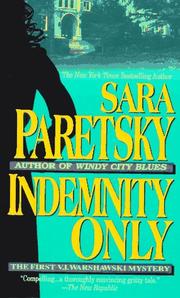
Start with Indemnity Only. It is the 1982 debut, and it beats jumping to a later, more famous entry for a specific reason: Paretsky ages her characters in real time, which almost no series novelist does. V.I. gets visibly older across the books, her injuries take longer to heal, and the friendships accumulate history. Come in at book twelve and you are reading the payoff of relationships you have not watched form.
Publication order is therefore the recommendation, without hedging. The cases themselves are self-contained, so you will not be lost if you dip in — but the thing that makes this series better than its plots is continuity, and dipping in throws it away.
What the series is arguing
V.I. is Victoria Iphigenia Warshawski: daughter of a Polish-American Chicago police officer and an Italian immigrant singer, a former public defender who quit because the job was rigged, working solo out of a Loop office. Paretsky's founding move was to write a female private eye who is the hero rather than the victim, the secretary or the corpse — the whole hardboiled apparatus with the assumption that the detective is a man removed.
Her recurring argument is stated in the first book and never dropped: white-collar crime is violent crime with better lawyers. The bodies come from insurance fraud, pension raids and negligent institutions rather than from criminal masterminds.
The early Chicago cases
Indemnity Only, Deadlock, Killing orders. These are the tightest books in the series and read fast. Deadlock starts the other habit — the case is personal, because someone V.I. is related to is dead, which keeps the corporate crime from going abstract. Killing orders is the toughest of the three and establishes the series' willingness to hurt its detective badly.
Two people arrive here who matter more than any villain. Lotty Herschel is an Austrian Jewish refugee doctor who came to Britain as a child on the Kindertransport, runs a storefront clinic, and is the person V.I. answers to. Mr Contreras is a retired machinist downstairs who appoints himself her protector without being asked — comic relief at first, and over the long run the emotional cost of her independence.
The series hits its stride
Bitter Medicine (A V. I. Warshawski Novel) puts V.I. inside the medical system and strains the friendship with Lotty in a way the plot depends on. Blood Shot, published in Britain as Toxic Shock, sends her back to the South Chicago steel-mill neighbourhood she grew up in and escaped; it is widely rated the strongest of the early novels, and the people being poisoned by industrial chemicals are the people she went to school with. Burn marks takes on arson, machine politics and her alcoholic aunt Elena.
The pattern is now visible: each book pairs a systemic crime with a family member who cannot be saved. The systemic half supplies the plot and the family half supplies the reason V.I. will not let go.
The nineties, and the reset
Guardian angel brings the crime to her own street, and Tunnel vision is openly a social novel containing a mystery — longer, with more subplots and more Chicago. Readers who preferred the lean eighties books usually part company here, which is a fair preference rather than a mistake. Tunnel vision closes the first phase; there is then a five-year gap before Hard Time, the longest break Paretsky has taken, and the change is audible. Hard Time puts V.I. inside a private prison she is investigating, and it is the book that turns her middle age and her limits into plot.
The modern run
Total Recall is the one many readers rate highest in the whole series. It braids Holocaust restitution claims, the insurance industry's wartime records and a man claiming recovered memories of being a child survivor, and it finally opens Lotty's own history after ten books of keeping it closed. That is the strongest single argument for reading in order.
Blacklist sets the 1950s red scare against post-2001 surveillance law. Fire sale returns to South Chicago with the mills gone and a big-box retailer in their place — read it against Blood Shot, same neighbourhood, twenty years of deindustrialisation later. Brush back goes back once more, through baseball and a conviction V.I. helped secure long ago.
Where to stop
There are more than twenty V.I. novels and this path stops at Brush back. That is a shaped ending rather than an arbitrary one: it closes the South Chicago material running from Blood Shot through Fire sale. If you want more, simply carry on in publication order — the cases stay self-contained, and what you gain is more time with Lotty and Mr Contreras. More crime paths are on Discover.
Follow the full ordered path here: V.I. Warshawski Reading Order: Where to Start.