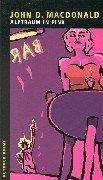
Start with The Deep Blue Good-By. The McGee novels are self-contained cases, which is why people will tell you the order does not matter, and they are half right — but publication order still wins, because the recurring cast accumulates and MacDonald's voice changes markedly across twenty-one years. Read the ending of the last book against the philosophy stated in the first and that twenty-one-year distance turns out to be the actual subject of the series.
Say the difficult thing before the recommendation rather than after it. These books begin in 1964 and their attitudes to women have dated badly. McGee narrates a running theory of female psychology, sorts women into types, and repeatedly restores a damaged woman to health by sleeping with her; it is presented as compassion and it reads now as something else. Violence against women is also a structural engine — a woman is hurt, McGee avenges her — and the frequency across the run is more striking than any single instance. What survives is the prose and the rage: MacDonald writes fast, precise sentences, and his contempt for what postwar development was doing to Florida is genuine and well ahead of its time.
The premise, in one paragraph
McGee is a salvage consultant. If something was taken from you and the law cannot get it back, he will, and he keeps half — a fee structure that lets a detective novel skip the client-and-retainer machinery entirely. He lives on the Busted Flush, a houseboat won at poker and moored at Slip F-18, Bahia Mar, Fort Lauderdale, and he is taking his retirement in instalments while young enough to enjoy it. Every title contains a colour, which MacDonald did deliberately so readers could see at a glance which ones they already owned.
The first three, all published in 1964
The Deep Blue Good-By, Nightmare in Pink and A Purple Place for Dying read as fast as they were written, and taking them consecutively lets you watch a formula being assembled in real time. The Deep Blue Good-By introduces Junior Allen, the template for MacDonald's villains: not a mastermind but a predator with patience, which is far more frightening.
The series at full strength
The quick red fox, then A Deadly Shade of Gold, where Meyer arrives and changes the books permanently. He is a hairy, gentle, internationally respected economist who lives two slips down, and his function is corrective — left alone, McGee's monologues have no opposition, and with Meyer aboard MacDonald can put the cynicism in one mouth and the humane counter-argument in another. A Deadly Shade of Gold is also the least tidy of the early run; readers who dislike it dislike exactly its sprawl.
Bright Orange for the Shroud is where the con-artist machinery gets genuinely good, and Darker Than Amber (Travis McGee Mysteries) opens with one of the best first lines in American crime fiction and then delivers MacDonald's most sustained physical menace.
The late-sixties peak
If you read only one stretch of this series, read this one. One Fearful Yellow Eye takes McGee out of Florida to a Chicago winter and strips away the beach-bum comedy. Pale Gray For Guilt is the series' most sustained piece of financial anger — a friend destroyed by a land grab, avenged through the stock market rather than through violence. The Girl in the Plain Brown Wrapper is the darkest of the four and the one that most severely tests whether you can stay with McGee, because its cruelty is directed specifically at women and children. A Tan and Sandy Silence (Travis McGee Mysteries) is the hinge of the whole series: McGee is threatened as he has not been before and it ends with him diminished rather than victorious.
Where to stop
There are twenty-one McGee novels and this path takes fourteen. That is deliberate. The remaining seventies books are mostly MacDonald running the formula competently rather than doing anything new, and completists usually stall in them.
The Dreadful Lemon Sky is the strongest of the seventies run. The Green Ripper is the tonal outlier of the whole series and won MacDonald his mainstream awards: after a personal loss McGee stops being a salvage consultant and becomes something much colder. It only works if you have read the books before it, which is the single best argument against dipping in at random. The Lonely Silver Rain, published in 1985 and the last he wrote before his death, is clearly built as an ending, and its final revelation changes McGee's situation permanently.
Stop there. If you want more, go sideways rather than forward — MacDonald's standalone Florida crime novels are where his reputation as a serious novelist actually rests. More crime paths are on Discover.
Follow the full ordered path here: Travis McGee Reading Order: Where to Start.