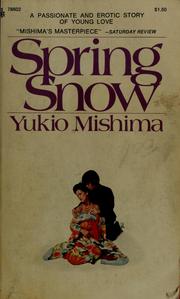
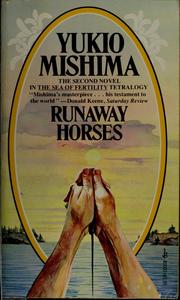
Start with Spring Snow. The tetralogy has one order and no ambiguity: four novels tracking the same observer, Shigekuni Honda, from 1912 to 1970, as he encounters what he comes to believe are successive reincarnations of his schoolfriend Kiyoaki. Each volume covers a different Japan and a different register, and the final page reaches back to the first line of book one. Read out of order it is simply four unrelated novels.
Spring Snow is also, conveniently, the most immediately seductive of the four — a doomed aristocratic love affair in late-Meiji Tokyo, written in prose of extraordinary sensual precision. If Mishima is going to work for you, you will know within fifty pages.
The four, in order
- Spring Snow (1969) — aristocratic Tokyo, forbidden love, snow. The entry point and the most beautiful.
- Runaway Horses (1969) — 1930s ultranationalism and a young man planning political assassination. A complete tonal reversal: ascetic where book one was sensual. The most uncomfortable volume, because Mishima's sympathy for his fanatic is not ironic.
- The Temple of Dawn (1970) — Thailand, India, and wartime Japan. The slow one, and the honest weak point of the tetralogy: its long middle section is a discursive essay on Buddhist theories of consciousness with the narrative on hold. Push through it; the ideas it lays out are what the fourth volume detonates.
- The Decay of the Angel (1970) — postwar Japan, an old Honda, and a final chapter that changes the meaning of everything preceding it.
The controversy that actually matters here
It is not publication order. It is whether the ending is a masterstroke or a demolition. Mishima delivered the last pages of the fourth volume on the morning of 25 November 1970 and killed himself by ritual suicide that same day after a failed nationalist coup attempt. Readers have argued ever since about how much of the final chapter is the novel's logic and how much is the author closing a door behind him. His politics and his death remain genuinely contested, and no reading of the tetralogy is neutral about them.
Most readers find The Decay of the Angel devastating; a real minority find it nihilistic in a way that retroactively cheapens three volumes. Both readings are honest. You will not know which you hold until you get there.
What to read alongside
The Buddhist framework is not decoration — the doctrine of momentariness in The Buddhist philosophy of universal flux and the account in The Zen doctrine of no-mind are the machinery of the plot, and the third volume assumes you have at least heard of them. The Noh Plays Of Japan explains the dramatic form Mishima worked in and the structure he keeps quoting. Hagakure - Book of the Samurai is the eighteenth-century text he obsessed over and wrote a commentary on; it will make the second volume legible.
For Mishima himself, Confessions of a Mask is the early autobiographical novel and the best short introduction to him, and Sun and Steel is the late essay on the body that reads uncomfortably like a plan. John Nathan's Mishima: a biography is the standard English life and was written by one of his translators. Accomplices of silence by Masao Miyoshi places him in the modern Japanese novel.
Where to stop
If the third volume defeats you, stopping after Runaway Horses is a coherent place to leave — two strong novels and a complete pair. But you will have skipped the point. Better to skim the Buddhist digression than to abandon the tetralogy before its ending.
For more single-author reading orders, browse the full library.
Follow the full ordered path here: The Sea of Fertility Reading Order and Guide.
Ready to learn something deeply?
Build a reading path — free