Start with Regeneration. It is the first published, it is the shortest, and it contains the scene the whole trilogy grows from: Siegfried Sassoon arriving at Craiglockhart War Hospital in 1917 after publicly declaring the war a deliberately prolonged deception, to be treated by the anthropologist-psychiatrist W. H. R. Rivers. Everything in the two later books answers questions this one asks.
There is no order controversy here. Publication order and chronology are the same, the novels were written as a sequence, and each takes up almost exactly where the last left off. The only real decision is pace: all three together run to well under a thousand pages, and they gain enormously from being read within a few weeks rather than a few years, because Rivers is the through-line and his slow disintegration is only visible across all three.
The three, in order
- Regeneration (1991) — Craiglockhart. Sassoon, Owen, Rivers, and the moral trap of curing men so they can be sent back. The most talked-about and the most accessible.
- The Eye in the Door (1993) — the surprise. Barker leaves the hospital for wartime London: the persecution of pacifists and homosexuals, a conspiracy trial, and Billy Prior's dissociation rendered as something close to psychological horror. Readers expecting a second war novel are often thrown. Stay with it; it is the most formally daring of the three.
- The Ghost Road (1995) — Prior back at the front in the last weeks of 1918, intercut with Rivers' memories of fieldwork in Melanesia. Won the Booker Prize, and the ending is one of the bleakest in modern British fiction.
What to know before you start
Two things. First, Billy Prior — the trilogy's invented protagonist, as opposed to the real Sassoon, Owen and Rivers — barely registers in book one and dominates books two and three. If you loved Regeneration for its historical figures, the shift can feel like a bait-and-switch. It is the trilogy's deliberate move from documented history into what the documents could not say.
Second, the sexual content and the class politics are much more forward in volume two than volume one. This is not a gentle heritage series.
Reading around the novels
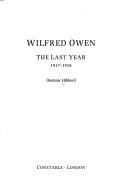
The primary material is the point of the whole exercise. The War Poems of Sassoon and Owen's Poems are short, and reading them after Regeneration rather than before means you meet them as the novel's characters wrote them. Robert Graves' Good-Bye to All That and Edmund Blunden's Undertones of war are the two great prose memoirs by men who appear in or around Barker's pages; Graves in particular reads very differently once you have seen Barker's version of him. Dominic Hibberd's Wilfred Owen is the standard life.
For the wider argument, Paul Fussell's The Great War and Modern Memory is the book that made the literary reading of the war respectable, and Judith Lewis Herman's Trauma and Recovery is the clearest modern account of the condition Rivers was inventing a treatment for without a name.
Where to stop
Do not stop after Regeneration, however satisfying it feels — the trilogy's argument is only completed by The Ghost Road, and its famous last line means nothing without the two books beneath it. If you can only read one, read one and accept that you have read a novel rather than the work.
For more three-volume sequences worth reading whole, see Wolf Hall trilogy.
Follow the full ordered path here: The Regeneration Trilogy Reading Order and Guide.
Ready to learn something deeply?
Build a reading path — free