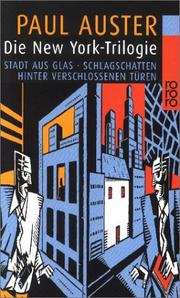
Start with The New York Trilogy itself, and read it straight through in the order the three novellas are printed. This is the rare series where the reading-order question resolves immediately: the three pieces were published separately in 1985 and 1986 but have been collected in one volume for decades, and the sequence — City of Glass, then Ghosts, then The Locked Room — is fixed and deliberate. The three are variations on one theme rather than a continuing story, but the final piece explicitly reflects back on the first two, so the order matters.
City of Glass is the entry point in every sense: a mystery writer receives a phone call for a detective agency that does not exist, impersonates the detective, and takes a surveillance job that dismantles him. It has the strongest hook and the most conventional shape. If you read forty pages of it and feel nothing, the other two will not convert you.
What the trilogy actually is
Auster takes the machinery of hardboiled detective fiction — the shabby office, the tail, the case notes, the client with a secret — and uses it to write about identity, authorship and disappearance. Nothing gets solved. Detectives fail to find anything except the fact of their own dissolution. Readers who arrive expecting a mystery generally feel cheated; readers who arrive expecting a formal experiment in the shape of a mystery tend to find it exhilarating.
The middle novella, Ghosts, is where most people stall. It is the shortest, the most abstract, and its characters are named after colours: a man called Blue watches a man called Black for a client called White. It has almost no incident. Some readers regard it as the purest expression of the whole project; others find it an exercise. If it defeats you, skip to the third piece, which is the most novelistic and the most emotionally direct of the three, and then come back.
What to read first, if anything
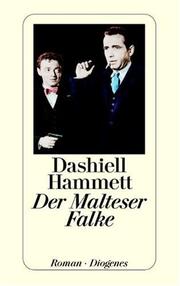
Nothing is required, but two books make the trilogy land harder. Dashiell Hammett's The Maltese Falcon is the detective novel Auster is dismantling — read it and you will recognise, sentence by sentence, what he is doing to the form. Albert Camus is the other half of the inheritance; his novel of a man estranged from his own life sits behind all three pieces, though our catalogue currently holds only a study guide edition, listed as The Stranger, The Plague (Coles Notes), rather than the novels themselves.
What to read after
Two directions. For more Auster, The Invention of Solitude is the memoir he wrote just before the trilogy, about his father's death and the strangeness of writing about a person; it contains, in non-fiction form, most of the preoccupations the novellas fictionalise. Hand to Mouth is his account of years of poverty and odd jobs and is the most likeable thing he wrote.
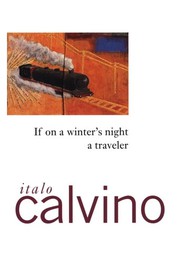
For the wider tradition, Pale Fire by Nabokov is the great precursor for fiction that eats its own apparatus, and Italo Calvino's If on a Winter's Night a Traveler does the same trick with the reader as the subject. Thomas Pynchon's The Crying of Lot 49 is the closest American cousin — a woman investigating a conspiracy that may not exist, at roughly the length of one of Auster's novellas, and funnier than any of them.
If you want the critical frame rather than more novels, Brian McHale's Postmodernist fiction is the standard survey of the techniques all these books share, and it is written to be used rather than admired.
Where to stop
The trilogy is about two hundred and fifty pages, so finishing it is not a commitment. The genuine question is whether to continue with Auster's later novels, which are numerous and uneven; opinions on them vary widely and the trilogy is generally agreed to be the place he was most in command of the trick. Read it, then decide. Browse Discover for adjacent formal experiments.
Follow the full ordered path here: The New York Trilogy Reading Order and Guide.