Between 1845 and 1852 roughly a million people died in Ireland and another million emigrated, out of a pre-famine population of about eight and a half million. Those figures are not seriously disputed. Almost everything else is: how much of the catastrophe followed from potato blight and a dependent cottier economy, how much from a British government committed to non-intervention and to Providentialist and free-market convictions, and whether the response amounts to negligence, culpable indifference, or something stronger.
That argument is the reason to read in order. Start with the economic historians who establish what the numbers show, then read the social history of pre-famine Ireland, then the policy debate, then the emigration. Start with the polemics and you will be choosing a position before you can weigh one.
The economic history first
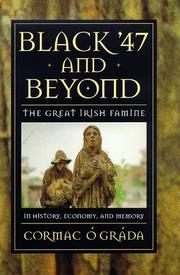
Begin with Black '47 and beyond, Cormac Ó Gráda's study of the famine's economics, demography, and memory. It is the modern standard: mortality by region, the failure of relief, the role of markets and food exports, and a careful assessment of what alternative policies could plausibly have achieved. Ó Gráda is precise about the difference between what the evidence supports and what commemoration asserts, which is exactly the discipline this subject needs.
Then read Ireland before and after the famine, his shorter economic history of the surrounding century. It is the necessary context: the population growth, the subdivision of holdings, the extraordinary dependence on a single potato variety, and the rural economy's condition before the blight arrived. The famine's severity is unintelligible without it.
The policy argument
The famine in Ireland is Mary Daly's concise account and a good introduction to the historiographical dispute — the relief schemes, the shift of costs onto Irish poor rates in 1847, the workhouse system, and the ideological commitments of Charles Trevelyan and the Treasury. Daly is measured and gives you the shape of the debate without settling it for you.
Famine: The Irish Experience 900-1900 is the long-run comparative volume, an edited collection setting 1845 against Ireland's earlier subsistence crises. Reading it makes clear what was and was not unprecedented about the 1840s, which is one of the more useful correctives available on this subject.
The emigration
Emigrants and Exiles is Kerby Miller's major study of Irish emigration to North America, built substantially from emigrant letters. His argument — that Irish emigrants tended to interpret their departure as exile rather than opportunity, and that this shaped the political culture of the diaspora — is contested by other historians who read the same sources as showing more agency and ambition. It is a genuine scholarly disagreement worth knowing about.
The Irish diaspora extends the frame beyond America to Britain, Australia, and elsewhere, treating emigration as a continuous feature of Irish life rather than a famine-specific rupture. Close with The Irish Famine, Noel Kissane's documentary volume of contemporary sources — relief committee records, newspaper reports, official correspondence, and illustrations. Reading primary documents last means you meet them already knowing what the historians dispute, which is the only way to read them usefully.
If you can manage only two, take Black '47 and beyond and The famine in Ireland: the evidence and the argument about it. Follow the full path for the whole sequence, and see the site's other history hubs for adjacent reading.
Follow the full ordered path here: How to Read About the Irish Famine, in Order.