Most readers arrive at Lebanon through the civil war, which is like arriving at a family through its worst argument. The war ran from 1975 to 1990, involved shifting alliances among a dozen militias plus Syrian, Israeli, and multinational forces, and is genuinely hard to follow without first understanding the confessional system that structured the state. Six books, read in order, is enough to get there.
The foundational problem is that Lebanon's communities hold incompatible accounts of what the country is. Some see an ancient Phoenician-descended Christian nation; others an Arab country artificially detached from Syria; others a state defined by its sectarian power-sharing arrangement. These are not fringe positions, they are the mainstream views of different communities, and no history can be written that satisfies all of them.
Start with the argument about the country itself
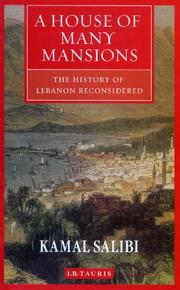
A house of many mansions by Kamal Salibi is the essential first book. Salibi, a Lebanese historian, examines the rival historical narratives each community tells and shows how each was assembled — including the Phoenician thesis he treats with considerable skepticism. Reading it first means you can recognize the underlying claim in every later account, including the ones that present themselves as neutral.
Then read Salibi's The modern history of Lebanon, which covers the nineteenth-century Ottoman period, the 1860 civil conflict, the French Mandate, and independence up to the 1960s. It supplies the institutional history — the National Pact, the confessional distribution of offices — that the war of 1975 was fought over.
Then the war
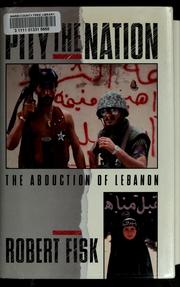
Pity the Nation by Robert Fisk is the great reporter's book on the civil war, written by a correspondent who lived in Beirut through most of it. It is long, personally engaged, and unmistakably opinionated — Fisk is not a neutral narrator and does not claim to be — but nothing else conveys the war's texture, its shifting alliances, or the Sabra and Shatila massacre with the same immediacy.
Israel's lebanon war by Ze'ev Schiff and Ehud Ya'ari is the necessary counterpart: two Israeli journalists reporting on the 1982 invasion from inside the Israeli political and military system, including Sharon's role and the extent to which the cabinet was misled about the operation's scope. Published soon after the events and highly critical, it is the best account of how the invasion was decided.
Then the postwar order and the region
Hezbollah by Matthew Levitt traces the organization's development, its external operations, and its financing. Levitt writes from a counterterrorism policy background and the framing reflects that; Lebanese and academic accounts that treat Hezbollah primarily as a domestic social and political movement reach different emphases. Read it for the operational detail and be aware of the vantage point.
Close with Fractured lands by Scott Anderson, the long-form account of how the post-2003 unraveling across the Arab world played out through individual lives. Lebanon is one thread among several, and it places the country's fragility in the regional context that now largely determines it.
For adjacent contested national histories, see the wider political reading via /discover.
Six books is a short path, deliberately. Follow the full path to keep them in sequence.
Follow the full ordered path here: The Best Books on Lebanon's History to Read First.
Ready to learn something deeply?
Build a reading path — free