Kenyan history has an unusual evidentiary story attached to it. Much of what happened in the detention camps of the 1950s emergency was known at the time, then dropped out of British public memory for fifty years, and then re-established — partly through the historians on this path — in litigation that ended with a British government apology and compensation in 2013. Some of the relevant colonial files had been physically removed from Kenya at independence and kept at a facility whose existence was denied. That context shapes how you should read the older books here.
Order matters for a second reason: the settler-colonial framework, the Kikuyu land question, and the Mau Mau rebellion form a single causal chain. Books that treat the uprising as a spontaneous eruption of violence are working without the land history that produced it.
Start with the survey and the wider region
Kenya by Charles Hornsby is the most thorough modern political history, running from independence through the multiparty era and the 2007–08 post-election violence. It is long and detailed and it is the reference the rest of the path hangs on.
A history of East Africa by Zöe Marsh and G. W. Kingsnorth is an older regional survey, useful for the pre-colonial and early colonial background across the wider area. Read it for the geography and the longer arc, with the awareness that its framing reflects the era in which it was written.
Then the colonial mind and the Kikuyu world
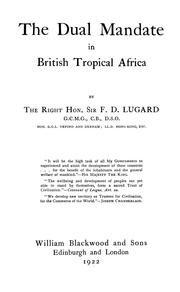
The dual mandate in British tropical Africa by Frederick Lugard is a primary source: the 1922 statement of indirect-rule doctrine by the administrator who built it. It is the colonial project explaining itself in its own terms, and reading it directly is far more instructive than reading characterizations of it.
Against it, read Facing Mount Kenya by Jomo Kenyatta — an ethnography of Kikuyu society written by the man who would become Kenya's first president, submitted as anthropology under Malinowski in London. It is simultaneously a scholarly work and a political argument for the integrity of a society the colonial state was dismantling. The Lugard–Kenyatta pairing is the intellectual core of this path.
Then the emergency
Mau Mau from Within by Donald Barnett and Karari Njama gives the rebellion from a participant's side — Njama was a forest fighter, and the book is one of very few accounts of the movement's internal organization and debates.
Britain's Gulag by Caroline Elkins is the study of the detention camp system, based on archival work and oral testimony, and it was central to the later legal case. Its casualty estimates have been contested by other historians, and that dispute is itself part of the record. Histories of the Hanged by David Anderson covers the parallel judicial machinery — over a thousand executions after trials of varying quality — and is generally regarded as the more source-cautious of the two. Read both; the disagreement between them is instructive rather than disqualifying.
Then independence and after
Decolonising the Mind by Ngũgĩ wa Thiong'o is the essay collection in which he explains his decision to stop writing in English, and it is the sharpest statement of the cultural dimension of colonial rule. The challenge of nationhood collects Tom Mboya's speeches and writings — the trade unionist and cabinet minister assassinated in 1969, and the clearest voice of what independence was supposed to mean.
Close with It's Our Turn to Eat by Michela Wrong, the account of whistleblower John Githongo and the Anglo Leasing scandal. It is reported, contested by those it names, and the best entry into how patronage politics actually operates.
For comparison with other post-colonial trajectories, the history of Brazil hub covers a different route through the same century.
Follow the full path to keep the order.
Follow the full ordered path here: How to Read the History of Kenya, in Order.