Brazilian history resists the templates imported from Spanish America. It was a single Portuguese colony rather than a set of viceroyalties, it became independent as a monarchy under the heir to the Portuguese throne, and it kept an emperor until 1889. It also received roughly forty percent of all Africans trafficked across the Atlantic and abolished slavery in 1888, later than any other country in the hemisphere. Reading in order is how these facts connect rather than accumulate.
The central historiographical fight you will encounter is over racial democracy — the idea, once semi-official, that Brazil escaped the racial hierarchies of the United States. That claim has been dismantled over the last several decades, and the book that made it most influentially sits in the middle of this path. Read the surveys first so you can see what it is arguing against and what came after.
Start with two surveys
Brazil by Lilia Schwarcz and Heloisa Starling is the best recent one-volume history — a genuinely national account, strong on slavery, on the empire, and on the twentieth-century dictatorships, written by Brazilian historians for a general reader.
A Concise History of Brazil by Boris Fausto is the shorter, more analytical alternative, particularly good on the political economy of the Old Republic and the Vargas years. If you want only one, take Schwarcz for narrative richness and Fausto for compression; reading both is not wasted, but the overlap is real.
Then the argument about race
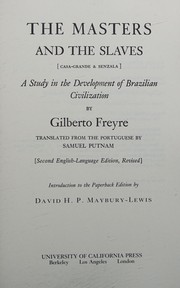
The masters and the slaves, Gilberto Freyre's 1933 study, is the most consequential book ever written about Brazil. It made the case that the plantation household produced a distinctively intimate racial mixing, and it underwrote the racial-democracy idea for generations. It is also, by current standards, an apologia in places — it minimizes plantation violence and romanticizes coercion. Read it as a primary document of Brazilian self-understanding, with the surveys already in hand.
Then read To be a slave in Brazil, 1550-1888 by Kátia Mattoso, a sober scholarly account of the institution itself: mortality, labor regimes, manumission, and resistance. It is the corrective, and the order matters — Freyre then Mattoso, not the reverse.
Then the specific transformations
Tropical Versailles by Kirsten Schultz covers the extraordinary 1808 relocation of the Portuguese court to Rio de Janeiro ahead of Napoleon's armies, which turned a colonial port into an imperial capital and set up independence in a form no neighbor shared.
Rebellion in the backlands is Euclides da Cunha's account of the 1897 destruction of the Canudos settlement in the sertão — part war reporting, part geology, part anguished reconsideration by a man who arrived believing the republic was crushing a monarchist revolt and left knowing better. It is the founding text of Brazilian nonfiction.
Then the modern state
Vargas of Brazil by John Dulles is the standard English biography of Getúlio Vargas, whose fifteen years of rule, the Estado Novo, and 1954 suicide shaped the modern state more than any other figure. The Brazilians by Joseph Page is the readable portrait of the country as it emerged from military rule, good on culture, region, and inequality. Close with Larry Rohter's Brazil on the rise, a correspondent's account of the boom years — worth reading with the knowledge that the recession, impeachment, and political turmoil that followed have complicated its optimism considerably.
For the regional comparison, the history of Argentina hub runs the parallel track.
Follow the full path to keep the books in order.
Follow the full ordered path here: Best Books on Brazilian History, in Reading Order.