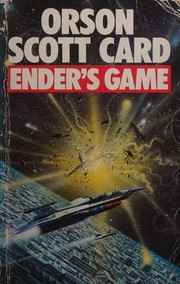
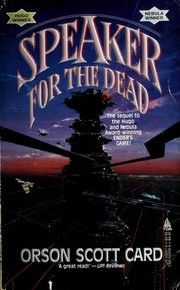
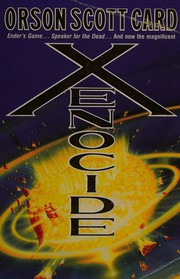
Start with Ender's Game. Everything in the saga branches from that one book, so read it first regardless of which track you eventually take. The genuine question is not where to start but what to do on the last page, because the series then forks into two parallel sequences that begin from the same moment.
One thing to state plainly and then move past: Orson Scott Card has been a prominent public opponent of same-sex marriage, including service on the board of a national campaign against it, which has made his books contested for many readers. Some people decline to buy them on that basis, some separate the work from the author, and some borrow from a library. That is your call to make and this guide will not make it for you.
Ender's Game was expanded from a 1977 novelette and won both the Hugo and the Nebula. Ender Wiggin is a six-year-old taken to Battle School to be trained as a commander against an alien species; the book's method is to isolate him deliberately and repeatedly, and to make you complicit in wanting him to win anyway. The prose is plain to the point of transparency and the pacing is close to perfect. If you have somehow avoided the ending, avoid discussion of the book entirely until you finish.
One tip: do not skim the subplot in which Ender's siblings Peter and Valentine write political essays under pseudonyms. It is widely considered the weakest thread in the novel and it is load-bearing for the entire Shadow track.
The fork
Take the quartet first, then the Shadow books. Reversing that also works and Card designed Ender's Shadow so either could be read first, but the quartet is where Ender's own story goes, and coming back to Battle School afterwards reads as reinterpretation rather than repetition.
The Ender quartet
Speaker for the Dead jumps three thousand years and is a completely different novel: an anthropological mystery on a colony world, about a human xenologist killed by the native species. Card has said this is the book he actually wanted to write and that Ender's Game was constructed to set it up.
Many readers who loved Ender's Game bounce hard off it. It is slow, talky, Catholic, densely populated with a Portuguese-speaking colonial family, and there are no battles. Go in expecting more military science fiction and you will be disappointed by what is probably the best book in the sequence. Its central idea, a graded scale of how alien something must be before you stop owing it moral consideration, is worth learning properly; write the four terms on a card and keep it in the book.
Xenocide and Children of the Mind were written as a single manuscript and split for publication, which is why Xenocide has no proper ending — it simply stops. Do not read one without the other. Both go a long way into metaphysics, including a theory of consciousness and a mechanism for instantaneous travel that many readers find unpersuasive. The philosophical ambition is real and the execution divides people sharply.
Where to stop
A lot of readers stop after Speaker for the Dead and are entirely satisfied. That is a defensible place to close the quartet, and if the metaphysics of the last two does not appeal, take it.
The Shadow series
Ender's Shadow is a parallel novel, not a sequel: the same Battle School years from Bean's point of view. Bean is the anti-Ender — genetically altered, starving on the streets of Rotterdam before Battle School, and entirely without Ender's moral discomfort. He understands the manipulation from the start. The two books contradict each other in small ways and Card has acknowledged it; treat them as two accounts rather than one record.
After it the series changes genre completely. Shadow of the Hegemon, Shadow Puppets and Shadow of the Giant are near-future geopolitical thrillers set on Earth, with the Battle School children as national assets in a scramble for global power. Peter Wiggin is the real protagonist, which is why those pseudonymous essays mattered. The geopolitics has not aged well and is frequently strange; read it as a thriller rather than as prediction. Shadows in flight is a short late coda following Bean and his children.
The gap-fillers
Ender in Exile slots between the end of Ender's Game and Speaker for the Dead, and reads best after both. A War of Gifts is a Battle School novella about a Christmas dispute and is entirely optional.
Browse more science fiction reading paths on Discover.
Follow the full ordered path here: Ender's Game Reading Order: Where to Start.