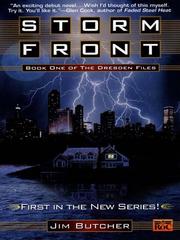
Start with Storm Front, and read it quickly. It is a competent, slightly generic wizard-detective novel, and it is genuinely not what people mean when they say the Dresden Files is one of the best long-running urban fantasy series going. The reason to start there anyway is that Butcher plays a very long game — characters, debts and offhand remarks from book one pay off eight and ten books later — and the alternative advice you will see online is worse.
That alternative advice is: skip to Summer Knight, book four. It is well meant, because the series really does level up around then. But you lose the introduction of Murphy, Marcone, Bob and Harry's own rules, and you lose the setup for the single most important relationship in the series. Better plan: read Storm Front and Fool Moon as fast as you can, accept them as prologue, and judge the series from Grave Peril onwards.
The order is publication order
There is no chronological reshuffle to argue about here. The books are told in first person by one man, in sequence, and the emotional through-line is the whole point.
- Storm Front
- Fool Moon — widely considered the weakest book in the series
- Grave Peril — the first genuinely good one; it introduces the Red Court and does real damage
- Summer Knight — where most readers say the series clicks
- Death Masks
- Blood Rites
- Dead Beat — the fan favourite of the early run, for a reason you will recognise when you get there
- Proven Guilty
- White Night
- Small favor
Book eleven, Turn Coat, is not currently in our catalogue; read it between Small favor and Changes, because it matters for the politics of the White Council and for one character's arc in particular.
- Changes — the hinge of the entire series
- Ghost Story
- Cold Days
- Skin Game — the best-executed book in the run
The series continues past this point with Peace Talks, Battle Ground and Twelve Months, none of which are in our catalogue yet. There is also a large body of short fiction, collected in Side Jobs and Brief Cases, which is genuinely optional except for one novella that sits between books twelve and thirteen.
The honest warnings
The first two books are weak, and Butcher has said as much himself. The early Harry is also condescending about women in a way that reads worse now than it did in 2000; Butcher walks it back deliberately over the series, but you have to get through several books before that becomes visible. If that is a dealbreaker, it is better to know at book one than at book five.
Ghost Story is the other divisive volume. It follows the most shocking ending in the series with a slow, interior book in which Harry can barely affect anything. Some readers consider it the most thoughtful thing in the run; others find it a stall between two great books. Both are defensible.
Where to stop
Changes is a real stopping point — it resolves the series' longest-running conflict and ends on a line that would work as a full stop if you wanted it to. It also ends on a cliffhanger, so stopping there requires discipline. The cleaner exit is Skin Game, which is a heist novel, a highlight, and a place where Harry is in a stable position for the first time in years. If you are still enjoying yourself after that, keep going; if you are running on obligation, stop.
For a very different take on bureaucratic occult horror, the Laundry Files is the obvious companion series.
Follow the full ordered path here: The Dresden Files Reading Order: Where to Start.
Ready to learn something deeply?
Build a reading path — free