The Berlin Wall stood for twenty-eight years and is usually read as two dramatic dates: 13 August 1961 and 9 November 1989. Both are unintelligible on their own. The Wall was the endpoint of a sixteen-year argument about a city divided among four occupying powers, and its collapse was the product of a summer of Hungarian border openings, East German protest, and — decisively — a botched press conference.
So this reading order runs the whole arc: how Berlin was carved up, why the blockade and airlift set the pattern, how 1961 was reached, what living behind the Wall was actually like, and how it opened by accident.
How Berlin was divided
Start with The Fall of Berlin, 1945. Antony Beevor's account of the Red Army's advance and the city's capture is brutal reading, including on the mass rapes committed during the occupation, and it establishes the fact everything else depends on: Berlin ended the war deep inside the Soviet zone, split into four sectors, with Western access guaranteed only by agreement.
Then read The candy bombers, Andrei Cherny's history of the 1948–49 blockade and the airlift that answered it. It is the moment the Western powers decided Berlin was worth a confrontation, and the moment the city's symbolic weight was fixed. Cherny is strong on the improvised, unlikely character of the operation and on how it changed German-American relations.
The Wall goes up
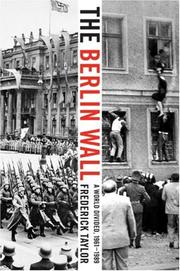
The Berlin Wall by Frederick Taylor is the core narrative history of the structure itself — the political pressure of the refugee exodus through West Berlin, the night the barbed wire went out, the successive rebuilds into a fortified death strip, and the escapes and killings along it. If you read only one book here, read this one.
Pair it with Berlin 1961, Frederick Kempe's account of the year from the diplomatic side: Kennedy newly in office, Khrushchev testing him after the Vienna summit, the tank standoff at Checkpoint Charlie, and the calculations on both sides about what could be tolerated. Taylor gives you the city, Kempe gives you the capitals; the pair works better than either alone.
Life behind it
Stasiland is the essential book on what the East German state did to the people inside it. Anna Funder interviewed both victims and former Stasi officers in the years after reunification, and the result is a portrait of surveillance as a domestic, banal, thoroughly staffed enterprise. It also confronts the awkwardness of what happened to the watchers afterwards.
The Spy Who Came in from the Cold is the novel, and it belongs here. Le Carré wrote it in 1963, having served in British intelligence, and it opens at the Wall. Its argument — that both sides ran the same machinery and spent the same people — is the sharpest contemporary counterweight to a purely triumphal Cold War story.
The night it opened
Close with The collapse, Mary Elise Sarotte's hour-by-hour reconstruction of 9 November 1989. Her case is that the opening was not granted but blundered into: a confused Politburo announcement, a spokesman improvising an answer, crowds massing at the crossings, and border officers with no orders deciding on their own to raise the barrier. It is the best possible ending to the sequence, because it shows a system falling to accident and nerve rather than to a signed decision.
Read them in this order and the twenty-eight years hold together as one story. Follow the full path to keep the sequence.
Follow the full ordered path here: The Berlin Wall: The Best Books to Read, in Order.