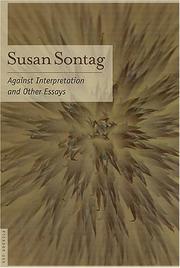
Start with Against Interpretation. It is the 1966 collection that made her, and the title essay is the shortest route to what she actually thought: that the reflex of asking what a work of art means, of translating it into content, is a way of avoiding the work itself. Read that essay and Notes on Camp — both are in this volume — and you have the Sontag method in about forty pages.
There is a real alternative, and it depends on what you want. If you want the single most useful book she wrote, it is Illness as metaphor, which she produced while being treated for cancer and which is a precise dismantling of the way disease gets loaded with moral meaning. It is short, angry and entirely free of jargon. If you want the most famous, it is On Photography. But Against Interpretation is the one that shows you how she argues, and everything else is easier once you have seen it.
The essays, in order
- Against Interpretation (1966)
- Styles of Radical Will (1969)
- On Photography (1977)
- Illness as metaphor (1978)
- AIDS and its metaphors (1989)
- Regarding the Pain of Others (2003)
Read these chronologically, and not because of any external chronology — because Sontag argues with herself across decades and the sequence is the argument.
The two pairs
The clearest reason to read in order is that the books come in pairs, published a decade or more apart.
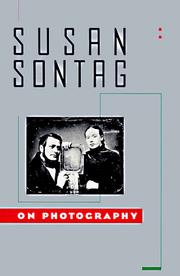
On Photography argues that photographs anaesthetise — that the sheer volume of images depletes our capacity to respond, and that photographing something is a way of refusing to intervene in it. Regarding the Pain of Others, twenty-six years later, revisits that position and substantially qualifies it. She does not recant, but she concedes considerably more to the photograph's capacity to hold attention. Read them back to back and the revision is the point.
The same shape applies to Illness as metaphor and AIDS and its metaphors. The first argues that tuberculosis and cancer accumulate metaphors that punish the sick; the second applies the argument to an epidemic that was actively being moralised while she wrote. The second is weaker on its own and much stronger as a sequel.
Honest warnings
Styles of Radical Will contains Trip to Hanoi, an account of a 1968 visit to North Vietnam, and it is the most dated thing in her work by some distance. Her later assessment of her own political writing from this period was notably harsher than her contemporaries'; the essay is worth reading as a document, but it is not the reason to buy the book. The essays on Bergman and on pornography as literature are.
More generally, Sontag can be difficult in a specific way: the sentences are clear but the referents are not. She assumes you have seen the Godard film, read the Cioran, know who Artaud was. You will do fine without, but expect to be reading past names.
The novels
The Volcano Lover and In America are her later historical novels — Nelson and Emma Hamilton in the first, a Polish actress emigrating to California in the second, which won the National Book Award. Most readers find the fiction considerably weaker than the essays, and the common judgement is that the analytical intelligence that makes the criticism formidable makes the novels airless. If you are not already committed, skip them. The Volcano Lover is the better of the two if you want to try one.
Where to stop
Against Interpretation, On Photography and Regarding the Pain of Others is a complete arc and takes about three weeks. Add Illness as metaphor if the subject reaches you, which for most people at some point it does. Then follow another reading path.
Follow the full ordered path here: Susan Sontag Reading Order: Where to Start.
Ready to learn something deeply?
Build a reading path — free