Smallpox is the only human disease ever deliberately eradicated, and the triumphal version of that story leaves out nearly everything interesting. Inoculation was practised in Asia and Africa long before Edward Jenner. Compulsory vaccination provoked mass organised resistance in Victorian England and in the United States. The eradication campaign succeeded through a technique that was not the one it started with. And the virus still exists, in two freezers, by international agreement that remains disputed.
The order below follows that shape: the disease first, then the long history of trying to prevent it, then the campaign, then the awkward epilogue. Take it in that sequence and the eradication reads as a contingent achievement rather than an inevitability.
What the disease was
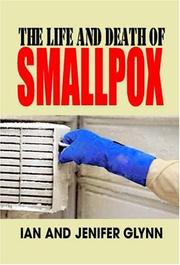
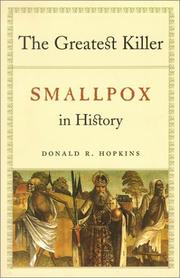
The life and death of smallpox by Ian Glynn is the general reader's overview and the right first book — the virus, its history, the vaccine and the campaign in one manageable volume. The Greatest Killer by Donald R. Hopkins is the scholarly history of smallpox across societies, from the Egyptian mummies onward, written by a physician who worked on the eradication itself. It was originally published under a different title, which is worth knowing if you go looking for it.
Before Jenner, and against Jenner
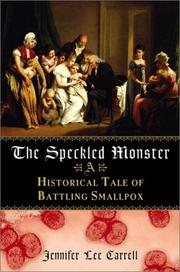
The speckled monster by Jennifer Lee Carrell reconstructs the introduction of inoculation into Britain and the American colonies through Lady Mary Wortley Montagu and Zabdiel Boylston. It is narrative history with reconstructed scenes and dialogue, which some readers enjoy and others distrust; treat it as a vivid entry rather than as a source.
Angel of death by Gareth Williams is the fuller history of smallpox and the development of vaccination — our catalogue stores the author's name in the inverted form its record uses. Bodily matters by Nadja Durbach is the corrective to any assumption that vaccine refusal is recent: it documents the mass anti-vaccination movement in Victorian England, which drew hundreds of thousands of people and eventually won a conscientious-objection clause.
Pox Americana by Elizabeth A. Fenn is the great American book on the subject, tracing the continent-wide epidemic that ran alongside the Revolutionary War and killed on a scale the war did not. Fenn also examines the documented British discussion of using infected blankets at Fort Pitt in 1763; the correspondence about that specific episode exists, while broader claims of systematic biological warfare against Native populations are debated by historians and rest on much thinner evidence. Fenn is careful about the distinction and it is worth reading her carefully in turn.
Pox by Michael Willrich carries the story into the American outbreaks of the early twentieth century, where compulsory vaccination, the police power and the courts collided — the case law from that period is still cited.
The campaign
Smallpox : the Death of a Disease by D. A. Henderson is the memoir of the man who led the WHO eradication programme. House on fire by William H. Foege is the memoir of the epidemiologist whose surveillance-and-containment method replaced mass vaccination as the campaign's core technique. Both are participants writing about their own work, and each is generous about the other, but they are accounts from inside the effort rather than independent assessments. Read them together and the strategic argument inside the programme becomes visible.
What remains
Scourge by Jonathan B. Tucker covers the Soviet weaponisation programme and the still-unresolved question of whether the remaining official stocks should be destroyed. The demon in the freezer by Richard Preston is the most gripping book in the path and the one to read most sceptically: Preston writes narrative nonfiction with strong dramatic shaping, and some specialists have objected to how he presents the risk. It is a good closing book precisely because it makes you weigh a claim rather than accept it.
Read in order, the sequence answers the question the triumphal version cannot: eradication was not the automatic consequence of having a vaccine. The subject hub has our other coverage.
Follow the full ordered path here: Smallpox and Its Eradication: The Best Books to Read, in Order.
Ready to learn something deeply?
Build a reading path — free