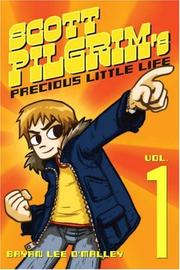
Start with Scott Pilgrim's Precious Little Life. The obvious alternative is the 2010 film, which compresses all six books into two hours and changes the ending; the other is one of the colour editions, which are the same story but reprinted years later at a different trim size and price. Neither is wrong, but the first volume in its original form is the cheapest way to find out whether the joke lands for you, and the joke is the whole proposition — if the first forty pages do not make you laugh, the remaining five volumes will not either.
There is no order controversy here. Bryan Lee O'Malley wrote six volumes between 2004 and 2010, they were published in sequence, and they are read in sequence. What people actually get wrong is edition mixing: the original digest-sized black-and-white volumes and the later hardcover colour editions have different page counts and cover art, so a shelf assembled from both looks like it is missing something. Pick one format and stay in it.
The six volumes, in order
Scott Pilgrim's Precious Little Life introduces the premise — a slacker bassist in Toronto must defeat his new girlfriend's seven evil exes — and plays it almost entirely for comedy. Scott Pilgrim vs. the world (Scott Pilgrim, Vol. 2) fills in the backstory the first book skipped, and is where the series starts admitting its protagonist is not a good person. Scott Pilgrim & the infinite sadness (Scott Pilgrim, Vol. 3) is the tonal hinge: still funny, noticeably sadder, and the point at which most readers commit.
Scott Pilgrim, Vol 4 — published as Scott Pilgrim Gets It Together — is the quietest instalment and the one people misremember as slow. It is doing setup, and the setup pays. Scott Pilgrim vs. the Universe (Scott Pilgrim, Vol. 5) takes the story somewhere genuinely bleak, and Scott Pilgrim's Finest Hour (Scott Pilgrim #6) resolves it. The sixth volume is the only one where the fantasy conceit and the emotional plot fully converge, which is why the ending reads as earned rather than tacked on.
Expect the art to change across the run. O'Malley's line gets cleaner and his layouts more confident with each book, and by volume five the fight scenes are doing real narrative work rather than functioning as gags.
Read these on either side
Two other O'Malley books sit in our path, and neither belongs in the middle of the series. Lost at Sea came first, in 2003, and reads as a rougher draft of the same sensibility — a road trip, an anxious narrator, and none of the video-game apparatus. Read it if the series worked for you and you want to see where the voice started, not as an introduction.
Seconds came after, in 2014, and is the stronger book of the two. It is a single self-contained volume about a restaurant owner given the ability to undo her mistakes, and it takes the theme Scott Pilgrim spent six volumes circling — that you do not get to erase the harm you have done — and states it directly. Read it last.
A note on completeness: our shelf holds the six main volumes plus these two, but not the short colour extras or the box-set-only material, and those are inessential.
If you want to see how the series reads alongside other graphic-novel runs, our related subjects cover neighbouring shelves.
Follow the full ordered path here: Scott Pilgrim Reading Order: Where to Start.
Ready to learn something deeply?
Build a reading path — free