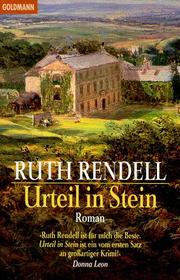
Start with A Judgement in Stone, a 192-page standalone that names its murderer and her motive in the first sentence. The obvious alternative is From Doon with Death, the first Inspector Wexford novel and the start of the series she is best known for — and it is the wrong opening, because the police procedurals are the lightest of her three strands and they will give you a false impression of the writer.
That is the thing to understand before buying anything. Ruth Rendell wrote in three modes and they are genuinely different books: the Wexford police procedurals, the standalone psychological novels under her own name, and the slower, denser reconstructions published as Barbara Vine. A reader who picks up one of each and expects a consistent writer will conclude she is inconsistent. This order keeps the strands separate and takes them one at a time.
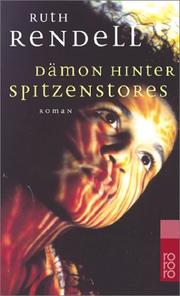
A Judgement in Stone tells you everything up front and then spends the novel showing how it became inevitable. There is no whodunit and no suspense about the outcome, and it is still unbearable — suspense generated by inevitability rather than by uncertainty, which is the technique of the entire standalone strand. Its subject is class as much as murder: an illiterate housekeeper in a cultured household, and a family whose kindness is inseparable from their condescension. Follow it with A demon in my view, narrated substantially from inside a disordered mind, with no psychiatric label offered and no explanation from outside. Both are under 200 pages and lose pressure if spread out.
The Wexford books, and how many you need
From Doon with Death was her first published novel and it is dated: neat plotting, 1964 social attitudes, and a solution the book treats as more shocking than a modern reader will. Read it as an origin rather than as a recommendation. The real series is the argument between Wexford — liberal, curious, self-questioning — and his subordinate Burden, who is conservative, moralistic and frequently wrong in ways that are never simply mocked.
A New Lease of Death has Wexford reopening a conviction he is no longer confident about; it is published in the United States as Sins of the Fathers, so check before ordering it twice. Some Lie And Some Die (Wexford Collection) puts a body in a quarry during a rock festival and is the first where the social observation outclasses the mystery. Shake hands forever is where the series stops being cosy, with Wexford convinced of a man's guilt, unable to prove it, and letting the obsession damage him.
Four is enough. The books are self-contained and the continuity is domestic rather than plot-driven, so there is no need to read twenty in sequence.
Late Wexford: skip twenty years
Jump straight to Simisola, the best of the late Wexfords and the one to read if you only read one. It is nearly twice the length of the early books, and the extra pages are social observation rather than plot. The case begins with the disappearance of the daughter of a Black doctor who is Wexford's own GP, and its central move is to make the decent, self-questioning detective the reader has trusted for thirty years confront his own assumptions and get things wrong because of them. That works precisely because the series had spent decades establishing his good faith. It was written in the mid-1990s and its picture of British race and class is of that moment.
The Barbara Vine novels, where the best writing is
Vine was a deliberate signal rather than a disguise — a reader picking one up would know they were getting a different kind of novel, and her identity was never hidden. The form is almost always the same: a narrator in the present reconstructing a family catastrophe from decades earlier out of letters, diaries and what people will not say. The crime is usually known from the start; what is withheld is why.
Read A dark-adapted eye first, then A Fatal Inversion, which is widely rated the best of them, then The House of Stairs and Asta's book. Read them at half the speed of the standalones — the commonest failure with the Vines is reading them like thrillers, which makes them confusing rather than tense. One buying warning: Asta's book is published in the United States as Anna's Book, and it is the likeliest duplicate purchase on this whole path.
Where to stop
Live flesh closes the loop back to the standalones at their hardest: a man released from prison for rape befriends the policeman he shot and crippled during his arrest, and inserts himself into that marriage. It includes his account of his own crimes from inside his head, with no diagnosis, no explanation and no authorial condemnation — and it makes him pitiable in places, then refuses to let that count for anything.
This is where the path stops and the work does not. There are more than twenty Wexfords, a dozen or so Vines, and the standalones simply continue with The Bridesmaid, The Keys to the Street and Thirteen Steps Down, none of which connect to each other. Pick your next one deliberately by strand — the choice matters more with Rendell than with almost any other crime writer. More routes on Discover.
Follow the full ordered path here: Ruth Rendell Reading Order: Where to Start.